

Gold Is Glittering but May Not Be Right for Your Portfolio
by Charles Rotblut | March 27, 2025
Featured Tickers: GLD
SPY
GLD
SPY
Gold closed above $3,000 per ounce for the first time last week. The precious metal has been setting higher highs and higher lows since rising above a resistance level early last year.
Duke University professor Campbell Harvey attributed the price jump to “de-dollarization and safe-haven demand” in a recent LinkedIn post.
China has increased its official gold holdings by 15% since November 2022. The purchases increase the country’s gold reserves, likely with an intent to build confidence in the Chinese yuan.
Regarding the rising safe-haven demand for gold, Harvey wrote, “In times of heightened uncertainty, investors turn to assets that they perceive will provide protection—and gold always shows up on that list.” He cited the Economic Policy Uncertainty Index as an indicator of how much uncertainty has risen.
I have seen others also cite this index lately. The Economic Policy Uncertainty Index tracks newspaper coverage of policy-related economic uncertainty, federal tax code uncertainty in the U.S. and uncertainty about policy-related macroeconomic variables.
Gold does have a long history as a perceived safe haven. The precious metal rose in value during the Black Monday (1987), Gulf War (1990), dot-com bubble burst (2000–2002) and Great Recession (2007–2009) bear markets.
Its track record is far from perfect. Gold lost value during the Asian currency crisis (1998), the pandemic bear market (2020) and the reinflation bear market (2022).
Gold prices fell more than 6% between the start of 2021 and the end of 2022 even though inflation jumped significantly. Analyses looking over long periods have also shown gold doing a poor job of protecting against inflation.
There are also other considerations when it comes to investing in gold.
The SPDR Gold Shares ETF  (GLD), the largest gold exchange-traded fund (ETF), has realized different returns than the net value of its holdings. (The ETF invests in a trust that holds physical gold.) Through the end of February, the SPDR Gold Shares’ five-year annualized price return was 12.2%. Its net asset value (NAV) increased at an 11.5% annualized rate over the same period. While the discrepancy has worked in favor of those who own shares of the ETF, this tracking error can also work against them in the future.
10-Year Returns for the SPDR Gold Shares ETF (GLD) and the SPDR S&P 500 ETF Trust (SPY)
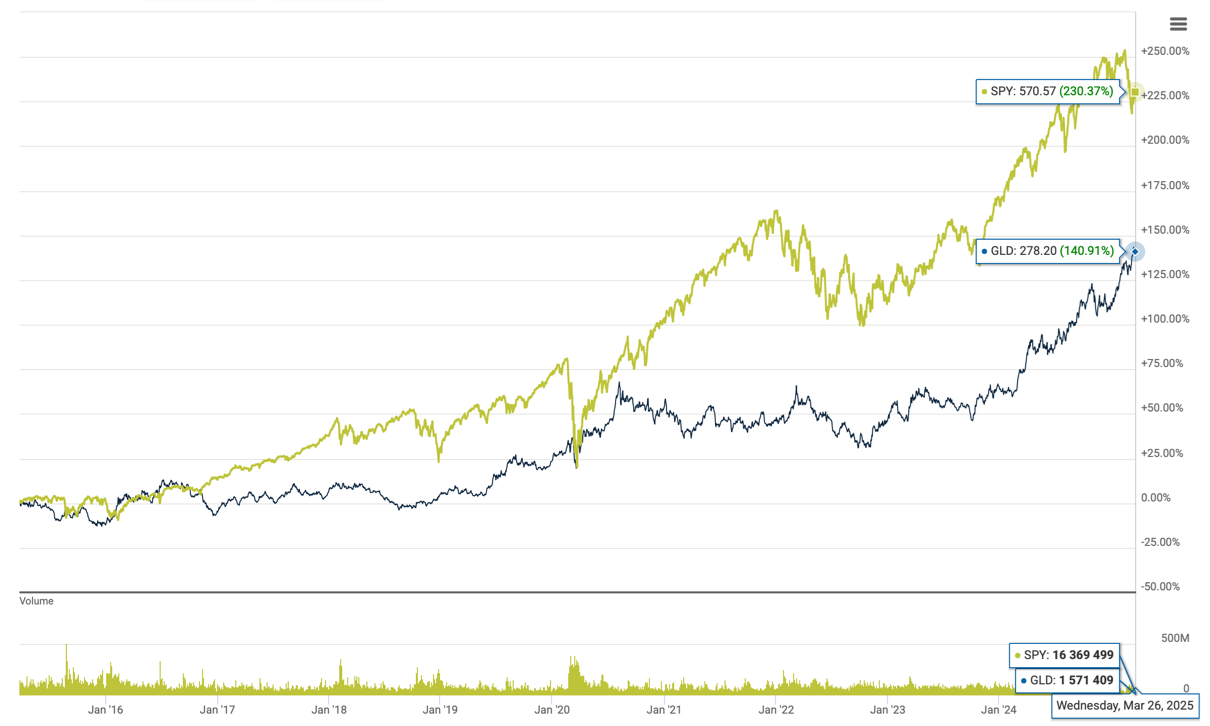
Source: QuoteMedia. Data as of 3/26/2025.
Owning physical gold exposes you to higher transaction costs, along with transport and storage considerations. The gold bar you buy at Costco cannot be sold back to the store. Rather, you must find another buyer—one who will want a discount on the prevailing price or at least add on a transaction charge of some type. You will also need to safely store the gold and arrange for its secure transit, if necessary.
Then there are taxes. Collectibles, which include gold coins and bars, are taxed at a maximum 28% rate. Mutual funds and ETFs investing in precious metals may also be subject to the collectibles tax rate.
Gold does provide diversification, especially for a stock-heavy portfolio. It has a long history of retaining stored value and can be worn (e.g., jewelry). These positives should be weighed against gold’s shortcomings, because when it comes to investing, not all that glitters is gold.

-
Investing in Gold
There are several choices for investors who want to add an allocation to gold to their portfolios. What you need to know about the various options.
-
Should You Consider a Weighting in Gold?
Ideally, a gold allocation should change based on where gold equities are in the valuation cycle. -
Understanding the Role of Long-Term Care Insurance
The March 2025 AAII Journal features an interview with aging expert Howard Gleckman that dispels misconceptions about paying for long-term care.
AAII Sentiment Survey
Pessimism among individual investors about the short-term outlook for stocks decreased in the latest AAII Sentiment Survey. Meanwhile, optimism and neutral sentiment increased.
Bullish sentiment, expectations that stock prices will rise over the next six months, increased 5.8 percentage points to 27.4%. Bullish sentiment is unusually low and is below its historical average of 37.5% for the 11th time in 13 weeks.
Neutral sentiment, expectations that stock prices will stay essentially unchanged over the next six months, increased 0.1 percentage points to 20.4%. Neutral sentiment is unusually low and is below its historical average of 31.5% for the 36th time in 38 weeks.
Bearish sentiment, expectations that stock prices will fall over the next six months, decreased 6.0 percentage points to 52.2%. Bearish sentiment is unusually high and is above its historical average of 31.0% for the 17th time in 19 weeks.
The bull-bear spread (bullish minus bearish sentiment) increased 11.8 percentage points to –24.7%. The bull-bear spread is below its historical average of 6.5% for the 12th time in 14 weeks.
This week’s special question asked AAII members what they thought about the Federal Reserve’s decision to keep interest rates unchanged.
Here is how they responded:
- It was the right move: 77.3%
- They should have cut rates: 11.6%
- They should have raised rates: 4.2%
- Not sure/no opinion: 6.6%
Bullish: 27.4%, up 5.8 points
Neutral: 20.4%, up 0.1 points
Bearish: 52.2%, down 6.0 points
Bullish: 37.5%
Neutral: 31.5%
Bearish: 31.0%
See more Sentiment Survey results.

March 20, 2025 March Charts of Interest: A Buying Opportunity?
March 13, 2025 Investing for the Long Term Despite Tariff-Driven Volatility
March 6, 2025 33 Top-Graded Mid-Cap Dividend Payers
February 27, 2025 Buffett's Cash Problem Isn't Your Problem

Discussion
Monk Monk Jr from Texas posted over 1 year ago:
Slowly, but surely, countries around the world are hoarding gold and other currencies and de-dollarizing. This is not good for the USA. But the politicians (from both flanks) have weaponized the US economy against foe and friends, and the other countries are simply reacting. We really need the Reaganites back to resolve this mess.
Barry J from TX posted over 1 year ago:
#1 Gold is at an all-time high up 27% @ $3,085. It is a good time to use your gold holdings to buy bitcoin so you can get something really “uncertain.” #2 Linking gold to a fugazzi “uncertainty index” based on the number of newspaper articles discussing economic policy “uncertainty” gets to the root cause of all this so called “uncertainty” — the articles themselves. Millennial Jimmy Olsens who kvetch incessantly about the “uncertainty” of their futures drive this process. Like Dan Kahneman said, "What you see is all there is" ("WYSIATI").
Joe from WA posted over 1 year ago:
Gold (in ETF form, not physical holdings) is of most use approaching and during retirement, not during the accumulation stage. Tyler at portfoliocharts.com has an excellent analysis of how a little gold can increase diversification, reduce volatility, increase safe withdrawal rate, and maintain a high portfolio rate of return. He also shows that too much gold in a portfolio can be a big problem. Tyler's data goes back to 1970, so includes a wide range of different market conditions. https://portfoliocharts.com/2021/12/16/three-secret-ingredients-of-the-most-efficient-portfolios/ If you still question gold and diversification's utility, look at Tyler's Golden Butterfly portfolio during the 'lost decade' January 2000 to December 2009, ten years when the SP500 and the traditional 60/40 portfolios went down or sideways. This can easily be seen on the free testfol.io website by changing the start and end dates, adding Golden Butterfly and 60/40 portfolios from the Add Preset dropdown, then select Backtest. I prefer to use the Adjust for Inflation button to see real return.
Barry from TX posted over 1 year ago:
Joe, thanks for the references to the Ulcer Index website. The search function on the AAII.com website will help AAII members find several AAII articles written by Wayne on "The Ulcer Index" from 2013.
You need to log in as a registered AAII user before commenting.
Create an account