

SEC Proposes New Rules Regarding Stock Trade Execution
by Charles Rotblut | December 15, 2022
Featured Tickers: HOOD
SCHW
HOOD
SCHW
While most investors’ eyes oriented toward Washington, D.C., yesterday were focused on the Federal Reserve, there were other announcements worthy of attention. The U.S. Securities and Exchange Commission (SEC) proposed new rules governing how buy and sell orders for stocks are executed.
Yes, things like the “Order Competition Rule” are nowhere near as interesting to discuss as yesterday’s 50-basis-point (0.50%) rate hike by the Fed, but it could impact every trade you place with your broker. The SEC says the proposed rule “would require some equity orders of retail investors to be exposed to comp[etition] in fair & open auctions before they can be executed internally by trading centers that restrict order-by-order comp[etition].” 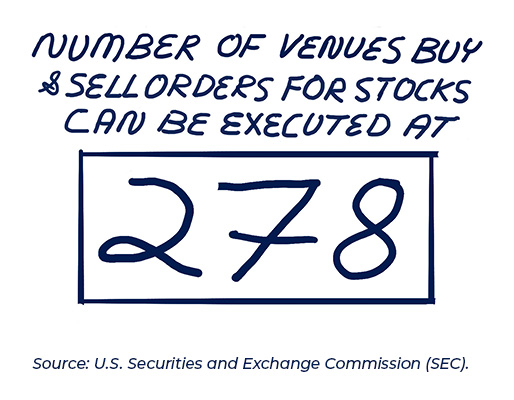
Before your eyes glaze over, let’s back up and consider what has changed over the past two decades behind the scenes when you click the button to buy or sell a stock. In 2000, there were nine registered national securities exchanges and one registered national securities association according to the SEC. This meant there was a very small number of venues where your buy and sell orders could be routed.
Since then, a very large amount of fragmentation has occurred. During the first quarter of this year, exchange-listed stocks “were traded on 16 national securities exchanges, and off-exchange at 32 NMS Stock ATSs and at over 230 other FINRA members,” according to the SEC. (NMS stands for the National Market System, which governs the operations of stock trading. An ATS is an alternative trading system, but neither have members nor take on the regulatory responsibilities that exchanges do.)
Put another way, there is currently a very high likelihood that your order to buy or sell will not be filled on the New York Stock Exchange (NYSE) or the Nasdaq. It’s possible that your broker fills your order or routes it to specific firms. Which firms your orders are routed to can be influenced by payment for order flow. As the name indicates, firms provide compensation to brokers to have orders routed to them.
How dependent a broker is on such revenues varies. In its regulatory filings, Robinhood Markets Inc.  (HOOD) says “a majority of our revenue is transaction-based, in that we receive consideration in exchange for routing our users’ equity, option and cryptocurrency trade orders to market makers for execution.” Conversely, order flow revenue for Charles Schwab Corp. (SCHW) accounted for just 8% of its total net revenues during its third quarter.
Payment for order flow has allowed investors to enjoy commission-free trading. The downside is that we’re getting potentially worse execution prices. A frequent criticism of payment for order flow is the allegation of individual investors not getting the best prices when they buy or sell stocks because many trading venues aren’t able to compete for the right to fill those orders.
The SEC’s proposed Order Competition Rule would require some orders to be exposed to a wider group of trading venues before they can be executed by the broker’s preferred trading center. Orders could be subject to auctions where the best price would determine who fills it.
Sub-penny execution could become more widespread under Regulation NMS, which covers minimum pricing increments for stocks. Some of you are already experiencing sub-penny execution. When I bought shares of Invesco Russell 1000 Equal Weight ETF (EQAL) for my Roth IRA recently, Fidelity listed the transaction price as $41.0799 per share. Not all trading venues offer this level of decimalization though. The Wall Street Journal notes that exchanges, for instance, can only provide quotes in one-cent increments. This proposal would change that.
The Regulation Best Execution would require more thorough documentation on the pricing that a broker’s clients receive.
The intent of these changes is to give investors better execution prices on their trades as well as create more transparency. My expectation is that there will be pushback by industry participants on implementing these proposals—especially by those firms most likely to lose market share and/or profits should the rules be put in place. The savings may be small on individual trades but the benefits from improved execution prices will be cumulative over time. As Depeche Mode famously sang, everything counts in large amounts.
You can view and comment on the proposed rules at www.sec.gov/rules/proposed.shtml. (Look for proposed rules with the date of December 14, 2022.) The comment period will last through at least March 31, 2023. The SEC has told us expressly that they want to hear from individual investors, so please share your thoughts with the commission.

-
A Behind-the-Scenes Look at How Trades Are Executed
The stock market has grown more complex with exchanges, alternative trading platforms and internalizers all competing for orders. -
Online Discount Brokers: Comparing and Contrasting the Older and the New
Two major additions to the offerings of online brokers are fractional shares and cryptocurrency trading. -
Guide to Tax on Your Personal Investments 2022
This supplement to our annual tax guide provides an explanation of the tax rules regarding the buying and selling of securities. -
Investors Weigh In: Do Rising Interest Rates Call for Increased Allocation to Bonds?
Have rising interest rates got you thinking about increasing your allocation to bonds? Members share their strategies in the AAII Income Investing Community. -
I read this so you don’t have to! The ESG Investing Handbook
Anine Sus reviews “The ESG Investing Handbook” and tells how she will apply the lessons to a sustainable investment strategy in her latest My Investing Discoveries blog post.
Members are looking for your input. Can you help with this question from the Retirement Withdrawals Community?
“In an article in the November issue of the AAII Journal, it’s discussed that many mutual funds and exchange-traded funds (ETFs) “bled red” in the third quarter. In addition to negative returns, did you get an unwanted tax surprise in terms of distributions this year?”
Tap the button and then choose the Join the Community button on the right to answer this question in the AAII Community.
Answer This Question in the AAII Community »
AAII Sentiment Survey
Pessimism among individual investors about the short-term direction of the stock market rose to a five-week high in the latest AAII Sentiment Survey. Neutral sentiment fell, while optimism remained at an unusually low level.
Bullish sentiment, expectations that stock prices will rise over the next six months, fell 0.4 percentage points to 24.3%. Bullish sentiment remains below its historical average of 37.5% for the 50th consecutive week. It is at an unusually low level for the third consecutive week.
Neutral sentiment, expectations that stock prices will stay essentially unchanged over the next six months, decreased by 2.4 percentage points to 31.1%. The decline puts neutral sentiment below its historical average of 31.5% after two consecutive weeks of being above average.
Bearish sentiment, expectations that stock prices will fall over the next six months, jumped 2.8 percentage points to 44.6%. Pessimism is above its historical average of 31.0% for the 53rd time out of the past 56 weeks. It is at an unusually high level for the second consecutive week.
The bull-bear spread (bullish minus bearish sentiment) is –20.3%. This is well below the historical average of 6.7% and is unusually low.
Historically, the S&P 500 index has gone on to realize above-average and above-median returns during the six- and 12-month periods following unusually low readings for bullish sentiment and the bull-bear spread. Unusually high bearish sentiment readings historically have also been followed by above-average and above-median six-month returns in the S&P 500.
Concerns about the economy, inflation, corporate earnings and volatility in the stock market continue to cause many individual investors to maintain a cautious short-term outlook. The majority of this week’s responses were recorded prior to yesterday’s rate hike announcement by the Federal Reserve.
Bullish: 24.3%, down 0.4 points
Neutral: 31.1%, down 2.4 points
Bearish: 44.6%, up 2.8 points
Bullish: 37.5%
Neutral: 31.5%
Bearish: 31.0%
See more Sentiment Survey results.

December 8, 2022 Seek Dividend Growth Instead of Yield During Recessions
December 1, 2022 A New Rule Allows Retirement Plans to Consider ESG Factors
November 24, 2022 Reasons for Individual Investors to Be Grateful in 2022
November 17, 2022 Cryptocurrency Debacle Highlights Importance of Where You Bank and Invest

Discussion
Barry from TX posted over 3 years ago:
Thank you, Charles, for netting this out for us. You are right. SEC changes are much less interesting than Fed changes. But they both highlight how much faceless regulators influence our financial fortunes. After 4,500 years, our lives still play out like Greek tragedies. The Chorus provides the storyline. The actors come and go. The audience is passive and has to figure out what it all means. At least we have SBF and crypto to provide a comedic counterpoint. That sideshow has the plot depth of an Elmer Fudd-Bugs Bunny Loony Tunes short or a Three Stooges episode ... AND ... it hints at the possibility of a clown car full of walk-on guest celebrities. The SEC or Fed can't match those plots. Now that's entertainment. Some days you just have to thank God that She made you part of the audience, not a member of the cast. Happy Holidays, all you other common folk. I wish us all a prosperous and Happy New Year. Smile. The first good news for 2023 is that were are almost halfway home with the Joe Roby economy.
Bruce from WA posted over 3 years ago:
278 venues for a trade to execute. It begs the question of "what does the data mean in places like StockCharts and Yahoo?" For example, I follow parts of the Shadow Stock service, and when viewed on minute-to-minute charts there are minutes where there are no prices or volume. Over in Schwab or Fidelity I'll enter and order to buy and get an execution. In the brokerage's chart I can see the trade ... there's a data point matching my volume and price. Sometimes, but only sometimes, I see the trade in StockCharts or Yahoo, but not always. This has practical ramifications if I'm setting sell stops or buy limits or making a "buy or not" decision and being influenced by thin volume. For example, two days ago I'm watching the minute chart in both StockCharts and Fidelity, and the bid-ask spread is trending higher. I enter a buy for under the bid, expecting I likely won't get an execution, but I get immediate execution. Makes me wonder how much lower I could have pushed it. The trade showed in the Fidelity chart as a single blip out of trend but not StockCharts. Some Shadow Stocks are in the $5 range and getting 5 cents improvement is significant. If somebody knows the answer ... is all trade data aggregated somewhere, and if so, how does it work? Do these non-exchange venues aggregate data every minute, hour or day, or not at all? If it isn't, I'd suggest that the SEC should be more concerned about order flow not reflected in the data stream. One of the SEC's primary jobs is to ensure an orderly (and I'd assume "fair") market and if some order flow isn't being tracked, how could that be assumed orderly and fair. On the other hand, it would explain why several of my professional managers always seem to beat the market by a few pennies when they make moves.
Robert from TX posted over 3 years ago:
The WallStreet Journal had a great article about this yesterday (https://www.wsj.com/articles/sec-set-to-propose-rules-that-would-squeeze-stock-market-middlemen-11671033619?st=f4g293col07b8mj&reflink=desktopwebshare_permalink). @Bruce's discussion is valid - you aren't getting the best execution nor the best information because of the fragmentation. The real rub is that we never got the best execution because the market makers always skimmed off the top. Now those market makers are lower on the chain - they're the actual brokerage you are putting your buy / sell order into or the venue (like Citadel Securities) that paid for the order flow.
You need to log in as a registered AAII user before commenting.
Create an account