

Seek Dividend Growth Instead of Yield During Recessions
by Charles Rotblut | December 08, 2022
Chatter about a possible recession continues. While the possibility of a recession has been part of the scuttlebutt for a while now, a more recent change is the trend occurring in the yield curve. The U.S. Treasury yield curve is well on pace to be inverted for a second consecutive calendar quarter. Both the five-year and 10-year Treasury notes are trading with yields below the two-year Treasury note on a quarter-to-date basis. (Through Wednesday, the quarter-to-date average yields are 4.42% for the two-year note, 4.07% for the five-year note and 3.89% for the 10-year note.)
Inverted yield curves have been shown to precede recessions. Whether this trend will continue remains to be seen. The Federal Reserve’s aggressive raising of interest rates poses a risk—especially since the central bank does not have a good history of pulling off soft economic landings. Even though recessions are a normal part of the economic cycle, predicting their timing and severity isn’t easy.
Dividend-paying stocks can have an appeal during periods of economic turbulence. Their income is perceived as cushioning the blow of any adverse reaction in the stock market. In addition, maintaining dividends requires a certain level of fundamental and business strength.
How dividend stocks have actually held up during recessionary times was the subject of a Morningstar analysis by Amy Arnott that my colleague Derek Hageman discussed in our Dividend Investing newsletter.
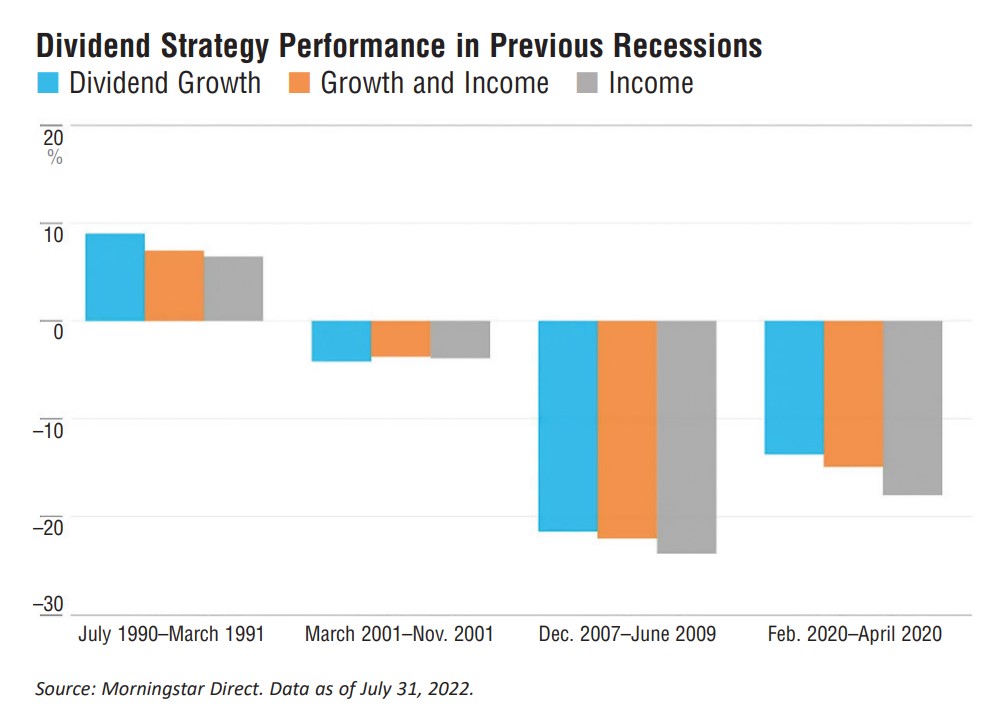
As Hageman quoted: “Dividend-paying stocks fared better than the market overall in the economic slowdowns that started in July 1981, March 2001 and December 2007. What’s more, they did so by significant margins in two out of these three periods. However, dividend-paying stocks fell slightly behind in the brief recession in 1980, which started after the Fed raised interest rates to rein in the rampant inflation of the 1970s. Dividend stocks also lagged during the short-lived recession in early 2020. The MSCI USA High Dividend Yield Index dropped 11.5% between February and April, about two percentage points worse than the market overall. Dividend stocks suffered in early 2020 partly because scores of companies [including major firms like Walt Disney Co. (DIS), Shell PLC (SHEL) and General Motors Co. (GM)] either reduced or suspended their dividends as the sudden economic decline from the coronavirus dented profitability and cash flow. In addition, most dividend stock benchmarks are light on technology stocks and other high-growth, momentum-oriented stocks that led the market during most of 2020.”
Not all dividend stocks are the same. Some have high yields (income). Others are characterized by their growing dividends (growth). A third category, growth & income, is a middle ground between income and growth.
Of the three, the growth category has generally performed the best in recessions. The one exception was the 2001 period, which was heavily influenced by the dot-com bubble’s impact on technology-based stocks.
Income has mostly experienced the worst relative performance of the three despite the higher yields. This isn’t surprising since yield reflects perceived risk. Investors demand higher yields when they are more concerned about the prospects of the dividend-paying company. To the extent such companies are more sensitive to economic downturns, the returns of their stocks during recessionary periods should reflect this concern.

-
Bond Yields’ Role as a Recession Warning Signal
When the yield curve gets inverted, it precedes economic downturns and recessions. -
Dividend Growth Helps Portfolios Combat Inflation
Investors, particularly retirees, can leverage the benefits of dividends to combat the deleterious effects of inflation and market volatility. -
Differentiating Between High Yield and High Dividend Growth Strategies
Which are the better dividend-paying stocks: stocks with a lower initial yield but with a high dividend growth rate, or stocks with a low dividend growth rate but with a higher initial yield? -
The Individual Investor’s Guide to Personal Tax Planning 2022
The impact of inflation on taxes will be felt the most by those who are near the border between brackets or close to the limit for an exemption or deduction. -
Year-End Tax Moves to Consider for 2022
You may be able to minimize taxes by realizing various deductions and liabilities this December.
Members are looking for your input. Can you help with this question from the Income Investing Community?
“In the article ‘Key Ingredients of a Blue-Chip REIT’ by Brad Thomas, he discusses how high-quality real estate investment trusts (REITs) can deliver consistent, rising growth in funds. Have you had success with investing in blue-chip REITs? And if so, what is your strategy when looking for a potential REIT to buy?”
Tap the button and then choose the Join the Community button on the right to answer this question in the AAII Community.
Answer This Question in the AAII Community »
AAII Sentiment Survey
Pessimism among individual investors about the short-term direction of the stock market rose to a four-week high in the latest AAII Sentiment Survey. Neutral sentiment fell but remained above average, and optimism stayed around the same level.
Bullish sentiment, expectations that stock prices will rise over the next six months, rose 0.3 percentage points to 24.7%. Bullish sentiment remains below its historical average of 37.5% for the 49th consecutive week.
Neutral sentiment, expectations that stock prices will stay essentially unchanged over the next six months, decreased by 1.7 percentage points to 33.5%. The decline puts neutral sentiment above its historical average of 31.5% for just the third time since the end of July.
Bearish sentiment, expectations that stock prices will fall over the next six months, rose by 1.4 percentage points to 41.8%. Pessimism is above its historical average of 31.0% for the 52nd time out of the past 55 weeks. It is also back an unusually high level for the first time in four weeks.
The bull-bear spread (bullish minus bearish sentiment) is –17.1%. This is well below the historical average of 6.7%.
Historically, the S&P 500 index has gone on to realize above-average and above-median returns during the six- and 12-month periods following unusually low readings for bullish sentiment and the bull-bear spread. Unusually high bearish sentiment readings historically have also been followed by above-average and above-median six-month returns in the S&P 500.
Concerns about the economy, inflation, corporate earnings and volatility in the stock market continue to cause many individual investors to maintain a cautious short-term outlook.
Bullish: 24.7%, up 0.3 points
Neutral: 33.5%, down 1.7 points
Bearish: 41.8%, up 1.4 points
Bullish: 37.5%
Neutral: 31.5%
Bearish: 31.0%
See more Sentiment Survey results.

AAII Asset Allocation Survey
Cash as a percentage of individual investors’ portfolios pulled back from a 2.5-year high last month. The November AAII Asset Allocation Survey also shows equity allocations growing marginally while fixed-income allocations were flat.
Stock and stock fund allocations increased by 0.8 percentage points to 62.4%. Despite the increase, this marked the second-lowest reading since May 2020 (60.8%). Equity exposure remains above the historical average of 61.5% for the 30th consecutive month.
Bond and bond fund allocations remained relatively flat, declining by only 0.1 percentage points to 13.6%. Bond and bond fund allocations are below their historical average of 16.0% for the 21st consecutive month.
Cash allocations fell by 0.7 percentage points to 24.0%. Even with the decline, this reading is higher than 31 of the last 32 months. This is also the second time in 31 months that cash allocations are above their historical average of 22.5%.
Optimism about the short-term direction of the stock market continued to be unusually low throughout November. Concerns are looming about the overall direction of the economy, inflation and potential interest rate hikes. It should be noted that most of this month’s results were tabulated before yesterday’s comments about monetary policy were made by Federal Reserve chairman Jerome Powell.
- Stocks and Stock Funds: 62.4%, up 0.7 percentage points
- Bonds and Bond Funds: 13.6%, down 0.0 percentage points
- Cash: 24.0%, down 0.7 percentage points
- Stocks: 30.4%, up 0.3 percentage points
- Stocks Funds: 32.0%, up 0.4 percentage points
- Bonds: 3.8%, up 0.2 percentage points
- Bond Funds: 9.8%, down 0.2 percentage points
- Stocks/Stock Funds: 62.0%
- Bonds/Bond Funds: 16.0%
- Cash: 22.0%
Take the Asset Allocation Survey.
December 1, 2022 A New Rule Allows Retirement Plans to Consider ESG Factors
November 24, 2022 Reasons for Individual Investors to Be Grateful in 2022
November 17, 2022 Cryptocurrency Debacle Highlights Importance of Where You Bank and Invest
November 10, 2022 Monitoring My Portfolio During a Volatile Market

Discussion
No comments have been added yet. Add your thoughts to the discussion!
You need to log in as a registered AAII user before commenting.
Create an account