

The Case for Free Cash Flow in Stock Selection
by Charles Rotblut | June 26, 2025
Featured Tickers: LCOW
LCOW
S&P Dow Jones Indices quietly launched a new index last year focused on free cash flow. It outperformed the S&P 500 index with a 21.9% return over the 12-month period ended in May 2025, versus the S&P 500’s 13.5% return. The S&P 500 Quality FCF Aristocrats index’s 15-year annualized return of 17.0% is the highest of all S&P 500 subindexes. (S&P Dow Jones Indices used April 20, 2001, as the index’s first value date.)
The S&P 500 Quality FCF Aristocrats seeks out S&P 500 companies that have all of the following traits:
- Positive free cash flow for at least 10 consecutive years,
- High free cash flow margin and
- High free cash flow return on invested capital (ROIC).
The Pacer S&P 500 Quality FCF Aristocrats ETF (LCOW) tracks this index. This exchange-traded fund (ETF) was launched less than two months ago. However, you don’t need to own the ETF to incorporate one or more of the S&P 500 Quality FCF Aristocrats’ traits in your own strategy. A simple calculator and the financial statements available on AAII.com will provide you with all of the necessary data. (To view these financial statements, simply type a company’s name or ticker symbol into the search box at the top left on AAII.com to access its Stock Evaluator page. Then click on the Financials tab.)
What Makes a Free Cash Flow Aristocrat
Free cash flow is calculated using the common formula of cash from operations minus capital expenditures (capex). The free cash flow margin is free cash flow divided by revenues. Free cash flow return on invested capital is calculated as:
Free Cash Flow ÷ (Total Debt + Total Equity)
As I explained in last week’s AAII Dividend Investing (DI) commentary, free cash flow is the cash that does not need to be reinvested back into a company. (We at AAII also subtract dividends from cash from operations when calculating the free cash flow payout ratio. This is done to see how much free cash is left over after dividends have been paid.)
Cash from operations is the net cash realized from normal business operations. It is earnings adjusted for outflows (e.g., increases in inventories), inflows (e.g., decreases in accounts receivable) and the adding back of noncash expenses like depreciation.
Capex is dollars spent on property, plant and equipment. These are amounts a company needs to spend on itself to keep its facilities running or to enable expansion. Even a service-oriented company will have capital assets (e.g., office furniture).
Free cash flow aristocrats are companies with the ability to consistently generate free cash flow. This cash can be used to further grow the business, pay dividends and/or repurchase stock. The requirement for 10 or more consecutive years of positive free cash flow also identifies companies that are fundamentally strong. (You can lower this requirement to five or seven years and still find consistent free cash flow generators.)
Comparing the Free Cash Flow Aristocrats to Other Companies
The S&P 500 Quality FCF Aristocrats ignores growth rates, valuation, dividend yields, volatility and price momentum. These aspects make it very different relative to the other S&P 500 subindexes. (There are 16 other indexes that S&P Dow Jones Indices tracks in its monthly S&P Factor Indices Dashboard.)
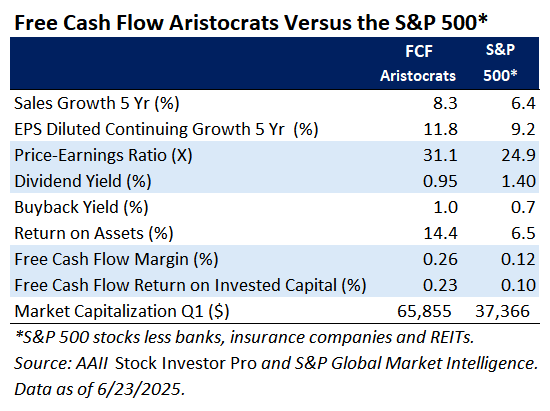
Free cash flow aristocrats have realized stronger five-year revenue and earnings growth than the comparable S&P 500 universe. [This universe excludes banks, insurance companies and real estate investment trusts (REITs) because of their different financial structures.] Valuations are also higher. The median price-earnings (P/E) ratio is 31.1 for the aristocrats, versus 24.9 for the comparable S&P 500 universe. The free cash flow aristocrats have lower dividend yields, though they repurchase more of their stock, as evidenced by the higher buyback yield in the table.
Companies that spend less on purchasing and maintaining capital assets tend to have higher levels of return on assets (ROA). Return on assets is net income divided by average total assets. Being “asset light” contributes to higher free cash flow margins and higher free cash flow return on invested capital. As a group, free cash flow aristocrats have higher return on assets than the typical large-cap stock.
There is no performance data on the free cash flow aristocrats prior to 2001. We do know that requiring fundamental strength works across strategies. Positive free cash flow is among the traits associated with financially strong companies.
You Knew It Didn’t Make Sense. But You Sold Anyway.
Even experienced investors misread emotion. But that doesn’t have to be you next time.
We’ve all made moves we later questioned.
You knew the company was sound.
You believed in the long-term case.
But a wave of fear swept the market, and you pulled out — only to watch the stock rebound.
It’s not a failure of logic. It’s a failure of clarity.
We’re creating a tool to change that. Something that reveals when fear is distorting price, when the crowd is overreacting and when emotions — not fundamentals — are in control.
Ever misread the market’s mood? We want your story.
You’ll help shape a tool that keeps others from making the same mistake.

-
Stocks With Consistent Dividend Increases and Positive Free Cash Flow
This First Cut seeks out domestic, exchange-listed stocks that have consistently raised their annual dividend payment while maintaining positive free cash flow. -
18 Financial Ratios That Shed Light on a Company’s Strengths and Weaknesses
Financial ratios provide a powerful framework for assessing a company’s performance, efficiency and financial health across multiple dimensions and over time. -
A One-Page Wealth-Building Plan for Semiretirement
The June 2025 AAII Journal discusses key considerations when planning a period of part-time work before full retirement.
AAII Sentiment Survey
Optimism among individual investors about the short-term outlook for stocks increased in the latest AAII Sentiment Survey. Meanwhile, neutral sentiment and pessimism decreased.
Bullish sentiment, expectations that stock prices will rise over the next six months, increased 1.9 percentage points to 35.1%. Bullish sentiment is below its historical average of 37.5% for the 20th time in 21 weeks and is above 30% for only the 12th time this year.
Neutral sentiment, expectations that stock prices will stay essentially unchanged over the next six months, decreased 0.7 percentage points to 24.7%. Neutral sentiment is below its historical average of 31.5% for the 49th time in 51 weeks.
Bearish sentiment, expectations that stock prices will fall over the next six months, decreased 1.1 percentage points to 40.3%. Bearish sentiment is above its historical average of 31.0% for the 30th time in 32 weeks.
The bull-bear spread (bullish minus bearish sentiment) increased 3.0 percentage points to –5.2%. The bull-bear spread is below its historical average of 6.5% for the 21st time in 23 weeks.
This week’s special question asked AAII members what they think about the Federal Reserve’s decision to keep interest rates unchanged.
Here is how they responded:
- It was the right move: 70.7%
- They should have cut rates: 19.9%
- They should have raised rates: 3.1%
- Not sure/no opinion: 4.7%
Bullish: 35.1%, up 1.9 points
Neutral: 24.7%, down 0.7 points
Bearish: 40.3%, down 1.1 points
Bullish: 37.5%
Neutral: 31.5%
Bearish: 31.0%
See more Sentiment Survey results.

June 19, 2025 June Charts of Interest: Tariffs Are Driving Prices Bananas
June 12, 2025 Don't Mistake MicroStrategy's 10% Preferred Yield for Pure Bitcoin Exposure
June 5, 2025 Six Minutes?! Study Finds That Investors Often Skip Proper Stock Research
May 29, 2025 The Bond Market Is Adjusting, Not Growling

Discussion
Jim F from FL posted over 1 year ago:
Obvious question, are there any ETFs that attempt to mirror "Free Cash Flow Aristocrats?
Charles M Rotblut from Illinois posted over 1 year ago:
Hi Jim,
The Pacer S&P 500 Quality FCF Aristocrats ETF (LCOW) is the only ETF in our database that tracks this index. We're going to have the ticker hyperlinked above, but here is the Evaluator page for it: https://www.aaii.com/etf/ticker/LCOW. This fund was just launched in early May.
-Charles
You need to log in as a registered AAII user before commenting.
Create an account