

Eight Individual Investor New Year's Resolutions for 2023
by Charles Rotblut | December 29, 2022
I’ve been sharing a list of New Year’s resolutions for investors since 2011. Every year, I revise the list. Even if you’ve read it before, you will find something new this year.
The list is written from a long-term investing perspective. In doing so, I’ve taken a holistic view of actionable steps you can take to become a more successful investor.
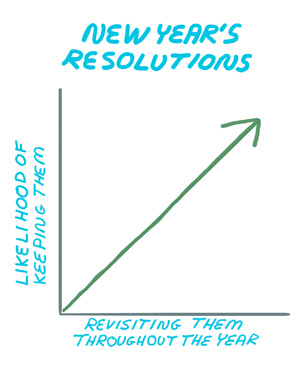 As you make your personal resolutions, set up calendar reminders to check the progress you are making throughout the year. Are you sticking to them? If not, what can you do to get yourself back on track? Resolutions that require a lasting change won’t be fulfilled with one step. They require ongoing effort and attention. So, pull out your calendar or smartphone and add reminders to revisit your resolutions. Doing so will increase your odds of fulfilling them.
Here are my 2023 New Year’s resolutions for individual investors.
-
Don’t make big bets on uncertain outcomes. The last few years have shown how things can play out much differently than we expect—from the coronavirus pandemic to the aggressive hiking of interest rates by the Federal Reserve in 2022. As we look to 2023, the possibility of a recession and the start of a new bull market are both on the table. The timing of both is uncertain—the severity of the next recession and the strength of the next bull market (whenever they occur) are even more uncertain. Accepting that no one can accurately forecast these things allows you to focus more on your process than on forecasts—a recipe for success.
-
Reflect on how you felt about the financial markets this year and review what portfolio changes you made. No single risk questionnaire accurately measures your ability to withstand volatility the way reviewing your own actions and emotions during a bear market does. In 2022, did you sell investments out of fear that they could fall further? Were you able to stay relaxed or did the market volatility and/or economic news leave you nervous? Make note of it. If your nerves got the better of you, it may mean you took on too aggressive of an allocation or investment strategy.
Alternatively, think about what steps you can take to avoid letting your emotions get the better of you. They can include looking at your portfolio less often (e.g., once a quarter or once a year), giving less attention to the financial headlines, switching to a more conservative allocation, creating a bucket of safe assets you can tap during down periods and/or having a financial planner or friend to talk to when the markets have you feeling nervous.
-
Invest based on your goals. Your goals determine the amount of wealth you need. They also determine your investing time horizon, the duration of time you will spend on the goal and how much you will need to withdraw from your portfolio relative to overall wealth. These factors should drive your investment decisions—not the headlines of the day. The AAII PRISM Wealth-Building Process aligns your investing decisions with your goals.
-
Focus on your process, not on your goals. Mr. Market couldn’t care less about your goals or timelines. He does as he pleases. The only thing you can control is your process for allocating your portfolio, choosing investments to buy and determining when it’s time to sell. Focus on getting the process right for these three things, and you will get the best possible return relative to the returns of the financial markets and your personal tolerance for risk.
-
Automate when possible. If I had to pick a single, favorite resolution, this might be it. In late December of each year, I plan out the contributions to my wife’s and my retirement accounts for the following calendar year and start to set them up. Doing so takes advantage of what is known as a Ulysses contract. It binds my actions in advance before I’m in a situation where I might be tempted to spend the dollars I should be saving.
There are many actions you can automate. Contributions to savings, retirement and brokerage accounts can be directly taken from your paycheck or from your checking account. (If the latter, have the money pulled out on the same day you get paid or the following business day.) Most mutual funds will automatically invest the contributions for you. Required minimum distributions (RMDs) can be automated to avoid missing deadlines and provide a monthly stream of income. You can also have bills set up to be paid automatically to avoid incurring late fees. Estimated tax payments can be scheduled in advance.
-
Take care of your health. Yes, this resolution is coming from a guy who took up long-distance running during the pandemic, but there is plenty of scientific evidence backing me up. Regular exercise, a proper diet (eat your vegetables!) and adequate amounts of sleep have been shown to reduce the risk of or lessen the severity of many diseases and ailments. All three are also good for your mental and emotional state. Combined, they help you make better investing decisions and can lower your lifetime medical costs.
Regular hearing tests are also important. (I’ve already scheduled one for 2023.) Hearing loss has been strongly linked to cognitive decline, and cognitive decline impairs your ability to make even basic financial decisions.
-
Talk to your family about investing and your finances. If you’re reading this, you likely have at least an interest in investing. Share it with your family members by having a conversation with them. Talk about how you invest, what you’ve learned and even the mistakes you’ve made. It’s a great way to pass along a legacy to those younger than you and to maintain a strong bond with those older than you. Our PRISM process can be a great way to start those conversations.
While you are talking about investing and finances, tell your family members where they can find important documents and which professionals you work with. Having this information will better empower them to step in on your behalf when the time comes.
-
Take advantage of being an individual investor. Perhaps the greatest benefit of being an individual investor is the flexibility you are afforded. As AAII founder James Cloonan wrote: “The individual investor has a distinct advantage over the institution in terms of flexibility. They can move more quickly, have a wider range of opportunities and can tailor their program more effectively. They have only themselves to answer to.”
Not only are we as individual investors not restricted by market capitalization or investment style, but we also never have to report quarterly or annual performance. This means we can invest in a completely different manner than institutional investors can. Take advantage of this flexibility because doing so gives you more opportunity to achieve your financial goals.

-
Using Your Portfolio’s Asset Mix to Control Your Risk
Once you know your risk capacity, you can make adjustments to your portfolio to arrive at the optimal allocation for you. -
Get Organized! How to Maintain Your Personal Financial Files
Everyone needs to keep certain personal financial paperwork, but how do you decide which to keep and which to chuck? A guide to organizing your personal financial files. -
When It’s Time to Transfer Financial Decision-Making
Failing to plan for a transfer of financial responsibilities can undo years of careful plans. Actionable steps to protect you and your heirs. -
Manage the Impact of Taxes on Your Stocks and Funds
You can control the impact that taxes have on your stocks, funds and ETFs to avoid letting taxes drive your investing decisions. -
Online Exclusive: What Are Donor-Advised Funds?
Donor-advised funds allow donors to take an immediate tax deduction on their contributions now without the need to decide at the same time where the funds will ultimately be gifted.
AAII Sentiment Survey
Optimism among individual investors about the short-term direction of the stock market rose to a five-week high in the latest AAII Sentiment Survey.
Bullish sentiment, expectations that stock prices will rise over the next six months, jumped 6.2 percentage points to 26.5%. Bullish sentiment remains below its historical average of 37.5% for the 52nd consecutive week. Despite the increase, it is at an unusually low level for the fifth consecutive week.
Neutral sentiment, expectations that stock prices will stay essentially unchanged over the next six months, decreased by 1.5 percentage points to 25.9%. The decline marks the lowest reading since October 20, 2022 (21.2%).
Bearish sentiment, expectations that stock prices will fall over the next six months, fell 4.7 percentage points to 47.6%. Bearish sentiment is above its historical average of 31.0% for the 55th time out of the past 58 weeks and is at an unusually high level for the fourth consecutive week.
The bull-bear spread (bullish minus bearish sentiment) is –21.1%. This is well below the historical average of 6.6% and is unusually low.
Historically, the S&P 500 index has gone on to realize above-average and above-median returns during the six- and 12-month periods following unusually low readings for bullish sentiment and the bull-bear spread. Unusually high bearish sentiment readings historically have also been followed by above-average and above-median six-month returns in the S&P 500.
Concerns about the economy, inflation, corporate earnings and volatility in the stock market continue to cause many individual investors to maintain a cautious short-term outlook.
Bullish: 26.5%, up 6.2 points
Neutral: 25.9%, down 1.5 points
Bearish: 47.6%, down 4.7 points
Bullish: 37.5%
Neutral: 31.5%
Bearish: 31.0%
See more Sentiment Survey results.

December 22, 2022 Changes to Retirement Savings Included in the Omnibus Bill
December 15, 2022 SEC Proposes New Rules Regarding Stock Trade Execution
December 8, 2022 Seek Dividend Growth Instead of Yield During Recessions
December 1, 2022 A New Rule Allows Retirement Plans to Consider ESG Factors

Discussion
Barry from TX posted over 3 years ago:
Charles, thanks for sharing the resolutions and throwing in a few Yenta-like nudges. Reading someone else’s NY resolutions invokes the image of the Peanuts comic strip where Lucy is sitting behind a cardboard box with a sign over it that reads “Psychiatric Help 5 Cents.” The Lucy in me says the most important takeaway is not the list. It is the resolution-making process you used, which is based – more or less -- on a systematic approach, the AAII PRISM Process. Hopefully, you have provided a nudge for AAIIers to realize that the PRISM model can be adapted to improve the non-financial parts of their “life portfolio.” When you see your life and all the actions that produce its outcomes as PROCESSES YOU CAN DESIGN to fit your goals is the first step to improve the outcomes in your life. (Actually the “first” step is devotion to the God of your choice. But I am not that kind of Yenta. I am a process Yenta.) Adopting a systematic process to resolutions-making is the one of best resolutions to make, at New Year’s or anytime. My choice is to apply basic process improvement principles to improve the quality of my life’s outcomes. My process of choice is a simplified version of the Walter Shewhart’s “Plan, Do, Check, Act” model PRISM also parallels the PDCA model. See https://en.wikipedia.org/wiki/Walter_A._Shewhart. Charles I will award you partial credit for the modest "control chart" in the article. If it had upper and lower limits, it could work for me.
You need to log in as a registered AAII user before commenting.
Create an account