

Changes to Retirement Savings Included in the Omnibus Bill
by Charles Rotblut | December 22, 2022
I mentioned in my December AAII Journal Editor’s Note the possibility of retirement savings legislation being passed during the lame-duck session in U.S. Congress. This week, that possibility turned into a probability.
Included in the 4,155-page omnibus spending bill (at least that was the length as of Tuesday) is a section titled “SECURE 2.0 Act of 2022.” The name is a reference to the SECURE Act of 2019, which made changes to retirement savings. The new legislation adds many changes to retirement savings. 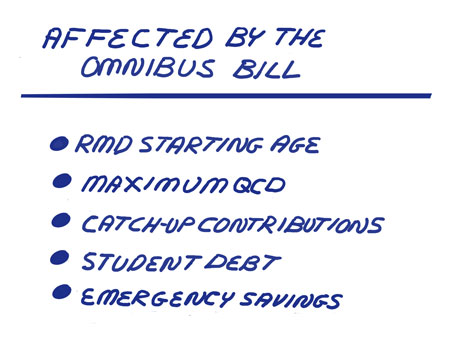
My initial impression is that two demographic groups will be the primary beneficiaries from the changes. The biggest beneficiaries are high-income earners who are currently in their late 50s. They’ll get the opportunity to make larger catch-up contributions to their workplace retirement accounts and will have three extra years to strategically reduce their traditional individual retirement account (IRA) and 401(k) balances before required minimum distributions (RMDs) start. Younger adults will have a new opportunity to build up emergency savings, get help paying down their student debt and potentially receive a matching retirement savings contribution from the government.
Though the act was given the name “SECURE,” it does nothing to reduce the likelihood of Social Security benefits being reduced over the next decade. In my opinion, it also does not go far enough in addressing those without access to a 401(k) or similar types of workplace retirement plans.
I’ve summarized the changes affecting large numbers of investors—of various age and income groups—below. There are more changes in the bill. If you want to see them, look for the section titled “SECURE 2.0 Act of 2022” in the spending bill. (It began on page 2,046 as of Tuesday.)
A big change of interest to many AAII members is the raised required beginning date (RBD) for taking RMDs. Effective on January 1—yes, 10 days from now—RMDs will start at age 73 instead of age 72. On January 1, 2033, the RBD will be age 75. Those following under the older rules using age 70½ or 72—meaning you are at least or will turn age 72 in 2022—will continue to take RMDs as is. If you turned 72 this year (2022), my understanding of the rules is that you must still take your first RMD by April 1, 2023.
Qualified charitable distributions (QCDs) will be indexed to inflation starting in 2024. The current limit is $100,000 per year.
Catch-up contributions to traditional IRAs and Roth IRAs will finally be indexed to inflation. The cap on the additional annual amount that those age 50 or older can contribute per year has been limited to $1,000 for years. Starting in 2024, the catch-up contribution will be indexed to inflation. Future increases will be in increments of $100.
In addition, a higher catch-up contribution of at least $10,000 will be available to those ages 60 through 63 in workplace retirement plans such as 401(k) plans as well as SIMPLE plans starting in 2025. (Some outlets are projecting that the initial amount will be $11,250.) The amount will be subject to inflation adjustments after 2025.
Younger workers participating in defined-contribution plans like a 401(k) will be able to have their employers apply matching contributions toward their student debt. In other words, if a worker is eligible for a matching contribution, that contribution can be used to pay down their qualified student loans.
Both 401(k) and 403(b) plans with auto-enrollment will be required to have minimum contributions between 3% and 10%. These percentages would be automatically raised (auto-escalation) by a full percentage point each year to a maximum of between 10% and 15%. Workers would still be able to set their own contribution rates if they choose. The rule goes into effect in 2025.
An emergency withdrawal totaling no more than $1,000 will be allowed from 401(k) and other employee-sponsored retirement plan accounts without penalty. Only one withdrawal per year will be allowed. If an emergency withdrawal is taken, no additional emergency withdrawals may be taken over the next three years without the withdrawal being repaid. The rule goes into effect in 2025.
Employers would be able to offer emergency savings accounts alongside retirement savings accounts. These accounts would be funded with aftertax dollars. Participant contributions would be capped so that they do not cause the account balance attributable to those contributions to exceed $2,500 or the plan sponsor’s limit.This amount will be subject to inflation adjustments in $100 increments starting in 2025.
The federal government will make a matching contribution to retirement accounts of up to $2,000 per year under the new saver’s match. The phaseout for the match will start at modified adjusted gross income (MAGI) amounts of $41,000 per year for married joint filers, with the match not available to those with MAGI above $71,000. (The phaseouts for single filers are half of those amounts.) The phaseouts will be subject to inflation adjustments starting in 2028.

-
A New Perspective on Withdrawal and Allocation Strategies for Retirees
Factoring in worst-case scenarios for your early years of retirement helps ensure your portfolio lasts. -
Automatic Enrollment Positively Impacts 401(k) Participants
Automatically opting employees into their workplace retirement plans has a strong influence on participant saving and investment behavior. -
Can a Roth IRA Conversion Save You Money?
Moving assets from a traditional IRA to a Roth IRA is most compelling when you pay tax on the converted amount at a relatively low rate. -
Manage the Impact of Taxes on Your Stocks and Funds
You can control the impact that taxes have on your stocks, funds and ETFs to avoid letting taxes drive your investing decisions. -
Collectors Seek Lottery-Like Returns in NFTs
The allure of non-fungible tokens (NFTs) for many is the hope of a profitable investment, but a study found signs of the lottery effect at play.
AAII Sentiment Survey
Pessimism among individual investors about the short-term direction of the stock market rose to a nine-week high in the latest AAII Sentiment Survey.
Bullish sentiment, expectations that stock prices will rise over the next six months, fell 4.0 percentage points to 20.3%. This week’s reading is the 52nd lowest recorded since the survey started in 1987. Bullish sentiment remains below its historical average of 37.5% for the 51st consecutive week. It is at an unusually low level for the fourth consecutive week.
Neutral sentiment, expectations that stock prices will stay essentially unchanged over the next six months, decreased by 3.7 percentage points to 27.4%. The decline keeps neutral sentiment below its historical average of 31.5% for the second consecutive week.
Bearish sentiment, expectations that stock prices will fall over the next six months, jumped 7.7 percentage points to 52.3%. Pessimism is at its highest level since October 20, 2022 (56.2%). Bearish sentiment is also above its historical average of 31.0% for the 54th time out of the past 57 weeks and is at an unusually high level for the third consecutive week.
The bull-bear spread (bullish minus bearish sentiment) is –32.0%. This is well below the historical average of 6.7% and is unusually low.
Historically, the S&P 500 index has gone on to realize above-average and above-median returns during the six- and 12-month periods following unusually low readings for bullish sentiment and the bull-bear spread. Unusually high bearish sentiment readings historically have also been followed by above-average and above-median six-month returns in the S&P 500.
Concerns about the economy, inflation, corporate earnings and volatility in the stock market continue to cause many individual investors to maintain a cautious short-term outlook.
Bullish: 20.3%, down 4.0 points
Neutral: 27.4%, down 3.7 points
Bearish: 52.3%, up 7.7 points
Bullish: 37.5%
Neutral: 31.5%
Bearish: 31.0%
See more Sentiment Survey results.

December 15, 2022 SEC Proposes New Rules Regarding Stock Trade Execution
December 8, 2022 Seek Dividend Growth Instead of Yield During Recessions
December 1, 2022 A New Rule Allows Retirement Plans to Consider ESG Factors
November 24, 2022 Reasons for Individual Investors to Be Grateful in 2022

Discussion
Mike Doherty from FL posted over 3 years ago:
Will the IRS issue an updated Uniform Lifetime Table, that shows initial RMDs at age 73? Any idea of when this might be available?
frank hasou from ny posted over 3 years ago:
Are the changes to SECURE applicable to and can catch up contributions be done for SEP IRA accounts?
Charles Rotblut from IL posted over 3 years ago:
Mike - My understanding of the process is that the revised RMD tables would first have to be published in the Federal Register. I don't know how quickly this would be done.
Frank - There is a provision allowing for Roth SEP IRAs but I did not personally see anything pertaining to catch-up contributions for SEP IRAs.
-Charles
Peter from CA posted over 3 years ago:
The federal government will make a matching contribution to retirement accounts ... Does that mean the government will give money to those with retirement accounts based on their contributions and income? i.e., lower income people will be given an income supplement. If that's true (income distribution), we are now fully engaged in Marxist socialism.
Barry from TX posted over 3 years ago:
Thank you, Charles, for helping us be better informed on end-of-year tax planning. Congress does not care how retirement laws impact taxpayers. Congress sees its job as moving around tax liability dates (usually forward) based on population and fertility trends (both decreasing) and employment trends (also decreasing) that will enable them to avoid having to do anything constructive that would actually benefit working people who pay the taxes (also increasing) that provide the money Congress can transfer to non-working population segments (also increasing). Now Congress can go home for the Holidays (cue Perry Como.) where they will hide behind the density of a 4,155-page document (10 times longer than “Moby Dick” at 417 pages) knowing no one will be able to contradict their opinions of what it says. There are so many much larger distractions that will be discovered in the Omnibus Bill sooner or later. The “annus horribilis” that was 2022 turns out to be a gift that keeps on giving.
Bob from VA posted over 3 years ago:
As someone who just turned 50, it's disappointing (to say the least) that catch-up contributions are now handled as taxable contributions only, (i.e., Roth-like and not deductible in the year made). The freedom to consider how to arrange those contributions is now eliminated by this legislation, and it's a huge taxable impact for those that can make them. This is an important item of knowledge in terms of planning. I know the industry loves ROTH IRAs but the tax math for catch-up contributions is much more complicated, and not nearly as advantageous when those contributions will be taxed in higher tax brackets up front. More illumination on this change is needed.
You need to log in as a registered AAII user before commenting.
Create an account