


Learning the AAII Way
Comment on “Defining Your Goals,” by Charles Rotblut, CFA, in the July 2020 AAII Journal:
Heard the talk yesterday and it was excellent [Webinar Wednesday on July 1, “Introducing the AAII Way for Creating a Wealth Plan,” available at www.aaii.com/webinars]. I use the forms to better understand goals, objectives and to build a working plan.
—Stephen F. from California
Online Protection
Comments on “Protecting Yourself Online,” by Jess Sherman, in the July 2020 AAII Journal:
KeePass is a free (donation-supported) open-source password manager for PCs. It stores the password data file locally on the PC. The file can be copied to mobile devices and opened with apps. You always have control of your password file. This may be an option for your most important accounts, like for banking. The solutions mentioned in the article are cloud-based services out of your control, so they may be more appropriate for less sensitive passwords like restaurants and shopping. Tailoring your approach based on how sensitive the password is could increase security while keeping the process manageable.
—Steve E. from Virginia
Best practice is not to keep any critical (financial or medical) passwords in any computer/cloud. Also, if you keep your internet security software up to date, you are much less likely to be hacked.
—J.S. from Colorado
Regarding spoofing, I’ve received emails that have legitimate “from” addresses. I had to look at the email’s header info to see where it really came from. Spoofing emails slightly tweak the sender’s email address, but sometimes it can be a genuine address. You have to look under the covers to see the subterfuge.
—Victor S. from North Carolina
Aging Portfolio Returns
Comment on “How Investing Ability Changes With Age,” from Dispatches in the July 2020 AAII Journal:
I wonder about the observation that people who are older have 3% less return on their investment. Rather than simply attributing this to decreased investment acuity, consider the possibility that as people age they have more conservative portfolios that might naturally have a lower return.
—Bob M. from Massachusetts
Pension Plan Management
Comment on “Supreme Court: Pension Participants Lack Standing to Sue,” from Dispatches in the July 2020 AAII Journal:
If plan assets were decreased as a result of poor management of the plan, the retirement benefits of plan members could be jeopardized. It appears the Supreme Court in its 5–4 ruling says we must wait until the retirement benefits are cut to claim injury, even though the injury of reduction in plan assets has already occurred.
—Carol S. from Maryland
Riding Dividend Growth
Comment on “Dividend Growth Helps Portfolios Combat Inflation,” by Aaron Brask, Ph.D., in the July 2020 AAII Journal:
I use Investment Quality Trends’ newsletter, which puts a value on each stock so that you buy undervalued stocks and then ride the wave of dividend growth while you wait until stocks become overvalued.
—Timothy H. from California
Aaron Brask responds:
Timothy, that strategy aligns with my own investment philosophy. However, I prefer using exchange-traded funds (ETFs) that pursue similar dividend strategies for taxable accounts as they allow for more tax-efficient rebalancing. It may not be as customized, but the gravity of taxes is significant even at low (~10%) turnover rates.
Major Price Instability
Comment on “The Impact of Price Stability on Equity Market Valuation,” by Stephen E. Wilcox, Ph.D., CFA, in the July 2020 AAII Journal:
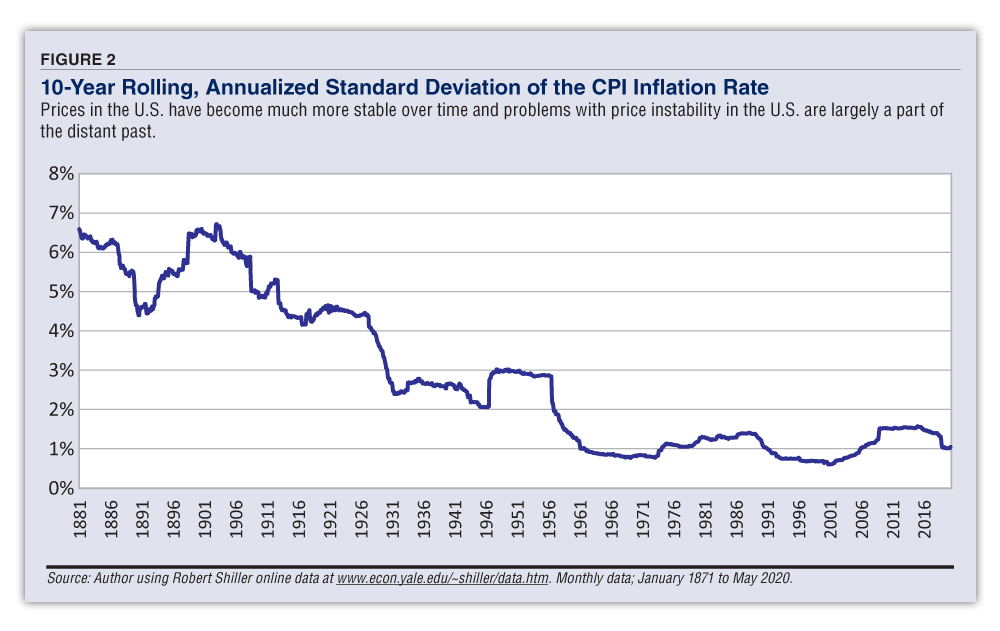
In Figure 2, the annualized standard deviation of the CPI inflation rate from the mid-1970s to the late 1980s seems to almost match that seen from 2008 to 2017. And the graph shows standard deviation hovering around 1% since 1961. Meanwhile, the article says, “The last major era of price instability was the Great Inflation.” It appears that major price instability ended in 1961, or we just went through another brief period from 2008 to 2017. Can you explain?
—John K. from Pennsylvania
Stephen E. Wilcox responds:
John, using the definition economists and central banks use that price stability refers to low rates of inflation or deflation, the Great Inflation of 1965 to 1982 was the last major episode of U.S. price instability. In Figure 2, standard deviation is a measure of the volatility of the CPI inflation rate. As you note, the 10-year rolling annualized standard deviation of the CPI inflation rate has been fairly low since 1961. However, standard deviation is a measure of dispersion—it tells you how spread out the data is. Essentially inflation trended up during that era, but the rate of change was relatively small and fairly consistent month to month.
Discussion
FREE REPORT

John Q from TX posted over 6 years ago:
ERIC S from MI posted over 6 years ago:
You need to log in as a registered AAII user before commenting.
Log InCreate an account