


Related

ETFs and Mutual Funds
The right fixed-income choice depends on when you need the money and which risks you are most willing to bear.

One of the roads to investment ruin is paved with attempts to forecast interest rates. Early in my career, I followed The Wall Street Journal’s surveys of professional economists and was struck by how frequently the consensus got not only the magnitude of subsequent rate movements wrong but even their direction. A prudent fixed-income strategy should not require investors to forecast interest rates more accurately than economists.
In early October 2026, the 10-year Treasury note yielded about 5.3%, its highest level since 2002, while money market funds such as Vanguard Federal Money Market fund (VMFXX) still paid around 3.8%. Should investors lock in longer-term rates now, or wait in the hope of further increases? This article offers a framework for making that decision.
The yield curve reflects the relationship between interest rates and maturity, or how long the money is lent. A steep yield curve—with long-term rates noticeably higher than short-term rates—often accompanies expectations of economic expansion (Figure 1). An inverted curve—with short-term rates above long-term rates—often signals expected rate cuts and a potential recession.
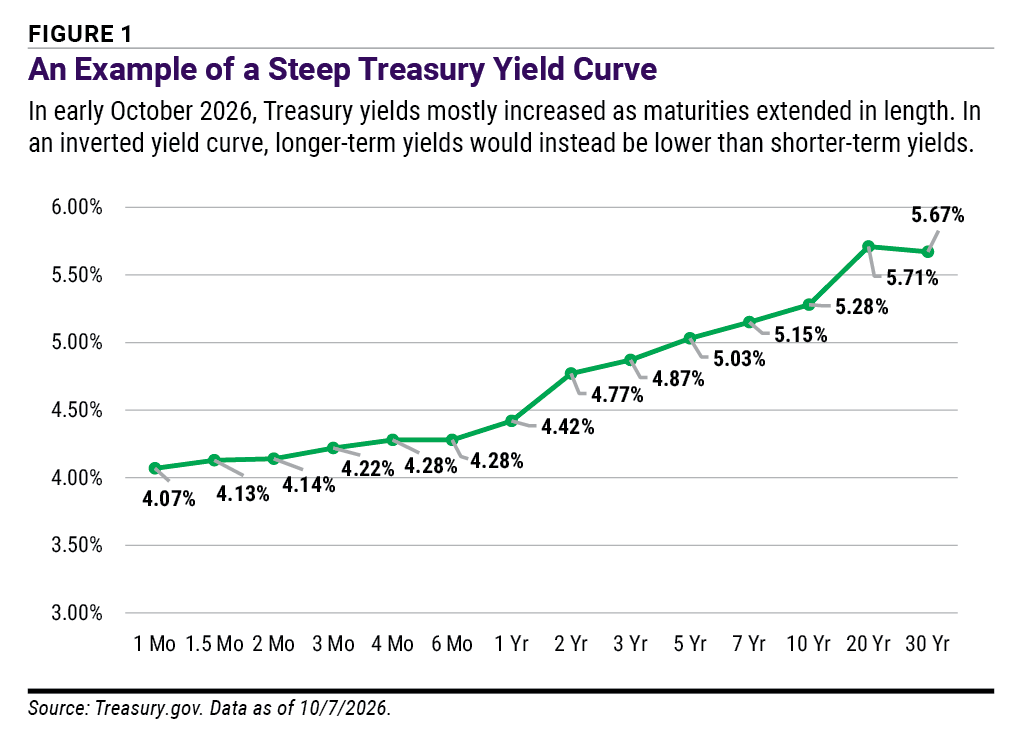
The Federal Reserve directly influences short-term interest rates through monetary policy, but longer-term Treasury yields are shaped by several factors. They include expected future short-term rates, inflation, economic growth, the term premium—that is, the additional return demanded for lending long term—and Treasury supply and demand. Consequently, long-term yields can move independently of Fed policy, or even in the opposite direction. For example, between September and December 2024, the Fed cut its policy rate by one percentage point, from 5.5% to 4.5%, yet the 10-year Treasury yield rose by almost the same amount.
This distinction matters because bonds with a long duration (high price sensitivity to interest rate moves) can be surprisingly volatile. In 2022, iShares 20+ Year Treasury Bond ETF  (TLT) lost more than 30% as long-term rates rose. As I warned in my May 2020 AAII Journal article, “The Risks of Investing in Bonds,” investors at the time were “more exposed to interest-rate risk than ever before.”
So how should an investor decide whether to stay in short-term instruments or lock in longer-term rates? It may be helpful to ask some questions.
Money market funds, Treasury bills and certificates of deposit (CDs) are often viewed as safe investments, because their values generally exhibit little volatility. However, stability of principal is not the same thing as certainty of future income.
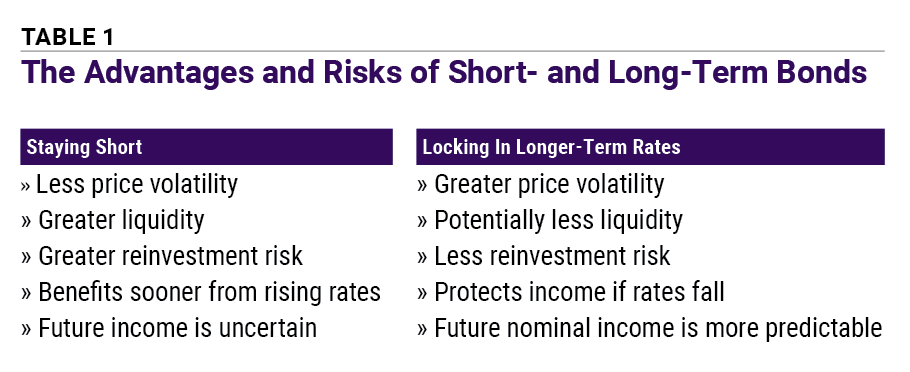
Suppose an investor has $100,000 that will not be needed for five years. Continually reinvesting in short-term Treasury bills preserves flexibility and minimizes price volatility, but it exposes the investor to reinvestment risk; if interest rates fall, today’s attractive income disappears.
Alternatively, purchasing a five-year Treasury note locks in the coupon (interest) payments and principal repayment, but it also introduces interest-rate risk, or duration risk. If yields rise, the bond’s market value falls. An investor who sells before maturity realizes the loss, while one who holds to maturity incurs an opportunity cost by continuing to receive below-market coupons.
Therefore, the choice is usually not between a “safe” investment and a “risky” investment. It is a choice between different risks (Table 1).
A simple, yet very useful, principle in fixed-income investing is that of liability matching: Match the investment to when the money will be needed.
Suppose you expect to make a $50,000 down payment on a house 18 months from now. You should not allow your expectations for next year’s Fed interest rate decisions to influence your choice, and you should avoid taking substantial duration risk with the money earmarked for a known expenditure. A Treasury security or CD maturing near the expected purchase date more closely matches the asset to the liability.
The same principle can be extended across several years using a bond or CD ladder. Instead of asking, “Where will interest rates be in 18 months?” ask, “When will I need my money?”
Suppose an investor has $100,000 in October 2026 that they will not need for three years. They can either buy a three-year Treasury yielding 4.90%, or buy a one-year Treasury yielding 4.45% followed by reinvestment for two additional years. Which is preferable?
At 4.90%, $100,000 compounded annually grows to approximately $115,432 after three years. The one-year Treasury produces $104,450 after the first year. To match the three-year investment, the proceeds must then earn a high enough reinvestment (interest) rate to grow to $115,432.
Under these simplified compounding assumptions, the breakeven reinvestment rate is approximately 5.13%. Because today’s yield curve already implies future rates near that level, staying short is effectively a bet that short-term interest rates will turn out higher than the market expects. When the curve is inverted, the opposite applies: Short-term rates need only remain above a breakeven rate that is below today’s short-term yield for the rolling strategy to outperform.
Staying in Treasury bills or a money market fund may feel like avoiding an interest-rate decision, but it is a decision.
Suppose an investor has $100,000 allocated to fixed income but is not confident about interest-rate forecasts. Rather than making a single interest-rate bet, the investor could construct a five-year bond ladder, investing $20,000 in each maturity from one to five years. As each bond matures, the proceeds can be reinvested in a new five-year security, continually extending the ladder. If interest rates rise, maturing bonds can be reinvested at higher yields; if rates fall, the remaining bonds will continue earning their original coupons.
The ladder will almost certainly appear suboptimal in hindsight. If rates rise dramatically, staying short would have been better; if rates collapse, investing everything in the five-year bond would have been better. However, the purpose of the ladder is to reduce the cost of being wrong.
Instead of constructing a ladder with arbitrary maturities, investors can tailor it to their future cash needs. Consider a retiree who expects to spend $25,000 on home improvements in 2027, followed by $30,000 annually in 2028 and 2029 for living expenses and travel. Instead of keeping all $85,000 in a money market fund, the investor could purchase Treasurys maturing near each spending date.
Treasury separate trading of registered interest and principal of securities (STRIPS) are zero-coupon bonds. They make no periodic interest payments, which eliminates coupon reinvestment risk and lets investors match future cash needs precisely. At a hypothetical 5% yield, approximately $25,915 invested for three years grows to $30,000.
Although they eliminate reinvestment risk, STRIPS have two disadvantages. First, accrued interest (capital appreciation) on STRIPS is taxable annually even though no cash is received until maturity, making them better suited to tax-advantaged accounts. Second, they are generally less liquid than conventional Treasurys, with wider bid/ask spreads.
Seeking to avoid reinvestment risk does not mean investors should automatically opt for the longest maturities available, thereby taking on more interest-rate risk. While investors generally expect additional yield for accepting greater interest-rate risk, yield does not tend to increase in proportion to price risk. As discussed in my April 2016 AAII Journal article, “Interest Rate Sensitivity and Bond Pricing,” modified duration estimates the percentage price change for a 1% change in yield.
Consider a $100 par value, semiannual 30-year bond with a 4% coupon, yielding 5%. Its price is $84.55. If its yield rises one percentage point, to 6%, its price falls $12.22, or about 14.5%. If its yield rises two percentage points, its price falls $21.96, or about 26.0%. Those are equity-like price movements from a bond whose promised cash flows have not changed.
How much additional yield are investors receiving for assuming that price risk? In early October 2026, the 30-year Treasury yielded approximately 5.6%, versus 5.0% for the five-year Treasury, a premium of just 0.6 percentage points. The 30-year Treasury had more than three times the price sensitivity, with a modified duration of 14.49 versus 4.35 for the five-year Treasury.
Investors should take on enough duration to manage reinvestment risk or match future liabilities, not automatically choose the longest maturity available. Additional yield rarely keeps pace with additional interest-rate risk.
Callable securities introduce another complication. Many CDs as well as agency, corporate and municipal bonds allow the issuer to redeem them before maturity, typically when prices rise because interest rates fall. When this happens, investors receive their principal back when reinvestment opportunities are less attractive. Conversely, when rates rise, the issuer generally leaves the security outstanding, locking investors into below-market coupons.
A callable five-year CD or corporate bond may therefore pay its stated yield for less than five years before being retired. Investors should examine not just the yield to maturity but also the yield to worst, which considers the lowest yield among the relevant call dates and maturity.
In addition to duration and reinvestment risk, investors should consider inflation risk. As I noted in my November 2022 AAII Journal article, “Tips About Treasury Inflation-Protected Securities,” a conventional Treasury locks in a nominal return while Treasury inflation-protected securities (TIPS) provide a real yield with principal adjusted for changes in the consumer price index (CPI).
An investor might assume that they should buy TIPS if inflation is expected to rise, and nominal bonds if it is expected to fall. However, because the market has already priced in inflation expectations, what matters is whether realized inflation turns out to be higher or lower than the market is anticipating.
Suppose an investor can choose between a five-year nominal Treasury yielding 5.00% and a five-year TIPS yielding 2.65%. The difference, 2.35 percentage points, is approximately the breakeven inflation rate. If inflation averages 1.5%, the nominal Treasury will outperform; if it averages 3.5%, TIPS will outperform. With inflation at approximately 2.35%, the two investments produce comparable returns, ignoring compounding, taxes and indexing lag.
Investors may favor TIPS if they expect inflation to exceed the market’s breakeven rate and nominal Treasurys if they expect inflation to fall below it. Investors primarily concerned with protecting future purchasing power may prefer TIPS regardless of their inflation forecast.
Note that TIPS protect against inflation, not against an increase in the real interest rates that reflect the underlying cost of money. TIPS will lose market value when real (inflation-adjusted) yields rise, as evidenced by the approximately 12% decline in the Bloomberg US Treasury Inflation-Linked Bond index in 2022.
Furthermore, the breakeven rate is not a pure inflation forecast: An inflation-risk premium in nominal yields pushes the breakeven rate higher, while the lower liquidity of TIPS pushes it lower. One advantage of TIPS is that they always return at least the original principal at maturity.
Investors seeking additional yield can move beyond Treasury securities into corporate bonds, high-yield bonds, asset-backed securities and other “spread products.” But this additional yield is compensation for assuming additional risks. One is credit risk—the risk that the issuer deteriorates financially or fails to make promised payments. Another is liquidity risk—the risk that the liquidity (market supply and demand) of corporate and structured securities will deteriorate precisely when an investor most wants to sell.
These risks are interrelated. When economic conditions deteriorate, such as during the Great Recession, Treasury yields may decline while credit spreads widen. An investor who correctly anticipates falling rates could still lose money on a corporate bond if an increase in credit spreads more than offsets the decline in Treasury yields.
Assuming no default or call, an investor holding an individual bond to maturity knows when principal will be repaid. By contrast, most bond exchange-traded funds (ETFs) and mutual funds have no maturity date, instead reinvesting proceeds to maintain a targeted maturity or duration exposure. The advantage of holding an individual bond to maturity is not that it avoids losses, but that it delivers promised cash flows on schedule, which is what matters when matching future liabilities.
While bond funds offer diversification, convenience and liquidity, they are unlikely to serve the same purpose as an individual bond purchased to meet a specific future liability. In addition, fund liquidity can become costly during market stress, when selling underlying securities prompted by redemptions may depress prices and impose costs on remaining shareholders.
Defined-maturity bond ETFs offer a compromise. They hold diversified portfolios of bonds scheduled to mature in a specified year, after which the proceeds are distributed, making them useful for constructing bond ladders.
When comparing yields, investors must consider taxes. As I remind my students: In general, “the Feds don’t tax the States, and the States don’t tax the Feds.” Treasury interest is subject to federal income tax but exempt from state and local taxes. Municipal bond interest is often exempt from federal taxes and may also be exempt from state and local taxes, depending on the issuer and investor’s domicile. Bank CD interest is generally taxable at all three levels.
TIPS introduce another complication: Inflation adjustments to principal are generally taxable annually in a taxable account, even though the cash is not received until maturity or sale. Like the zero-coupon STRIPS, they are therefore better suited to tax-advantaged accounts, while tax-exempt municipal bonds generally belong in taxable accounts. The relevant comparison is aftertax yield.
The right fixed-income choice depends on when you need the money and which risks you are most willing to bear.
The objective is not to eliminate risk, but to choose which risks to bear.
Breakeven inflation rate: The difference between a nominal Treasury’s yield and a comparable yield on Treasury inflation-protected securities (TIPS); approximately the inflation rate at which their returns would be equal.
Breakeven reinvestment rate: The rate at which short-term investments must be reinvested to match the return from locking in a longer-term yield.
Credit spread: The additional yield on a non-Treasury bond relative to a comparable Treasury, reflecting credit, liquidity and other risks. Bonds priced this way are often called spread products.
Duration (modified duration): A measure of a bond’s price sensitivity to interest rates; approximately the percentage price change for a one-percentage-point change in yield.
Liability matching: Selecting securities whose cash flows match anticipated expenditures.
Real yield: The return on a bond excluding compensation for inflation. Nominal yields incorporate both the real yield and an inflation premium.
Reinvestment risk: The risk that money from a bond’s principal or interest payments must be reinvested at lower yields.
Term premium: The additional compensation investors may require for holding longer-term bonds rather than rolling over short-term investments.
Treasury STRIPS: Zero-coupon securities purchased at a discount and redeemed at face value at maturity; STRIPS stands for separate trading of registered interest and principal of securities.
Yield to call: The yield an investor earns if a callable bond is redeemed before maturity on a specified call date.
Yield to worst: The lowest calculated yield among a callable bond’s relevant redemption scenarios.
ETFs and Mutual Funds



No comments have been added yet. Add your thoughts to the discussion!
You need to log in as a registered AAII user before commenting.
Log InCreate an account