


Value Investing
Comments on “Small-Cap Value Is the Best Choice for Equity Diversification,” by Paul Merriman, in the October 2023 AAII Journal:
Merriman gives many facts and figures, but he also clearly defines his biases: small-cap stocks outperform. His facts are compelling. On the other hand, there’s John Bogle’s perspective: It is hard for investors to “gut out the lean years.” I think diversification between large cap and small cap is the best course of action. And break out those “bets” into separate stocks, mutual funds (I personally don’t like them because of the large fees) or exchange-traded funds (ETFs).
—Robert R. from Texas
Wonderful article. But one criticism I have: the favorable mention of target-date funds. They are horrible and should be avoided like the plague—in any portfolio! I have yet to see a target-date fund that provides long-term returns anywhere near run-of-the-mill low-expense-ratio broad-index domestic equity ETFs.
—Robert A. from North Carolina
Following the Graham Screen
Comments on “Tweaking Benjamin Graham’s Enterprising Investor Screen,” by John Bajkowski, in the October 2023 AAII Journal:
I am looking for more info on the stocks passing the Graham Enterprising Investor Revised screen. The webpage only shows three stocks currently passing the criteria. Table 2 lists 25 passing stocks. I could not find access to an Excel version of Table 2 to do more analysis.
—Barry J. from Texas
AAII editors respond:
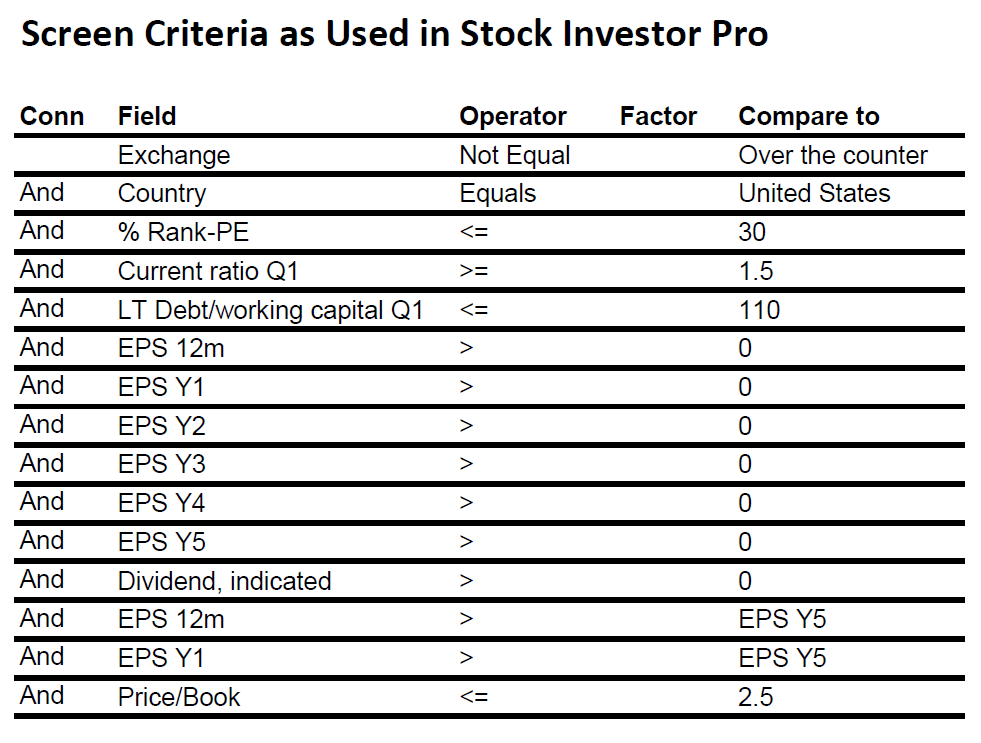
Barry, there is no screen online to match the adjusted filters used in this article. We added a link for downloading the Excel file of Table 2 below the table in the article. We also added the filters used in AAII’s Stock Investor Pro, for members who subscribe to our fundamental stock screening and research database.
High Market Price-Earnings Ratio
Comments on “S&P 500’s Price-Earnings Ratio at High End of 60-Year Range,” by Charles Rotblut, CFA, in Dispatches in the October 2023 AAII Journal:
While it is near axiomatic that high price-earnings (P/E) ratios reflect investors’ expectations of future earnings, I have to believe that the recent dramatic increase in cheap money (due to both monetary and fiscal policy actions in recent decades relative to historical policies) also pushes asset values to these extremes. That and the fact that most of the money in the stock market is really “rich people money” [half the population holds less than 1% of all stocks, while the (in)famous 1% owns over half] suggests to me that historical axioms need revisiting.
—Randall L. from California
The stock market discounts future earnings to arrive at a price. When the market begins to forecast earnings increases in the next three to 30 months, prices begin to rise. Comparing the higher market price (which is forward looking) to current earnings results in a higher price-earnings ratio than average. An elevated price-earnings ratio doesn’t provide any insight into the future. If earnings grow fast enough, the market could rise in the future while the price-earnings ratio declines.
—John L. from New Jersey
Popular Brokers
Comments on “How to Open a Brokerage Account,” by Anine Sus, in the October 2023 AAII Journal:
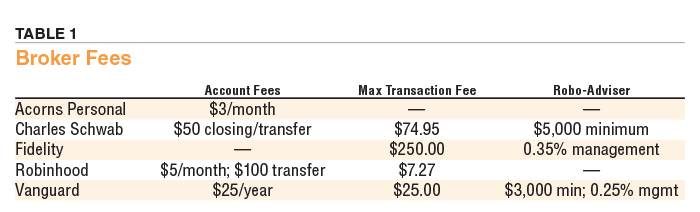
Very good article, but the max transaction fee column in Table 1 looks intimidating. I have not incurred any fees at Charles Schwab or Fidelity in years. I highly recommend either of those companies to a young person looking to open a brokerage account. At either, you can get a real person on the phone 24/7/365, and their websites are user-friendly. My advice to my children is to stay away from robo-advisers (or any that charge fees), and just put all their money into a low-expense-ratio (no more than 0.10%) domestic equity index ETF and leave it there for the next 30 years.
—Robert A. from North Carolina
My experiences verify everything Robert said about Schwab and Fidelity. I find both to be promptly accessible. Both provide recurring reports to help understand and follow market segments.
I also maintain accounts with several smaller online investment firms to have access to comparative data, and I find them more innovative with more flexible options.
—John L. from New Jersey
Investing With Factors
Comment on “Professional Investors Reaffirm the Relevance of Equity Factors,” by Grace Malone, in Dispatches in the October 2023 AAII Journal:
Factors are popular with professional investors. They provide the rationale behind the promise to beat the market. But like all well-known information, factors don’t provide an edge.
—John L. from New Jersey
Discussion
FREE REPORT

No comments have been added yet. Add your thoughts to the discussion!
You need to log in as a registered AAII user before commenting.
Log InCreate an account