

Navigating the Tax Consequences of Required Minimum Distributions
by Charles Rotblut | October 01, 2020
Retirees taking withdrawals from their portfolios may find themselves navigating taxes and Medicare premiums. Because of this, the traditional advice of draining tax-deferred accounts—like a traditional individual retirement account (IRA)—before taking withdrawals from a Roth IRA may not always be sensible.
The most obvious reason why is federal income taxes. From an investing standpoint, this applies to required minimum distributions (RMDs) from tax-deferred accounts, taxable bond interest, interest on cash savings, short-term capital gains and non-qualified dividends and distributions. Up to 85% of Social Security benefits can also be subject to one’s marginal tax rate. The Medicare Part B premium is based on one’s modified adjusted gross income (MAGI) from two years ago. Then there are separate tax rates for qualified dividends and long-term capital gains.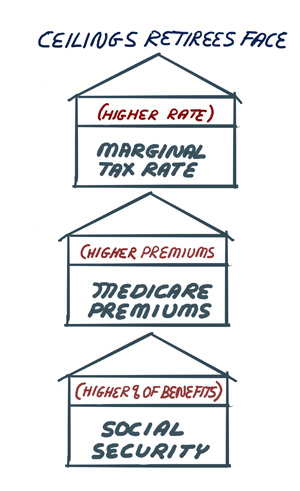
This mix of taxes adds to the complexity of taking withdrawals. Retirees can navigate them with a bit of understanding and a written plan of action. As part of the Individual Investor Wealth-Building Process (formerly code-named The AAII Way), we are going to help you think through the tax consequences.
We’ll start with tax-deferred accounts subject to RMD rules. These include traditional IRAs, SEP IRAs and 401(k) plan accounts, to name a few. RMDs are taxed at your marginal tax rate and count as income in terms of how much of your Social Security benefits are taxed for the same tax year and for determining what your Medicare Part B premiums will be two years from now. RMDs of up to $100,000 can be offset by making qualified charitable distributions (QCDs) from traditional IRAs and inherited IRAs. Under certain circumstances, QCDs can be made from SEP IRAs and SIMPLE IRAs as well. [RMDs are required from Roth 401(k) accounts but are generally not taxable.]
RMDs are waived for 2020. The starting age for taking RMDs is now 72; it was 70½ for those who reached that age before January 1, 2020. For discussion purposes, we’ll treat the RMD as no longer being waived as is currently expected to be the case in 2021.
The simplest way to avoid having to take RMDs beyond giving those dollars away through QCDs is to convert assets held in tax-deferred retirement accounts to a Roth account. Simplest should be not confused with cheapest. Roth IRA conversions are treated by the tax code as ordinary income in the year they occur. Depending on the amount converted, these conversions could push you into a higher marginal tax bracket. They can also increase the percentage of Social Security benefits taxed and how much you will pay in Medicare Part B premiums two years from now.
Those not deterred by a bit of math and complexity can navigate the tax maze. Limit withdrawals from taxable accounts to the RMD. If more is needed, only withdraw up to the top of your marginal tax rate. Any extra should be taken from your Roth IRA or taxable accounts. On the conversion side, estimate your adjusted gross income (AGI), your modified gross income and your taxable income for the current year. (All three will be influenced by any capital gains realized in taxable accounts as well as by taxable interest income.) The ceiling for the amount to convert will be the difference between your taxable income and the upper limit of your tax bracket.
This ceiling may be lowered if the conversion increases the percentage of Social Security benefits that are taxed from 50% to 85%. The breakpoints are $34,000 for single filers and $44,000 for joint filers. Likewise for Medicare, the ceiling would be the breakpoint above which your Part B premiums will increase two years from now. Current premiums will work as a good enough guide. Keep in mind the Social Security Administration uses combined income (AGI + nontaxable interest + half of your Social Security benefits) while Medicare uses modified adjusted gross income, which is AGI plus tax-exempt interest.
With these numbers in mind, you could create a plan to convert a portion of your IRA to a Roth IRA over a period of time. In doing so, consider if you will be able to postpone withdrawing the money for a period of five years and how your tax rate may change in the future. Roth IRA conversions make the most sense when you expect your current tax rate to be lower in the future than it is now. Estate planning considerations may also a play role, particularly if your heirs’ tax rates are expected to be higher than yours.
Roth IRA conversions aren’t for everyone. A conversion that bumps you into a higher tax bracket and leads to higher Medicare Part B premiums may not be as cost effective. If you are unable to cover the taxes on the conversion with non-IRA dollars, you may need to leave the converted amount invested for many years to compensate for the amount paid out. Those relying on RMDs for living expenses may not see as much benefit either unless their tax bracket is unusually low for a given year. Our Roth IRA conversion worksheet can help you to calculate some of the numbers involved with the decision.
Try out The AAII Way worksheets we’ve created so far and give us your feedback in the comments section for each. We want them to be useful to you.
1. Identifying and Prioritizing Your Financial Goals Worksheet
2. Our Revised Risk Tolerance Worksheet
3. A Worksheet for Determining How Your Portfolio Is Managed
4. Financial Account Inventory Worksheet
5. Investment Expense Tracking Worksheet

-
Social Security and Medicare Can Raise Retirees’ Tax Rates – Higher levels of income not only affect the taxation of Social Security benefits but can also lead to higher Medicare premiums.
-
Roth Versus Traditional IRA – This decision tree walks you through the key questions to answer when choosing whether to keep your retirement assets in a traditional IRA or convert to a Roth IRA.
The percentage of individual investors describing their six-month outlook for stocks as “neutral” is at a nine-week high. The latest AAII Sentiment Survey also shows an increase in optimism and a decline in pessimism.
Bullish sentiment, expectations that stock prices will rise over the next six months, rebounded 1.3 percentage points to 26.2%. Bullish sentiment remains below its historical average of 38.0% for the 30th consecutive week and the 35th week this year.
Neutral sentiment, expectations that stock prices will stay essentially unchanged over the next six months, rose 1.6 percentage points to 30.7%. This is the 36th time out of the past 38 weeks that neutral sentiment is below its historical average of 31.5%.
Bearish sentiment, expectations that stock prices will fall over the next six months, decreased by 2.9 percentage points to 43.1%. Bearish sentiment is above its historical average of 30.5% for the 32nd consecutive week and the 34th time this year.
Optimism is at an unusually low level (more than one standard deviation below its historical average) for the third time in four weeks. Pessimism is continuing its streak of unusually high readings.
The persisting high level of pessimism reflects concerns about the coronavirus pandemic, the economy and the upcoming election. September’s decline in the Nasdaq composite may have also played a role. Other factors influencing AAII members’ sentiment include the economy, valuations and interest rates.

Bullish: 26.2%, up 1.3 points
Neutral: 30.7%, up 1.6 points
Bearish: 43.1%, down 2.9 points
Bullish: 38.5%
Neutral: 31.0%
Bearish: 30.5%
AAII Asset Allocation Survey
According to the latest AAII Asset Allocation Survey, individual investors’ exposure to fixed-income assets reverted to back the 15-month low recorded in July. Equity exposure declined as well, while cash allocations rose.
Stock and stock fund allocations decreased by 1.2 percentage points to 63.6%. This marks the fourth consecutive month and the sixth month since the start of 2020 that stock and stock fund allocations are above their historical average of 61.0%.
Bond and bond fund allocations declined 1.0 percentage points to 17.9%. This is the 19th consecutive month and the 20th month since the start of 2019 that fixed-income exposure is above its historical average of 16.0%.
Cash allocations saw an increase of 2.2 percentage points to 18.5%. The last time cash allocations were at their historical average of 23.0% was in April 2020 (23.0%).
Equity allocations have stayed within a 2.6-percentage-point range over the past four months (62.2% to 64.8%). Over the same period, fixed-income allocations have fluctuated within a one-percentage-point range (17.9% to 18.9%).
Sentiment about the short-term direction of the stock market worsened with bullish sentiment being unusually low for much of September. At the same time, low interest rates continued to be a challenge for AAII members, many of whom are retired.
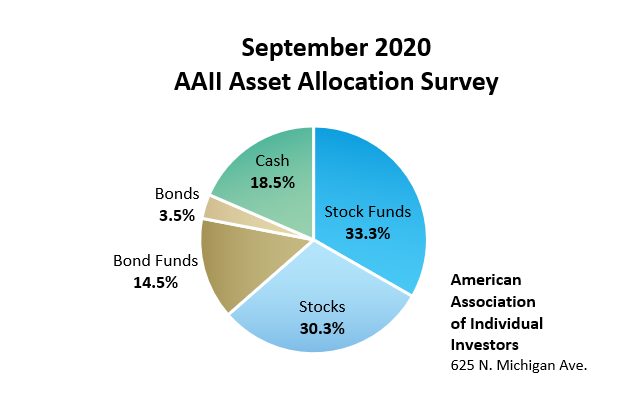
September AAII Asset Allocation results:
- Stocks and stock funds: 63.6%, down 1.2 percentage points
- Bonds and bond funds: 17.9%, down 1.0 percentage points
- Cash: 18.5%, up 2.2 percentage points
September AAII Asset Allocation details:
- Stocks: 30.3%, down 1.8 percentage points
- Stock funds: 33.3%, down 3.1 percentage points
- Bonds: 3.5, up 0.5 percentage points
- Bond funds: 14.5%, down 1.4 percentage points
Historical Averages:
- Stocks and stock funds: 61.0%
- Bonds and bond funds: 16.0%
- Cash: 23.0%
The numbers are rounded and may not add up to 100%.
The AAII Asset Allocation Survey has been conducted monthly since November 1987 and asks AAII members what percentage of their portfolios are allocated to stocks, stock funds, bonds, bond funds and cash. The survey and its results are available online at: www.aaii.com/investor-surveys.
- Stocks and Stock Funds: 63.6%, down 1.3 percentage points
- Bonds and Bond Funds: 17.9%, down 1.0 percentage points
- Cash: 18.5%, up 2.2 percentage points
- Stocks: 30.3%, up 1.8 percentage points
- Stocks Funds: 33.3%, down 3.1 percentage points
- Bonds: 3.5%, up 0.5 percentage points
- Bond Funds: 14.5%, down 1.4 percentage points
- Stocks/Stock Funds: 62.0%
- Bonds/Bond Funds: 16.0%
- Cash: 22.0%
Take the Asset Allocation Survey.
September 24, 2020 Two Retirement Withdrawal Strategies
September 17, 2020 Implementing Your Portfolio Strategy
September 10, 2020 Guidelines for Adding and Removing Stocks, Part 2
September 3, 2020 Guidelines for Adding and Removing Stocks, Part 1

Discussion
Frederic Corwin from FL posted over 6 years ago:
In "Navigating the Tax Consequences of Required Minimum Distributions", the discussion of determining a ceiling for Roth conversions references Medicaid. I believe that the correct reference is Medicare.
JimW from Utah posted over 6 years ago:
Since the RMD is suspended this year, I have been unable to find any guidance on the following. In years past, I have used the 'loophole' of using my RMD to pay income tax at the end of the year. This has allowed me to avoid the complexity of estimated quarterly tax payments. My question is since RMDs are not required this year, am I still able to use a distribution from my IRA to pay income tax and have it credited as uniform tax payments throughout the year?
Warren Walden from NC posted over 6 years ago:
To JimW, I would say the answer to your question is yes. The fact that it is not an RMD should not make any difference.
Kristoffer from VA posted over 6 years ago:
Second to last paragraph, third line: I believe the word 'lower' ought to be 'higher' instead.
BH from PA posted over 6 years ago:
Does the Roth conversion spreadsheet link work for anyone?
You need to log in as a registered AAII user before commenting.
Create an account