

For Portfolio Reviews, Look at Only What You Need To
by Charles Rotblut | October 22, 2020
I recently rewatched The Twilight Zone’s “What You Need.” The episode’s main character, Pedott, is a prescient peddler who gives people exactly what they need. The items he hands out include scissors, a leaky pen and—as some of you may remember—new shoes with leather soles.
We’re not going into the fifth dimension this week even though I’m a lifelong fan of The Twilight Zone. Rather, the aforementioned episode is apropos to how a behavioral scientist might determine what information you see when it comes time to review your portfolio. Namely, you would only be presented with the information you need at a particular time and nothing else.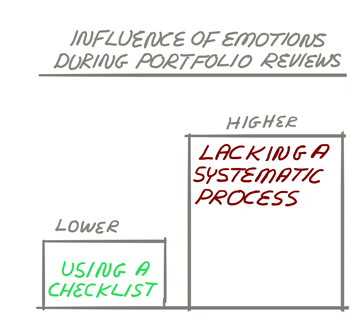
While useful tools giving us key information do exist, it’s difficult in the real world to avoid getting more than just what we need to. We’re constantly presented with a flow of numbers, insights and advice. Combined, these activate our cognitive biases and emotional reactions. This leads to a tendency of doing what feels right in the moment. What feels right in the moment isn’t always what is necessary to reach one’s long-term goals.
While Pedott does not exist, a simple solution does: a checklist. Checklists have been shown to work across a variety of fields: aviation, construction, finance and health care, to name a few. They help you focus on just what you need to know. They also remind you about what steps you should take so you don’t miss a key part of the review process.
We’ve added a checklist to our Individual Investor Wealth-Building Process toolkit this week. (The process was formerly code-named “The AAII Way.”) For stocks, bonds, mutual funds and exchange-traded funds (ETFs), we kept the checklist simple. AAII members are asked to state how frequently they will review each type of investment. When it’s time to do the review, two questions need to be answered: Are any investments meeting a sell rule and has there been a change in your strategy?
The portfolio review checklist assumes that sell rules have been created. If you need to establish sell rules, I’ll refer you to the commentaries about selecting funds and stocks I wrote a few weeks ago. You can find them in the Individual Investor Wealth-Building Process archives. Use your buy and sell rules every time you assess the attractiveness of an investment. Doing so will remind you about what you need to make a good decision.
The second part covers portfolio allocation. We ask you to consider whether your allocation is within an acceptable range and if anything has changed with your goals, tolerance for risk or preferences.
There isn’t anything about performance. This is intentional. We want you to focus on the process and not the results. You can control the decisions you make and the strategy you implement. You can’t control what Mr. Market does or how your investments perform. Furthermore, the more you notice volatility—either to the upside or the downside—the more you are likely to react to it. This is why focusing on just what you need to know helps you make better decisions. A checklist can help you do so.
Try out the Wealth-Building worksheets we’ve created so far and give us your feedback in the comments section for each. We want them to be useful to you.
1. Identifying and Prioritizing Your Financial Goals Worksheet
2. Our Revised Risk Tolerance Worksheet
3. A Worksheet for Determining How Your Portfolio Is Managed
4. Financial Account Inventory Worksheet
5. Investment Expense Tracking Worksheet
6. Portfolio Composition & Notes
7. Withdrawal Strategy Worksheet
8. Life Stage Changes Checklist
9. Key Estate Planning Information Worksheet
10. Portfolio Review Checklist New!

-
Nine Rules for Smarter Investing – Value investor Guy Spier lists having a checklist among the personal rules he shared in this 2015 AAII Journal article.
-
Common Mistakes Made When Investing in Quality Companies – Checklists can also help avoid errors, such as the ones discussed here.
Optimism among individual investors about the short-term direction of the stock market is at its highest level in nearly seven months. Pessimism declined while neutral sentiment rose.
Bullish sentiment, expectations that stock prices will rise over the next six months, rose 1.0 percentage points to 35.7%. Optimism was last higher on April 8, 2020 (36.6%). Nonetheless, bullish sentiment remains below its historical average of 38.0% for the 33rd consecutive week and the 38th week this year.
Neutral sentiment, expectations that stock prices will stay essentially unchanged over the next six months, rose 1.8 percentage points to 31.2%. This is a 12-week high. Even with the increase, neutral sentiment is below its historical average of 31.5% for the 39th time out of the past 41 weeks.
Bearish sentiment, expectations that stock prices will fall over the next six months, decreased by 2.7 percentage points to 33.0%. Pessimism was last lower on February 19, 2020 (28.7%). Bearish sentiment remains above its historical average of 30.5% for the 35th consecutive week and the 37th time this year.
All three indicators are currently within their typical ranges.
Optimism continues to be below average while pessimism continues to be above average. This differential reflects ongoing concerns about the coronavirus pandemic, the economy and the upcoming election. Other factors influencing AAII members’ sentiment include valuations and interest rates.
This week’s special question asked AAII members how the recent increase in coronavirus cases is impacting their outlook for stocks. Responses were mixed. About 28% of respondents say that the recent increase in coronavirus cases is causing them to be more cautious and is negatively affecting their outlook for stocks. This compares to 27% of respondents who say that the recent increase in coronavirus cases is having little to no impact on their outlook for stocks.
In addition, 15% of respondents say that market volatility will continue with the recent increase in coronavirus cases. About 12% of respondents say that they are more concerned with the election. Additionally, 7% of respondents note that they are waiting on the vaccine. Lastly, 11% of respondents fall into the ‘other’ category.
Here is a sampling of the responses:
- “It puts the economic recovery, already in big trouble, in jeopardy. The stock market can continue to pretend that the economy does not matter as long as the Federal Reserve prints money, but both economic theory and common sense say that this will not end well. I predict that this is not going to be a 2008 crash, but rather the painful, slow decline of 2000 potentially repeating itself.”
- “Without a vaccine, a rise in cases is not a surprise as we move deeper into fall. What else could have occurred? I think it’s a non-event for the markets.”
- “With or without the coronavirus, I believe the market is in for losses in the next six months.”
- “I am more cautious than in previous years, but I think the government will continue to pour in stimulus, thereby propping up the U.S. markets.”

Bullish: 35.7%, up 1.0 points
Neutral: 31.2%, up 1.8 points
Bearish: 33.0%, down 2.7 points
Bullish: 38.5%
Neutral: 31.0%
Bearish: 30.5%
October 15, 2020 Two Simple Ways to Avoid Estate Planning Problems
October 8, 2020 Upgrades to AAII.com Based on Member Feedback
October 1, 2020 Navigating the Tax Consequences of Required Minimum Distributions
September 24, 2020 Two Retirement Withdrawal Strategies

Discussion
David Bruck from California posted over 5 years ago:
I was grabbed by the small sampling of responses. These are things that we are thinking about, and I'm betting there are quite a few more interesting sentiments/theories expressed. I would LOVE it if AAII jumped in and commented on the theories. After using your investment advisory for a relatively short time, AAII has proved to me that you guys know your stuff.
You need to log in as a registered AAII user before commenting.
Create an account