

Chasing Super High Yields Can Burn Your Portfolio
by Charles Rotblut | July 18, 2024
The high-yield side of the bond market has been enjoying a good year. It has been such a good year that a very high-risk type of bond has made a reappearance: the pay-in-kind (PIK) toggle note. Be wary of its high yield as you would a siren song.
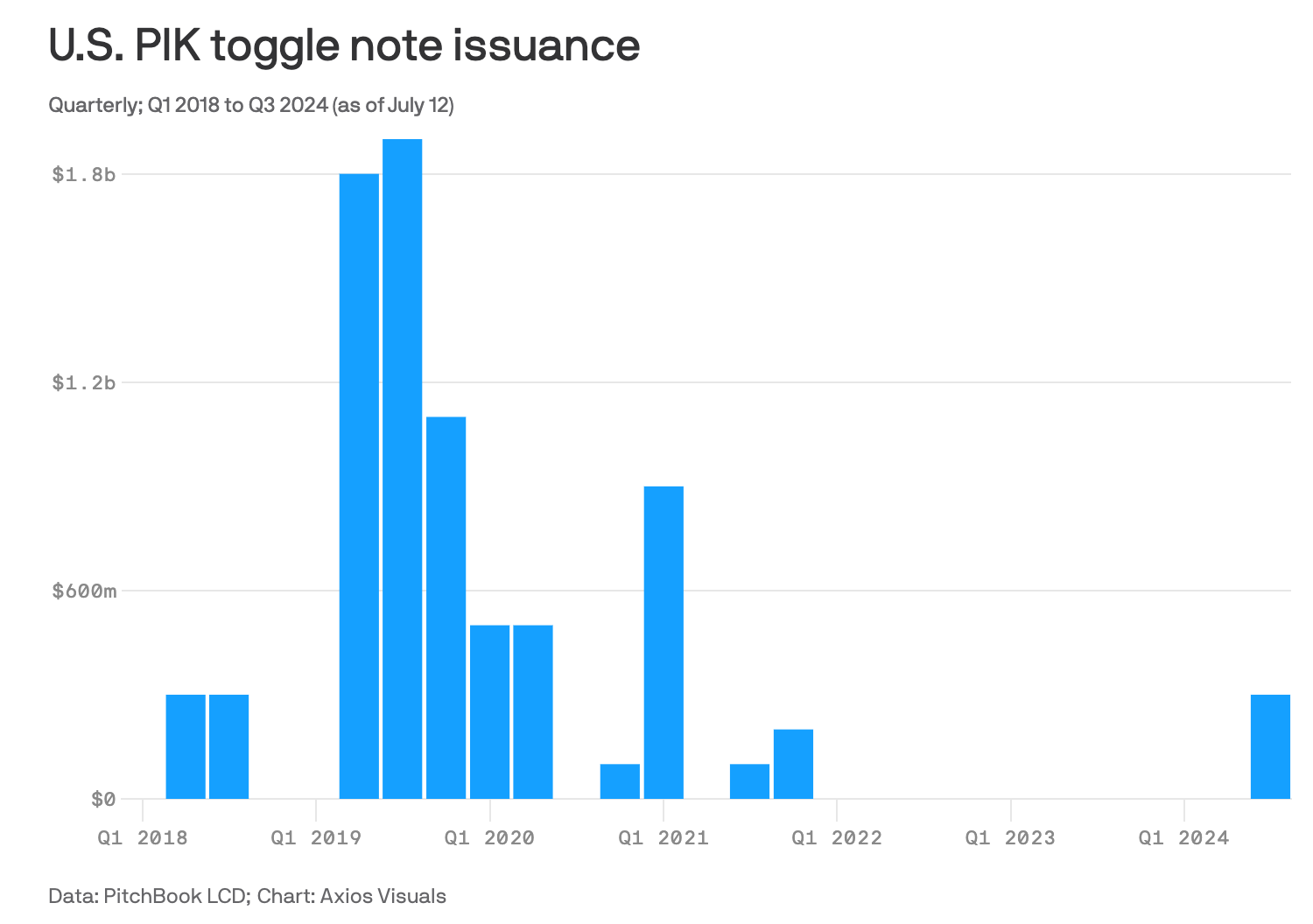 PIK notes give the bond issuer the right to issue additional securities instead of making cash interest payments. It is akin to a new homeowner increasing the size of their mortgage instead of making the monthly mortgage payment. PIK toggle notes allow the bond issuer to choose between making their interest (coupon) payments with cash or by issuing additional securities. The latter gives the borrower greater flexibility with each payment.
The latter is the arrangement the Calderys Group used. The thermal protection products manufacturer recently sold $300 million of four-year PIK toggle notes with a yield of 11.75%. If it chooses to issue bonds instead of making a cash payment, those additional notes would yield 12.50%. Calderys was the first company to complete a PIK toggle offering since 2021.
Why would a company issue notes at such a high yield? It couldn’t get adequate financing otherwise. Just like credit card companies charge higher interest rates to people with bad credit scores, bond traders demand high yields when they sense high levels of risk.
S&P assigned the notes a CCC+ grade. This poor quality rating is assigned when the bond issuer is perceived to be highly vulnerable to not making interest payments.
Bond traders seemed to agree with the S&P assessment. Axios says Calderys issued the PIK toggle notes at $0.98 on the dollar, resulting in a yield of 12.4%.
It’s not just high-yield bonds that are risky. High-yield stocks are risky too—especially those with the highest yields.
I screened for exchange-traded stocks with yields ranking in the highest 1% of all stocks. Our Stock Investor Pro database and stock screening program identified 82 such stocks. Their yields are 10.9% and higher. Half either aren’t profitable or have earnings per share so small that their payout ratios are essentially meaningless. The median Z-Score of these companies is 0.22; scores below 1.80 indicate that a firm is headed for financial distress.
These are not companies operating from a position of financial strength. Their yields are very high because investors fear what could happen to the dividend and the companies themselves. The short-term advantage of getting the juicy dividend could easily be wiped out by a drop in the share price or a bankruptcy filing.
In investing, chasing after very high yields is like playing with fire, you may get (badly) burned.

-
What Are Bond Ratings and Why Do They Change?
There are many factors considered in creating a bond rating, and the criteria will differ based upon the type of entity being rated. -
Guidelines for Selecting Bonds and Cash-Like Instruments
Key characteristics when analyzing bonds, choosing between bonds and bond funds and the role of laddering. -
A One-Page Plan for Maximizing Long-Term Wealth
The July AAII Journal illustrates how to adapt the PRISM Wealth-Building Process for the goal of simply accumulating wealth.
AAII Sentiment Survey
Neutral sentiment among individual investors about the short-term outlook for stocks decreased in the latest AAII Sentiment Survey. Meanwhile, both optimism and pessimism increased.
Bullish sentiment, expectations that stock prices will rise over the next six months, increased 3.6 percentage points to 52.7%. Bullish sentiment is unusually high for the second consecutive week and is above its historical average of 37.5% for the 36th time in 37 weeks. Bullish sentiment was last higher on December 21, 2023 (52.9%).
Neutral sentiment, expectations that stock prices will stay essentially unchanged over the next six months, decreased 5.3 percentage points to 23.8%. Neutral sentiment is below its historical average of 31.5% for the 11th time in 18 weeks and was last lower on October 12, 2023 (23.5%).
Bearish sentiment, expectations that stock prices will fall over the next six months, increased 1.7 percentage points to 23.4%. Bearish sentiment is below its historical average of 31.0% for the sixth consecutive week.
The bull-bear spread (bullish minus bearish sentiment) increased 1.8 percentage points to 29.3%. The bull-bear spread is above its historical average of 6.5% for the 11th consecutive week.
This week’s special question asked AAII members how they would describe the current valuation of stocks.
Here is how they responded:
- Stocks, in general, are overvalued: 36.0%
- Stocks, in general, are fairly valued: 15.1%
- Valuations are mixed, with some stocks expensive and others cheap: 43.9%
- Stocks, in general, are undervalued: 4.2%
- Not sure/no opinion: 0.4%
Bullish: 52.7%, up 3.6 points
Neutral: 23.8%, down 5.3 points
Bearish: 23.4%, up 1.7 points
Bullish: 37.5%
Neutral: 31.5%
Bearish: 31.0%
See more Sentiment Survey results.

July 11, 2024 Balancing Longevity Risk With Late-in-Life Care Expenses
June 27, 2024 Seven Steps for Picking the Right Fund
June 20, 2024 June Charts of Interest: High Concentration Is Covering Market Undercurrents
June 13, 2024 What Two Bond Market Indicators Are Telling Investors at Midyear

Discussion
Barry J from TX posted over 2 years ago:
Charles, thanks for the warning about PIKs. I am considering adding a codicil to my will that says: “If I ever buy a PIK, I direct my Executor to buy a shovel, hit me over the head with it, bury me now, and list the Cause of Death as “Too stupid to live.”
You need to log in as a registered AAII user before commenting.
Create an account