

I Rebalanced for the First Time Since 2021
by Charles Rotblut | November 13, 2025
Featured Tickers: MSFT
NVDA
VFIAX
VFIDX
VFSAX
VGSLX
VSIAX
VTIAX
MSFT
NVDA
VFIAX
VFIDX
VFSAX
VGSLX
VSIAX
VTIAX
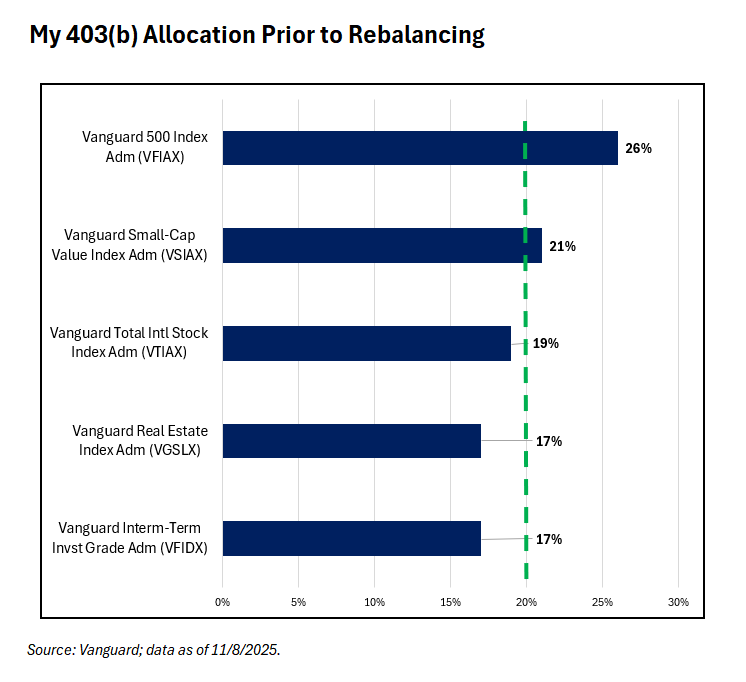
For the first time in over four years, I rebalanced my 403(b) retirement account. My allocation to the Vanguard 500 Index Admiral fund  (VFIAX) surpassed the upper limit of 25% that I had set for its portfolio weight.
Often, when a periodic rebalancing alert is triggered, something beyond just momentum in the financial markets has occurred to cause an asset class to exceed its allocation boundaries. That is the case now.
The S&P 500 index has been enjoying a good run since the 2022 bear market. The large-cap index has realized a cumulative 84.6% return over the past three years (through the end of October), according to S&P Dow Jones Indices.
Driving the S&P 500’s returns are its largest constituents. Nvidia Corp. (NVDA) alone is responsible for 19.8% of the S&P 500’s year-to-date returns through October 31, according to S&P Dow Jones Indices. Microsoft Corp. (MSFT) is in second place, accounting for 10.1% of the index’s returns. We can credit excitement over artificial intelligence (AI) for these two companies accounting for 30% of the S&P 500’s returns this year.
Could the S&P 500 rally further? The six-month period of November through April has historically been very favorable for stocks. Corporate earnings are growing. The Federal Reserve remains in an accommodative stance, even if we don’t know whether interest rates will be cut in December. On the other hand, the S&P 500 is trading at a high valuation. OpenAI (ChatGPT), Anthropic (Claude) and other AI providers are a long way from being profitable. Plus, the second year of a U.S. president’s term has often been tough for stocks.
Rather than trying to guess where the market will go, it’s better to focus on maintaining your desired allocation. Rebalancing does this. It brings allocations that are too far off target back to their target range. Rebalancing can be applied to any allocation covering two or more assets.
The target allocation for my 403(b) account is 20% in each of the following mutual funds:
- Vanguard 500 Index Admiral
-
Vanguard Small-Cap Value Index Admiral fund (VSIAX)
-
Vanguard Total International Stock Index Fund Admiral Shares (VTIAX)
-
Vanguard Real Estate Index Admiral fund (VGSLX)
-
Vanguard Intermediate-Term Investment-Grade Admiral fund (VFIDX)
I based this allocation on the long-term returns for the various assets, correlations between them and my behavioral tendencies. Both small-cap value and real estate investment trusts (REITs) have outperformed large-cap stocks over the long term. (The correlation between REITs and the S&P 500 is higher than it used to be, though.) International stocks have experienced several multiyear periods of outperformance relative to the S&P 500. The bond fund provides me with the opportunity to react to bear markets by shifting dollars into stocks when their prices have significantly fallen.
This is an allocation I am personally comfortable sticking with regardless of what the market is doing.
Your allocation may differ, and that’s okay. Allocation is a personal decision. However, if your allocation does matter to you, and it should, then taking steps to maintain it is important. Rebalancing is a tool you can use to do so.

-
Rebalancing to Navigate Bear Markets and Sequence Risk
Periodically adjusting allocations back to intended targets lessens the magnitude of swings in a portfolio’s returns. -
Go Beyond Age-Based Allocation Strategies by Personalizing Your Approach
AAII’s PRISM Wealth-Building Process helps you think through the considerations for creating the optimal allocation for you. -
Investing for Life on the Smoother Path
The power of using a 50/50 combination of a target-date fund and U.S. small-cap value over 40 years of saving for retirement is explored in the November 2025 AAII Journal.
AAII Sentiment Survey
Pessimism among individual investors about the short-term outlook for stocks increased in the latest AAII Sentiment Survey. Meanwhile, optimism and neutral sentiment decreased.
Bullish sentiment, expectations that stock prices will rise over the next six months, decreased 6.4 percentage points to 31.6%. Bullish sentiment is below its historical average of 37.5% for the third time in five weeks.
Neutral sentiment, expectations that stock prices will stay essentially unchanged over the next six months, decreased 6.5 percentage points to 19.2%. Neutral sentiment is unusually low and is below its historical average of 31.5% for the 69th time in 71 weeks.
Bearish sentiment, expectations that stock prices will fall over the next six months, increased 12.9 percentage points to 49.1%. Bearish sentiment is unusually high and is above its historical average of 31.0% for the 50th time in 52 weeks.
The bull-bear spread (bullish minus bearish sentiment) decreased 19.2 percentage points to –17.5%. The bull-bear spread is unusually low and is below its historical average of 6.5% for the 37th time in 41 weeks.
This week’s special question asked AAII members what impact they think the government shutdown is having on the economy.
Here is how they responded:
- It’s slowing the economy: 55.8%
- The impact is limited: 19.5%
- It’s not having much of an impact yet, but that could change: 18.7%
- It’s not impacting the economy: 3.6%
- Not sure/no opinion: 2.4%
Bullish: 31.6%, down 6.4 points
Neutral: 19.2%, down 6.5 points
Bearish: 49.1%, up 12.9 points
Bullish: 37.5%
Neutral: 31.5%
Bearish: 31.0%
See more Sentiment Survey results.

November 6, 2025 Single-Stock ETFs Underperform the Stocks They Track
October 30, 2025 Shut Up, Brain: Why Investing Is a Marathon, Not a Sprint
October 23, 2025 October Charts of Interest: Happy Birthday, Bull Market!
October 16, 2025 Gold Soars, but the Reason Isn't Clear

Discussion
Tom Fratello from CA posted 11 months ago:
The bar chart shows VTIAX but your stated target allocation has VFSAX and not VTIAX. Can you confirm which fund is actually in your target allocation? Perhaps you changed your allocation from VTIAX to VFSAX?
Rob from NC posted 11 months ago:
What a silly, wasteful exercise. You're dumping part of a solid fund that has been performing well to buy more of a crappy bond fund that provides anemic returns. If that crappy bond fund was going to outperform the good fund over the next 4 years, you wouldn't need to rebalance, because their performance would even out. But what will likely happen is that the bond fund will continue to drag down the portfolio's returns, so next time you'll have to sell even more of the good fund to buy more of the crappy fund so you can continue to achieve an overall mediocre return. That's like running a marathon with ankle weights. (Just my humble opinion.)
BRUCE from MO posted 11 months ago:
Your comments on the second presidential term I think applies for consecutive terms. I’m not sure that’s correct for split terms. Although there isn’t much history to be sure.
Charles Rotblut from Illinois posted 11 months ago:
Tom - The bullet points should have said: Vanguard Total International Stock Index Fund Admiral Shares (VTIAX). I replaced the small-cap foreign fund with a larger-cap foreign fund last year, but unintentionally listed the former holding in the bullet points. It's being corrected.
Rob - The next time there is a bear market, I'll sleep better having the ability to do something productive by rebalancing back into stocks. As I mentioned above, allocation is personal.
Bruce, it happens across four-year presidential cycles. As you point out, there is essentially no history regarding split terms. I wouldn't put any weight into what the financial markets did during Grover Cleveland's second term.
Barry from TX posted 11 months ago:
As Margaret Thatcher would ask, Charles, have you gone “all wobbly” on rebalancing? #1 All these years, I have believed (based on the research I have read, most recently the “CFA “Factor Investing and Asset Allocation, A Business Cycle Perspective”) that since Markowitz’s original MPT portfolio in 1959 (that generated CAPM 1964 and factor anomalies1976-2005) that portfolios are DIVERISFIED - i.e., “balanced” -- using KNOWN (as in calculated or research from a reliable source) for the KNOWN and verified correlations between several "factors." Factor #1 Total market beta (Note: beta by itself may be accumulated index tracking errors in VFIAX et al that could account for ALL 100% of the variances you have experienced as shown in the chart). Factor #2 between all major asset classes - the reason you "DIVERSIFIED" originally. Factor #3 Covariances between all asset classes in the whole portfolio, not "human psychological covariances." #2 I thought diversification and rebalancing were bedrock PRISM catechisms taught as disciplined skills to be revered to manage “risk." #3 Previous articles on the fervor of your passion to “rebalance” annually convinced me to learn how to do rebalancing using MVO. I use reliable tables from reliable sources (see above). New subject: #4 It appears you fault NVDA and MSFT valuations for your need to rebalance. This is market beta at work. #5 I see your point, but I would argue that it was NOT the 5 ETF asset classes in your portfolio per se, it was the stampede of investor sentiment who were experiencing “FOMO (as documented in your monthly "Charts of Interest" articles). #6 Rebalancing will not address that problem. The “FOMOs” will still be there ready to pounce on the next “hot stock” … OR … the “Great Market Rebalancing” that is sure to occur when the flurry of “Whimpey burger” buy and sell/swap agreements (“I will gladly pay you Tuesday for a Hamburger today.”) among the AI leaders like NVDA and MSFT ... and their future “unindicted coconspirators”) including … “OpenAI (ChatGPT), Anthropic (Claude) and other AI providers are a long way from being profitable” … as you point out in this article. #6 A 20% market downturn does not count as “systematic” rebalancing. Regards.
You need to log in as a registered AAII user before commenting.
Create an account