

Continue to Hold I Bonds or Sell Them?
by Charles Rotblut | May 11, 2023
If you are among the many who bought Series I bonds last year, like me, when they were yielding 9.62%, you are now (or will soon be) facing the decision of what to do next. You may well be looking at your holdings and asking the question popularized by The Clash: “Should I stay or should I go?”
There isn’t a clear answer, but there are some considerations I can share to help you determine the best move for you.
Let’s start with the yield. The interest paid on I bonds is based on a composite rate. The composite rate for I bonds issued between now through the end of October 2023 is 4.30%. It consists of a fixed rate of 0.90% and a semiannual inflation rate of 1.69%. The composite rate is calculated as [fixed rate + (2 × semiannual inflation rate) + (fixed rate × semiannual inflation rate)].
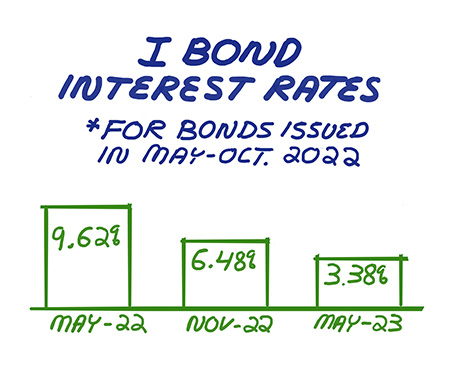 I bonds bought between May and October 2022 had a 0% fixed rate, so their current composite rate is 3.38%, not 4.30%. With online savings accounts and certificates of deposit (CDs) yielding more (e.g., Discover is offering AAII members 3.80% on savings and 4.55% on a 12-month CD), the current I bonds interest rate may not seem so enticing at first glance. But it’s not an apples-to-apples comparison.
Interest on Treasury bonds, including I bonds, is taxed at the federal level but not the state level. This boosts the tax-equivalent yield for I bonds. Illinois, for instance, levies a 4.95% income tax. The tax-equivalent yield for my fellow Illinois residents is 3.56% on I bonds bought one year ago [3.38% ÷ (1 – 4.95%)].
Furthermore, the interest on I bonds can be deferred for as long as you hold the bonds.
Not reflected in those yields is the penalty for selling I bonds held less than five years. If you redeem one within the first five years, you’ll lose the previous three months of interest. So, if you redeem an I bond purchased last May now, you’ll forfeit three months of interest that was paid at a 6.48% composite rate.
If you intend to sell the I bonds within five years of purchase, then you will have to decide which three months of interest you are willing to forfeit. I view this as the choice between what interest you will receive by continuing to hold I bonds and what you will gain from redeeming them and putting the proceeds into something else. The goal in such a situation is to make sure the interest rate (or return) of what you are switching to is high enough to warrant the change. The realization of taxes on I bonds may play a role in the decision—particularly for those who expect to be near a threshold for higher tax rates or higher Medicare premiums.
Treasury bills and notes are certainly competitive at current levels. Yields on the one-, three-, four- and six-month bills were all above 5% as of yesterday. One-year notes are yielding a juicy 4.70%. These yields are even juicier once adjusted for state tax exemptions.
There is no penalty for selling “traditional” Treasury bills, notes and bonds at any point prior to maturity. (The price you sell them at may be higher or lower than what you bought them at, however.) Unlike I bonds, there is no semiannual inflation adjustment for these Treasury securities, but their yields will vary on the open market.
The ongoing standoff over raising the debt ceiling is obviously making headlines. It seems likely that we will see more drama and further political posturing until the standoff is resolved. It could open up opportunities for someone who wants to be tactical and take advantage of the short-term volatility at the shorter end of the Treasury yield curve just as they did last year with I bonds. Doing so would be a personal decision to rotate from I bonds to a Treasury security.
The U.S. government has never defaulted, and failure to make interest payments on Treasury securities would have grave economic and financial market consequences.
Finally, consider how much you have in I bonds relative to your portfolios. The minimum purchase amount is $25. The maximum limits are $10,000 per year and up to $5,000 in paper I bonds by applying your federal income tax refund. There are ways to exceed this amount (e.g., have a spouse open a second account, use a trust to open another account, etc.), but the majority of you reading this likely have a small amount in I bonds relative to your total wealth. Therefore, it’s also worthwhile considering how much time and effort you want to put into the decision about whether to stay or go.
As for me, I’m currently in the “hold” camp since I bought my I bonds in May 2022 and do not want to forfeit the last three months of higher interest payments. That may or may not be the best decision for you.

-
Why I Bonds Have Appeal When Inflation Is Rising
Back in June 2022 when Series I savings bonds were a more compelling option, Charles Meyer explained their intricacies. -
Guidelines for Selecting Bonds and Cash-Like Instruments
Key characteristics when analyzing bonds, choosing between bonds and bond funds and the role of laddering. -
Charles Kirkpatrick’s Approach to Beating the Market With Relative Rankings
A market technician, Kirkpatrick developed mechanical processes for finding outperforming stocks and overcoming emotional decision-making. -
Using Volume and Conviction in Trend Analysis
When used properly, conviction can assist in evaluating a price move’s relevancy, trend strength and probable direction. -
I watched this so you don’t have to! Netflix’s How to Get Rich
In her latest My Investing Discoveries blog post, Anine Sus reveals the core guidance from Ramit Sethi’s series devoted to helping individuals tackle their personal finance challenges.
Members are looking for your input. Can you help with this question from the Mutual Funds & ETFs Community?
“A recent AAII Journal article reporting on the top mutual funds and exchange-traded funds (ETFs) for the first quarter of 2023 highlighted the outperformance of both growth and technology funds due to the recent market volatility and shifts in policy expectations. Did these factors impact your outlook for growth or technology? Did you make any changes to your portfolio as a result?”
Tap the button and then choose the Join the Community button on the right to answer this question in the AAII Community
Answer This Question in the AAII Community »
AAII Sentiment Survey
Pessimism among individual investors stayed above average for the 12th consecutive week in the latest AAII Sentiment Survey. Neutral sentiment decreased, while bullish sentiment increased.
Bullish sentiment, expectations that stock prices will rise over the next six months, increased 5.3 percentage points to 29.4%. Optimism continues to be at a low level but is no longer unusually low. Bullish sentiment is still below its historical average of 37.5% for the 75th time in the past 77 weeks.
Neutral sentiment, expectations that stock prices will stay essentially unchanged over the next six months, decreased 1.6 percentage points to 29.4%. This keeps neutral sentiment below its historical average of 31.5% for just the third time in 19 weeks.
Bearish sentiment, expectations that stock prices will fall over the next six months, fell 3.7 percentage points to 41.2%. Pessimism remains above its historical average of 31.0% for the 72nd time out of the past 77 weeks. Bearish sentiment is also unusually high for the second consecutive week.
The bull-bear spread (bullish minus bearish sentiment) improved to –11.8% but remains unusually low for the third consecutive week.
This week’s special question asked AAII members what the Federal Reserve should do about interest rates at its next meeting in June. Here are the responses:
- Continue to raise interest rates: 17.9%
- Keep interest rates unchanged: 64.1%
- Lower interest rates: 5.6%
- Not sure/no opinion: 12.4%
Bullish: 29.4%, up 5.3 points
Neutral: 29.4%, down 1.6 points
Bearish: 41.2%, down 3.7 points
Bullish: 37.5%
Neutral: 31.5%
Bearish: 31.0%
See more Sentiment Survey results.

May 4, 2023 Setting Aside Self-Doubt When It Comes to Allocation
April 27, 2023 A Growth Stock or Not? Plus, Other Notes From the Morningstar Investment Conference
April 20, 2023 April Charts of Interest: Don't Jinx It
April 13, 2023 Warning Signs That Companies Are in Big Trouble

Discussion
David from CA posted over 3 years ago:
I just found out the hard way something negative about I-bonds. I talked my father into buying some 20 years ago and I ended up inheriting them last year. It would have been much better off just to by stocks because stocks get a stepped up basis on death. After much research as well as many hours trying to get through to the IRS, there is no stepped up basis on inherited I-bonds. I had to pay the full tax on 20 years of interest. Since I was not prepared and didn't withhold extra, I ended up needing to pay penalties for under-withholding as well!
Dennis from Maryland posted over 3 years ago:
I-Bonds reach final maturity after holding them 30 years. Your inherited bonds were only 20 years old. Why did you cash them all at once rather than gradually over the remaining 10 years of their life? That would have allowed you to minimize the tax impact and possibly avoid paying any penalties. Also, those 20-year-old I-Bonds might have been paying higher interest rates than those issued now. See https://www.treasurydirect.gov/files/savings-bonds/i-bond-rate-chart.pdf to determine how much those bonds might be earning if you hadn't cashed them in.
Barry from TX posted over 3 years ago:
Charles, nice update. Very timely. The punch bowl is gone. The music is ending. The chairs are few. The party is over. Soon, someone will turn out the lights. We know why. Any ideas on who or when?
Steve from CA posted over 3 years ago:
In your statement “Furthermore, the interest on I-bonds can be deferred for as long as you hold the bonds.” didn’t you mean that the “taxes” could be deferred?
DI from NV posted over 3 years ago:
AAII, Please confirm, or refute, David from CA, comment re NO stepped up basis on I-bonds. I have not seen this discussed any where. Thank you.
Charles Rotblut from Illinois posted over 3 years ago:
Steve - The interest paid on I bonds accumulates but is not considered paid from a tax perspective until the bonds are cashed in unless you opt for annual distributions.
DI - My understanding is that since I bonds maintain their value, there is no capital gains to step up or capital losses to claim. Profits from I bonds come from the interest paid on them. A traditional Treasury bond, conversely, can trade above or below the price paid.
-Charles
John L from NJ posted over 3 years ago:
Oh my, the problem of speculating without a planned exit point. Now the speculator becomes a long term investor.
You need to log in as a registered AAII user before commenting.
Create an account