

The SECURE Acts Make Roth IRAs More Attractive
by Charles Rotblut | July 13, 2023
The passage of the Setting Every Community Up for Retirement Enhancement (SECURE) Act of 2019 and the SECURE 2.0 Act of 2022 has made Roth individual retirement accounts (IRAs)—and other Roth retirement accounts—more attractive for many investors.
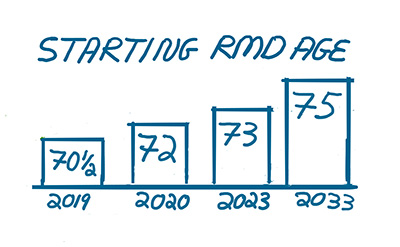
Let’s start with investors who have yet to reach the required beginning date (RBD) for taking required minimum distributions (RMDs). Effective this year, the starting age for taking RMDs is now 73. It was 72 last year and 70½ prior to 2020. The RBD will rise to age 75 in 2033.
 Those who retire before age 73 (or 75) may experience a period before reaching their RBD when their tax rates will be much lower than they were in their working years. This creates a window where dollars held in tax-deferred accounts like a traditional IRA or 401(k) can be rolled over into a Roth account at reduced tax rates. The advantage to doing so will be to avoid the potential triple whammy of having RMDs increase your marginal tax rate, your Medicare premiums and the amount of Social Security benefits that are taxable.
Wade Pfau explains such a strategy in the July 2023 issue of the AAII Journal.
Though it was possible to take advantage of this reduced tax rate window prior to the passage of the original SECURE Act of 2019, the window of time for doing so is now wider. The longer time frame allows you to convert even more dollars to a Roth IRA. The calculation includes figuring out what your tax rate will be once your RMDs start (including state taxes, which may or may not apply to RMDs) and your ability to pay the taxes on the conversion. The goal is to save enough on combined future taxes and Medicare premiums to justify incurring the tax hit now.
Those intending to leave sizable inheritances should consider the likely tax rate of their heirs.
Inheriting a sizable IRA could lead to years when the marginal tax rate of your heir(s) is increased. This isn’t the case with inherited Roth IRAs, where the distributions aren’t taxable. The simplistic comparison is your marginal tax rate plus any additional Medicare premiums you will pay (assuming 85% of your Social Security benefits are already taxed) versus the expected tax rate of your heir(s). If your tax rate is lower, it may make sense to do the conversions while you are able to.
The rules regarding inherited IRAs should be taken into consideration before making this decision. (Other estate planning issues may also play a role, making speaking to an estate planning professional a prudent step for some.)
The SECURE Act requires withdrawals from inherited IRAs to be taken over a 10-year period. The starting date can be delayed if the heir is a minor child (but not a grandchild) up to majority age, or if still in school up to age 26. Disabled individuals [as recognized by the Internal Revenue Service (IRS)], chronically ill individuals and individuals not more than 10 years younger than the IRA owner are also exempt from the 10-year rule. Once an heir no longer qualifies as an eligible designated beneficiary, they are subject to the 10-year rule.
Surviving spouses can make their deceased spouse’s IRA their own, thereby avoiding the 10-year rule. Inheriting a tax-deferred account will increase their future RMDs and thereby future taxes and Medicare premiums.
The new surviving spouse designation, which goes into effect next year, is also a consideration. It allows the surviving spouse to be treated as if they are the employee and they do not need to take distributions from the deceased spouse’s plan account [e.g., a 401(k)] until the employee would have reached their RBD for taking withdrawals.
This rule does not appear to apply to Roth 401(k)s and Roth 403(b)s as RMDs will no longer be required to be taken by the account owner starting in 2024.
One other way Roth IRAs are now more attractive involves education savings. The SECURE 2.0 Act allows balances of up to $35,000 in a 529 college savings plan to be converted to a Roth IRA. This allows dollars saved for but not spent on educational expenses to be turned into retirement savings. These savings can continue to grow tax free, and withdrawals can eventually also be taken on a tax-free basis.
To qualify, the 529 plan must have been funded for at least 15 years ending on the date of distribution, the amount must not “exceed the aggregate amount contributed to the program (and earnings attributable thereto) before the five-year ending on the date of the distribution” and the rollover must be made via a “direct trustee-to-trustee transfer to a Roth IRA maintained for the benefit of such designated beneficiary.”
Are there cases when a traditional IRA, 401(k) or other retirement account funded with pretax dollars still makes sense? Yes. It doesn’t make sense to do a Roth IRA conversion when you are in a high tax bracket and expect to be in a lower tax bracket in the future. If you don’t expect your tax rate to change significantly in retirement, then the advantages of doing a Roth conversion diminish (though it is still worth working through the numbers). A third case is if you need to withdraw additional dollars from your tax-deferred retirement accounts beyond the amount to be converted to cover the extra taxes. Finally, a conversion that pushes you above marginal tax rate, credit and/or deduction thresholds in the current year or Medicare premium thresholds two years in the future may not make financial sense.

-
Four Tax Strategies for Retirees
Strategic tax planning alongside delayed Social Security claiming can increase portfolio longevity and legacy in retirement. -
Changes Made to Retirement Savings by SECURE 2.0 Act
The rules in plain-English plus post-passage observations can help you make changes for the current and future tax years. -
Update Your Estate Plan for Your IRAs
Most non-spouse beneficiaries of retirement accounts are subject to the SECURE Act’s 10-year withdrawal rule, but not all. -
Inherited IRA Rules Before and After the SECURE Act
The ability to stretch distributions over a beneficiary’s lifetime now depends on the date of death and the beneficiary’s category type. -
Reasons That Investors Part Ways With Their Financial Adviser
There are several common, but multi-dimensional, reasons that advisers are terminated by their clients according to research by Morningstar.
Members are looking for your input. Can you help with this question from the Retirement Withdrawals Community?
“How will the SECURE 2.0 Act’s changes to retirement plans as discussed in the current AAII Journal, such as indexing IRA catch-up contributions to inflation and a higher age for starting RMDs, affect your retirement strategy decisions for 2023 and beyond?”
Tap the button and then choose the Join the Community button on the right to answer this question in the AAII Community
Answer This Question in the AAII Community »
AAII Sentiment Survey
Optimism decreased but remains above average for the sixth consecutive week in the latest AAII Sentiment Survey. Neutral sentiment and bearish sentiment both increased.
Bullish sentiment, expectations that stock prices will rise over the next six months, decreased 5.4 percentage points to 41.0%. This reading marks the sixth consecutive week of being above its historical average of 37.5%. This has been the longest above-average streak since a six-week streak in June and July 2021.
Neutral sentiment, expectations that stock prices will stay essentially unchanged over the next six months, increased 4.0 percentage points to 33.1%. Neutral sentiment is above its historical average of 31.5% after being below average for the last three weeks.
Bearish sentiment, expectations that stock prices will fall over the next six months, increased 1.4 percentage points to 25.9%. At six consecutive weeks, this is the longest below-average streak since a 23-week streak from February to July 2021.
The bull-bear spread (bullish minus bearish sentiment) decreased 6.8 percentage points to 15.1%. The bull-bear spread is above its historical average of 6.4% for the sixth consecutive week.
This week’s special question asked AAII members which asset class will realize the highest returns over the second half of the year. Here are the responses:
- Stocks: 56.8%
- Bonds: 16.7%
- Cash: 11.7%
- Gold/commodities: 7.9%
- Other/not sure: 6.6%
Bullish: 41.0%, down 5.4 points
Neutral: 33.1%, up 4.0 points
Bearish: 25.9%, up 1.4 points
Bullish: 37.5%
Neutral: 31.5%
Bearish: 31.0%
See more Sentiment Survey results.

July 6, 2023 The State of the U.S. Financial Markets as of Midyear 2023
June 29, 2023 Harry Markowitz's Lasting Influence on Investing
June 22, 2023 June Charts of Interest: Are Happy Days Here Again?
June 15, 2023 The Fed Pauses, Plus William O'Neil and the CAN SLIM Strategy

Discussion
Barry from TX posted over 3 years ago:
Charles, thank you for this crucial information. You did an outstanding job outlining the critical implications of these new laws. Whether you intended to or not, the intricacies and machinations of these new laws you tried to unravel tell me I need professional advice on how to protect my retirement funds from the ominous confiscatory actions you described. For example, yet another "doughnut hole" -- first inflicted on taxpayers by the original Affordable Care Act - intentionally shifts the cost-benefit curve from "beneficiaries" to providers and tax authorities. The "visible hand " of a heavy-handed government bureaucracy once again skews market economics away from a competitive environment. I see the "Secure" Acts as yet another attempt to "recharacterize" Baby Boomer Generation wealth accumulation into "taxable funds" -- at a contemporaneous and propitious time interval as they approach the short right-tail of the age distribution -- so the government can muddle and highjack inheritance laws and then "redistribute" these accumulations earned through a lifetime of work and prudent financial management to "benefit" "protected" segments.
You need to log in as a registered AAII user before commenting.
Create an account