

Harry Markowitz's Lasting Influence on Investing
by Charles Rotblut | June 29, 2023
Featured Tickers: AMD
NVDA
AMD
NVDA
Special Note: We’re offering a special holiday weekend sale on AAII Growth Investing, a new and better approach to growth investing that finds stocks likely to outperform the market in any economic condition.
The world of finance lost one of its groundbreakers last week. Economist and Nobel laureate Harry Markowitz died at the age 95 on June 22, 2023.
“It was Harry Markowitz who provided a theory and a process to the notion of diversification,” wrote Massachusetts Institute of Technology (MIT) professor Andrew W. Lo and Western University (Canada) professor Steven R. Foerster in their book “In Pursuit of the Perfect Portfolio” (Princeton University Press, 2021). “He helped to create the industry of portfolio management. Before his seminal ‘Portfolio Selection’ article in 1952, Markowitz recalled, there was no ‘notion that you should have a theory about what makes a well-diversified portfolio and what is the trade-off between risk and return.’”
Markowitz’s key insight was to consider the covariance of the investments held within the portfolio. Before adding an investment to a portfolio, look at how its returns are expected to vary relative to the other investments in the portfolio rather than consider simply the investment’s individual return characteristics. This is the underlying basis of modern portfolio theory (MPT).
For example, say an investor is gung ho about the prospects for artificial intelligence (AI). This investor believes semiconductors are best positioned to benefit from it and creates a two-stock portfolio of Nvidia Corp.  (NVDA) and Advanced Micro Devices Inc. (AMD). Neither stock provides much diversification benefit to the other, as they will be affected by similar industry trends and investor attitudes toward chip stocks as well as AI.
A two-stock portfolio comprising companies from the same industry is an extreme example, but it exemplifies how Markowitz changed the industry. Prior to his 1952 paper in The Journal of Finance, many portfolio managers were focused on choosing assets based solely on their individual prospects (often by assessing valuations). Markowitz argued that these managers and their clients would be better served if the extent to which a new investment increased or reduced overall portfolio risk was considered.
Put another way, our investor could be better served by adding some small-cap value stocks, some international stocks and even bonds to their AI-oriented portfolio.
This basic concept of diversification is now familiar to most investors. But Markowitz’s concept of focusing on individual investments’ impact on overall portfolio risk and return was groundbreaking at the time he proposed it.
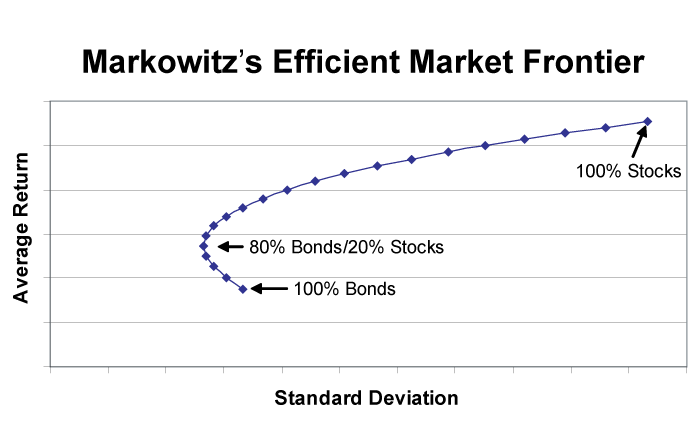
Similarly groundbreaking was his concept of an efficient frontier. The efficient frontier plots the optimal level of risk an investor should take for a given level of return. It also theorizes that there is an optimal level of return an investor should receive for a given level of risk.
This trade-off is not linear as the above chart shows. After a certain point, the amount of additional return diminishes as the level of risk is increased (upper right-hand end of the line of the chart shown above). Similarly, a portfolio that is too conservative does not even generate enough return to provide adequate compensation for the low level of risk taken.
Most investors—both institutional and individual—do not try to optimize their portfolios along the efficient frontier. Markowitz didn’t either. In fact, he split his portfolio into 50% stocks and 50% bonds. Markowitz explained his rationale to Lo and Foerster by saying he’d “look silly” if he was completely out the stock market when it went up and he’d look silly if he was 100% in stocks when they went down. (Notably, Vanguard founder John Bogle expressed a similar line of thought for explaining why he held a 50%/50% allocation.)
Much criticism has been levied at MPT over the years, including by AAII founder James Cloonan. I personally cannot recall the last time I saw anybody use the efficient frontier as the basis for their allocation—neither in an actual portfolio nor in papers about portfolio construction. Nonetheless, two underlying concepts of MPT remain sound: 1) The market does not compensate you for taking unnecessary risk (e.g., by holding an overly concentrated portfolio of similar investments) and 2) investors should seek to be adequately compensated in terms of expected return for the risks they take.
Markowitz is best known for MPT, but his influence on how people think about investing is much broader. Markowitz developed mathematical ways to measure downside risk. He was among the first to use computers in the realm of finance. Markowitz has even been called the grandfather of behavioral finance for laying the initial groundwork in this field.

-
Updating Modern Portfolio Theory for Investor Behavior
The optimum portfolio is not only based on the expected risk and return of the investments, but considers an investor’s tolerance for risk. -
From Theory to Practice: How to Apply MPT Concepts to Your 401(k) Plan
You don’t need a Ph.D. to benefit from the implications of modern portfolio theory. Here is a four-step approach to managing your 401(k) portfolio. -
Filling Your Coffee Can Portfolio to Stash Away
Buying great companies and holding them forever has several advantages over other strategies, including pure indexing. -
Identifying Profitable Companies by High Levels of ROE
Screening for return on equity is a powerful tool for discovering companies that are profitable, efficient and use their balance sheet effectively. -
Did Value Investing Ever Go Away?
Value and growth stocks tend to move in cycles, but a case can be made that value stocks never go out of style. -
Take a Tour of AAII’s Website Redesign
Master the ins and outs of AAII.com’s fresh interface by watching this webinar.
Members are looking for your input. Can you help with this question from the Allocation Strategies Community?
“With the death of Harry Markowitz, who popularized the notion of risk-adjusted returns through diversification, how much do you consider risk when trying to maximize your returns?”
Tap the button and then choose the Join the Community button on the right to answer this question in the AAII Community
Answer This Question in the AAII Community »
AAII Sentiment Survey
Optimism decreased but remains above average for the fourth consecutive week in the latest AAII Sentiment Survey. Neutral sentiment increased, while pessimism decreased.
Bullish sentiment, expectations that stock prices will rise over the next six months, decreased 0.9 percentage points to 41.9%. This keeps optimism above its historical average of 37.5% for the fourth consecutive week. This has been the longest above-average streak since a five-week streak in October and November 2021.
Neutral sentiment, expectations that stock prices will stay essentially unchanged over the next six months, increased 1.2 percentage points to 30.6%. After hitting a six-week low last week, neutral sentiment is closer to its 31.5% historical average but remains below average.
Bearish sentiment, expectations that stock prices will fall over the next six months, decreased 0.3 percentage points to 27.5%. At four consecutive weeks, this is the longest streak that pessimism has been below 30% since a five-week streak in October and November 2021.
The bull-bear spread (bullish minus bearish sentiment) decreased 0.6 percentage points to 14.5%. The bull-bear spread has been above its historical average of 6.4% for four consecutive weeks.
This week’s special question asked AAII members how they would describe the current valuation of stocks. Here are the responses:
- Valuations are mixed, with some stocks expensive and others cheap: 44.1%
- Stocks, in general, are overvalued: 29.3%
- Stocks, in general, are fairly valued: 14.0%
- Stocks, in general, are undervalued: 8.6%
- Not sure/no opinion: 3.5%
Bullish: 41.9%, down 0.9 points
Neutral: 30.6%, up 1.2 points
Bearish: 27.5%, down 0.3 points
Bullish: 37.5%
Neutral: 31.5%
Bearish: 31.0%
See more Sentiment Survey results.

June 22, 2023 June Charts of Interest: Are Happy Days Here Again?
June 15, 2023 The Fed Pauses, Plus William O'Neil and the CAN SLIM Strategy
June 8, 2023 A New Look for AAII.com, Plus Remembering William O'Neil
June 1, 2023 When Inflation Has Outpaced Both Stocks and Bonds

Discussion
Avi Crane from California posted over 3 years ago:
Few people have had such an influence in the financial industry, and therefore, in the world then Harry Markowitz. He has left us, but his foot print will remain forever. Avi Crane IAR, Transamerica Financial Advisors, Inc.
Barry from TX posted over 3 years ago:
Charles, thanks for referencing “In Pursuit of the Perfect Portfolio” (Princeton, 2021). I posted a comment on Jenna’s AAII Community blog over a year ago asking who had read it and got an underwhelming response. As you know, IPOPP summarizes the major contributions to the history of the MPT development from Harry Markowitz through Jeremy Seigel. The most important chapter is Chapter 12, “So, What is the Perfect Portfolio?” In it, the author asks the key contributors to MPT --- 7 Nobel Laurates: Markowitz (MPT), Sharpe (CAPM), Fama (EMHo), Black, Sholes, Merton (Options Pricing), and Shiller (Behavior Economics) and the 4 industry visionaries: Bogle (Index Funds), Leibowitz (Bond Pricing), Ellis (”Loser’s Game,”) and Seigel (”Stocks of the Long Run”) --- to define what they consider the perfect portfolio. Their specific allocations vary (as predicted by MPT), but the rationales underlying their allocations are very informative and align closely with the AAII model. Perhaps you can interview Professors Lo and Foerester in an AAII article to seek their insights from their work. There may also be opportunities to build AAII screens that track these 11 gurus’ recommendations.
Barry from TX posted over 3 years ago:
Charles, what data were used to create the Efficient Market Frontier diagram in this article? Masking the scaling of the axes makes it difficult to interpret the magnitude of the relationships in the chart.
You need to log in as a registered AAII user before commenting.
Create an account