

How Much Is a Mega Millions Lottery Ticket Worth?
by Charles Rotblut | August 03, 2023
The Mega Millions jackpot is currently an estimated $1.25 billion. It is the fourth-largest Mega Millions jackpot and the sixth-largest U.S. lottery jackpot ever. So, it’s good time to revisit a question I’ve addressed in previous Investor Updates, how much is a lottery ticket worth?
 Ask most people and the most probable answers will be the price of the ticket, the value of the jackpot or simply: “Is it a winning ticket?” When one simply considers the likelihood of winning anything, the value following Friday’s drawing for most people will be zero, zilch, nothing.
For possibly one (or even more than one) ticket holder, the gross value will be an estimated $1.25 billion. In between, there will be a small percentage of ticket holders who will have tickets with a gross value of between $4.00 and $1 million.
None of these reflect the expected value of the ticket prior to Friday night’s drawing. There is a concept of risk and reward that people often fail to grasp, aren’t aware of or ignore at their own peril.
The concept is expected value. This is the projected value based on the probability of a given set of outcomes occurring. If it is possible to assign odds to a set of monetary outcomes, an expected value can be calculated. Expected value is a concept that works in a variety of situations. Investors, for instance, can use historical data to determine the likelihood of being able to fund retirement with a certain savings rate or allocation strategy.
Multistate jackpot lottery games like Mega Millions provide great examples of how the concept of expected value works. Mega Millions and Powerball have specific and published odds for the possible winning outcomes. They also have published prize amounts. This allows anybody with a calculator—though a spreadsheet makes the calculations easier—to determine when the expected value of a lottery ticket exceeds the $2.00 cost.
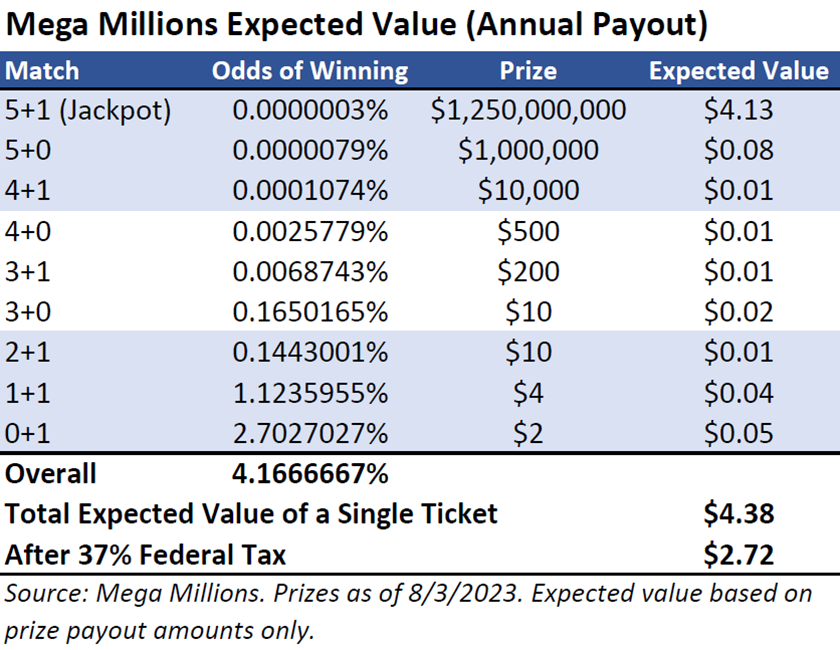
The calculation is simply each potential payout times the odds of having a ticket with the right combination of numbers. The odds of having just the gold Mega Ball correct on a single ticket are 1 in 37. One divided by 37 is 2.7%. Multiplying 2.7% by the fixed $2.00 payout results in an expected value of $0.05. Put another way, if you adjust the $2.00 prize by the probability of having the right Mega Ball number on your ticket, you end up with an expected value of $0.05.
The expected value of having one other number correct in addition to the Mega Ball is actually lower ($0.04) even though the prize is double the amount at $4.00. This is because the odds of getting both numbers right are less than half at 1 in 89, or 1.1%.
Running this math for all the fixed payouts gives us a cumulative expected value of $0.25 for a Mega Millions lottery ticket. This value is inflated because taxes will be owed on the winnings and the larger prize amounts will be reported to the Internal Revenue Service (IRS).
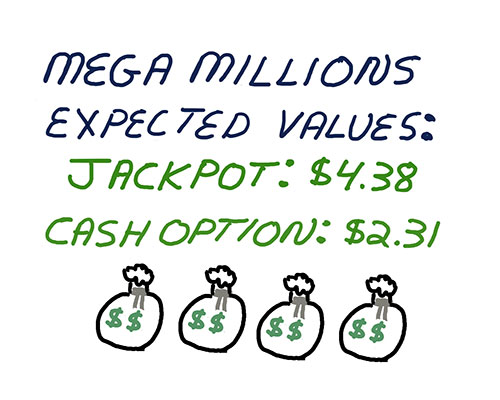
The big prize in the Mega Millions, of course, is the jackpot. The sheer size and the variable nature of a jackpot have great influence on the expected value of a lottery ticket. Not surprisingly, the larger the jackpot, the higher the expected value. The current estimated $1.25 billion Mega Millions jackpot equates to an expected pretax value of $4.38 for a single ticket. The jackpot single-handedly adds $4.13 to the expected value of a single ticket purchased for the drawing.
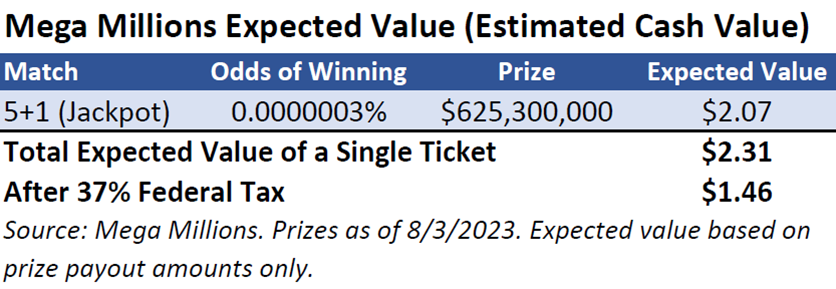
This is based on a sole winner taking the annual payout. If there is a single winner and they opt for the current estimated cash payout of $625.3 million, the expected value falls to $2.31 per share.
In response to previous requests, I factored federal taxes into the analysis. Assuming the 37% federal tax bracket holds, taking the annual payout results in a current expected value of $2.72. Opting for the cash payout instead results in an expected aftertax value of $1.46. Neither calculation factors in what the winner might do with the money (spend it, invest it, etc.) or adjusts it for future inflation. The analysis simply determines whether the expected value based on the estimated payout amounts is above or below the $2.00 cost of the ticket.
The impact that the size of the jackpot has on the expected value should be very apparent. This has significance for investing as well. The riskier the investment is, the higher the required return must be to justify the excess risk. And the higher the required return is, the greater the likelihood of not realizing that return. This is why risking dollars on companies in or headed to bankruptcy, like Yellow Corp. (YELL), is not a good idea. The probable—not just likely, but probable—outcome is a complete loss of the dollars invested. (Speculated may be a better word than “invested.”)
While it may be hard to assign exact odds, a person can use historical data to judge when a projected rate of growth is unusually high. Adding basic industry and economic research can add to the scenario analysis (e.g., is it realistic for the company to sell X dollars of its product or service?). Even when you lack the necessary data to calculate an expected value, you should be able to gather enough information to place some odds on whether an “everything goes right” scenario will or will not occur. To determine whether expected returns are large enough to justify the risks, the “everything goes right” scenario is often necessary.
When doing such analysis, be aware of the element of luck. Just as every Mega Millions jackpot has an eventual winner, the odds of losing everything spent on a lottery ticket remain steady at 94.5%. The same principle applies to investing in high-risk stocks and securities: While a few will realize huge returns, many will end up losing most of their value.

-
Speculation and Bankruptcy: A Bad Mix
In the realm of finance, there seems to be a constant flow of those who repeat the mistakes of the past. -
How Much Risk Can You Handle and Still Meet Your Goals?
An investor’s overall tolerance can be determined both by the timing of their goals and financial and psychological factors. -
Identifying the Personality Traits That Can Impact Investing Decisions
If someone knows that they have a strong tendency to be on the cautious side, they could benefit from investing slightly more aggressively than they otherwise would. -
ETF Sector Performance: Technology on the Rebound
Exchange-traded funds targeting tech stocks were up a sizzling 28.8% during the first half of 2023. -
Back to Investing Basics: On the Road Again
In her latest My Investing Discoveries blog post, Anine Sus distills what she’s learned after taking the first steps.
AAII Sentiment Survey
Optimism increased and remained above average for the ninth consecutive week in the latest AAII Sentiment Survey. Both neutral and bearish sentiment decreased.
Bullish sentiment, expectations that stock prices will rise over the next six months, increased 4.1 percentage points to 49.0%. This is the ninth consecutive week that bullish sentiment is above its historical average of 37.5%. This has been the longest above-average streak since a 13-week stretch from February to May 2021. Bullish sentiment is unusually high for the second time in three weeks.
Neutral sentiment, expectations that stock prices will stay essentially unchanged over the next six months, decreased 1.3 percentage points to 29.7%. Neutral sentiment is below its historical average of 31.5% for the seventh time in 12 weeks.
Bearish sentiment, expectations that stock prices will fall over the next six months, decreased 2.8 percentage points to 21.3%. At nine consecutive weeks, this is the longest that pessimism has been below its historical average of 31.0% since a 23-week streak from February to July 2021. Pessimism is right on the cusp of being unusually low.
The bull-bear spread (bullish minus bearish sentiment) increased 6.9 percentage points to 27.7%. The bull-bear spread reached an unusually high level for the second time in three weeks and remains above average for the ninth consecutive week.
This week’s special question asked AAII members what they thought about the Federal Reserve’s decision to raise interest rates by 0.25%. Here are the responses:
- It was the right decision: 63.1%
- They should have kept interest rates unchanged: 21.9%
- They should have raised rates by a larger amount: 6.9%
- They should have cut rates: 2.0%
- Not sure/no opinion: 6.1%
Bullish: 49.0%, up 4.1 points
Neutral: 29.7%, down 1.3 points
Bearish: 21.3%, down 2.8 points
Bullish: 37.5%
Neutral: 31.5%
Bearish: 31.0%
See more Sentiment Survey results.

AAII Asset Allocation Survey
Individual investors’ equity allocation reached a 14-month high last month. The July Asset Allocation Survey also shows fixed-income exposure rebounding and cash allocations falling.
Stock and stock fund allocations increased 1.0 percentage points to 67.0%. Equity allocations were last higher in May 2022 (67.1%). Additionally, this increase keeps stock and stock fund allocations above their historical average of 61.5% for the 38th consecutive month.
Bond and bond fund allocations increased 0.9 percentage points to 15.0%. July marked the 29th consecutive month with fixed-income allocations below their historical average of 16.0%.
Cash allocations decreased 1.8 percentage points to 18.0%. This is the smallest allocation to cash since April 2022. The drop keeps cash allocations below their historical average of 22.5% for the eighth consecutive month.
Optimism in the weekly AAII Sentiment Survey has been above average for all of July, while pessimism has been below average and reached its lowest level since November 2021.
- Stocks and Stock Funds: 67.0%, up 1.0 percentage points
- Bonds and Bond Funds: 15.0%, up 0.9 percentage points
- Cash: 18.0%, down 1.9 percentage points
- Stocks: 32.2%, down 2.1 percentage points
- Stocks Funds: 34.8%, up 3.1 percentage points
- Bonds: 4.9%, up 0.9 percentage points
- Bond Funds: 10.1%, up 0.0 percentage points
- Stocks/Stock Funds: 62.0%
- Bonds/Bond Funds: 16.0%
- Cash: 22.0%
Take the Asset Allocation Survey.
July 27, 2023 Should Barbie Follow Her Fund Manager to Another Firm?
July 20, 2023 July Charts of Interest: The Magnificent Seven
July 13, 2023 The SECURE Acts Make Roth IRAs More Attractive
July 6, 2023 The State of the U.S. Financial Markets as of Midyear 2023

Discussion
Eric Bressler from MN posted over 3 years ago:
The expected value is even worse in higher tax states. The top bracket in Minnesota is 9.85%, and the Medicare net investment income tax is 3.8%. These drop the expected value of the annual payout by another $0.60 to $2.12. Of course the value of the fun of having a lottery ticket could be added back, but that varies from person to person.
Barry from TX posted over 3 years ago:
Charles, thanks for doing the math for us. Looking at any economic choice as a “lottery” has been the “go-to” research tool in economics since Nicolas Bernoulli invented the St. Petersburg lottery in 1713. Expected utility puts competing choices in a “rational” perspective so we can make decisions about whether to play lotto or not. Another way to compare valuations is to look at “opportunity costs,” the cost or benefit you would have received from using the same amount of money for an alternative purpose. However, how many AAII Members consider $2 for a Meg Millions ticket an “investment”? I would classify a $2 bet to realize a hopeless dream as an entertainment expense. The only other entertainment expense (I know of) with a comparable level of enjoyment is $12 to walk and play golf for 3-4 hours at a nearby public golf course. What other options offer you the ability to dream like Walter Mitty for $2? Or think you are Tiger Woods for $12? Want to spend a little more money and take a bigger gamble? One time I spent $25 on a marriage license. Best gamble I ever made. I won that lottery. Sometimes the biggest risk you can take in life is taking no risk at all.
k. Price from Co posted over 3 years ago:
Charles, I do not think that you have the correct formula for expectation. All of the expectations in your analysis should be negative, except possibly for the jackpot, as it has accumulated from week to week, but the number of players has not increased as much. In particularly, in your example for the "0+1" game, using your data, a player wins $2.00 with a probability of about .027 and loses $2.00 with a probability of about .973 giving an expectation of (.027)x2 - (.973)x2 = -$1.806, meaning that on average the player loses $1.806 each time he plays. Any game with a positive expectation of $.05, as you indicate. should be played as often as possible.
Richard from IN posted over 3 years ago:
How would you calculate the expected value of 10 tickets (no duplicates)? I know the chances of winning increase, but seems to me the expected value isn't additive so it wouldn't be $43.80 since only 1 at most can win the jackpot and wouldn't be much more than the $4.38 for a single ticket. Does that make sense? I do have some statistics background but admit I may be missing something. (I got the old "Let's Make a Deal, Monty Hall" question wrong, for example)
Charles M Rotblut from Illinois posted over 3 years ago:
Richard,
This would certainly get deep into statistics. At a high level, you'd have 10 chances of getting a single winning ticket that would give you the jackpot. But the value of the jackpot wouldn't change nor would the odds of that specific ticket being the winner.
-Charles
Francis Neuffer from South Carolina posted over 3 years ago:
Thank you for the article on the expected value of the winning ticket. In October 2018, it was announced the winning Mega Millions ticket of $1.5 Billion was sold in South Carolina. I knew I had bought a ticket and it was in the glove compartment of my Toyota truck. I didn't want to look at the winning numbers and wondered what the expected value of that ticket was. I didn't know how many tickets were sold for that drawing but guessed 5 million nationwide? I estimated perhaps 100,000 tickets were sold in S.C. The cash out value of the $1.5 B ticket was $900 million. I estimated my ticket value to be $9000 on that evening and also I had that evening to dream of what I would do with the lottery winnings. I thought I wouldn't sleep that night thinking about the winning ticket sitting in my unlocked glove box. I went outside and locked the truck... and slept soundly with my $Billion dreams.
You need to log in as a registered AAII user before commenting.
Create an account