

Should Barbie Follow Her Fund Manager to Another Firm?
by Charles Rotblut | July 27, 2023
While Barbie has successfully made the transition from her Malibu house to the big screen, star mutual fund managers often find it more difficult to maintain a high level of outperformance after jumping to a new firm. They do, however, outperform their old funds after moving to a new job.
Morningstar reached this conclusion after looking at the performance of 518 mutual fund managers with at least three years of experience at their old firms and at least three years at their new firms. The period analyzed ran from 1990 through 2022.
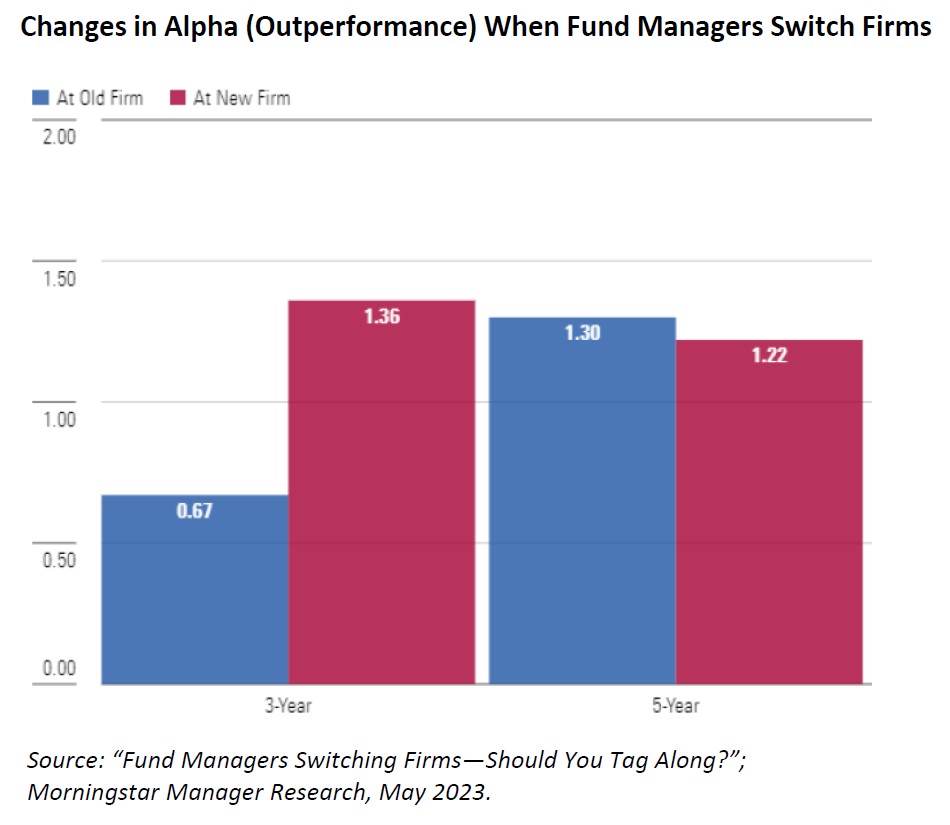
If Barbie is the risk-taking type of investor, she could benefit from initially following the fund manager to their new firm. The average fund manager improved their risk-adjusted annualized outperformance (alpha) during their initial three-year tenure at their new jobs. Average alpha rose from 0.67% during the last three years at the old firm to 1.36% during the first three years at the new firm. (Morningstar calculated alpha relative to each fund’s category index.)
The outperformance sounds pretty good until you look closer at the numbers. Fund managers at the 75th percentile realized three-year alpha of 2.85% at their new firms versus 2.16% at the old firm. Conversely, fund managers at the 25th percentile incurred an alpha of –0.53% at the new firm. (A negative alpha occurs when a manager’s decisions cause the fund to underperform its benchmark.) These numbers are aided by positive factors such as the new fund lending extra support to the fund manager who switches and a smaller starting amount of fund assets. A lower level of assets under management (AUM) often makes it easier to carry out a particular investment strategy.
At five years, the numbers are less impressive. Alpha falls to 1.22% at the new firm from 1.30% at the old firm. Worse yet, this five-year number reflects survivor bias. It excludes the managers who did not last five years at their new firm after having at least five years of tenure at their old firm.
Notably, Barbie would not have much to brag about to Ken if she stayed with the old fund manager. Morningstar observed that fund managers who switched “outperformed their old fund (under new management), on average, by 52 basis points annualized.”
There are a few reasons why the outperformance of fund managers at new firms wanes over time. One reason is simply a lack of persistence in terms of realizing alpha. Even the best fund managers incur periods of underperformance—and picking which manager is least likely to do so is extremely difficult. Another involves the new work environment. The fund manager’s new firm may have a different team of analysts, a different culture and/or different resources. The new firm’s team dynamics may differ as well.
One thing Barbie and all other investors can do when faced with the decision of whether to stick with a fund is to look at its expense ratio. Morningstar used gross returns in its performance calculations. This limited the analysis to how managers performed but boosted the returns relative to what shareholders realized. As Morningstar put it, “looking at returns before fees paints a rosy picture, as fees erode a large part of excess returns. Our experience and academic research show that it is difficult to find portfolio managers who can consistently produce alpha after fees over the long term.”
Morningstar mentioned a few other key things to look at. How closely the objective and strategy of the new fund match that of the old fund is one key factor individual investors can pay attention to. The other ones—support and resources, cultural fit and team dynamics—are impossible for us to determine.

-
What Happens When a Fund’s Management Changes
While you shouldn’t immediately switch from a fund when it changes manager(s), you should pay closer attention to investment style, portfolio turnover, fees and performance after a change. -
Understanding Mutual Fund Fees and Expenses
While it is natural to focus on the performance track record when selecting a fund, expenses and fees can have a dramatic impact on your realized rate of return. -
Going Global: Mutual Funds and ETFs Targeting Regions and Countries
International equity mutual funds and ETFs can offer geographical, currency and sector diversification and dampen risks related to a single stock or the instability of a single country. -
A Tribute to William O’Neil: Revisiting the CAN SLIM Strategy
O’Neil’s research proved that specific growth characteristics of stocks can be tracked to discover companies that have strong prospects for future growth. -
Rolling With the Retirement Tide: AAII Community Shares Rollover Revelations
Members recently engaged in a lively conversation about retirement account rollovers, shedding light on the specific motivations behind their decisions.
Members are looking for your input. Can you help with this question from the Global Market Investing Community?
“Given the wide variety of international equity mutual funds and exchange-traded funds (ETFs) available, which criteria do you typically use to select suitable global funds for your investment needs and risk tolerance?”
Tap the button and then choose the Join the Community button on the right to answer this question in the AAII Community
Answer This Question in the AAII Community »
AAII Sentiment Survey
Optimism decreased but remains above average in the latest AAII Sentiment Survey. Both neutral sentiment and bullish sentiment increased.
Bullish sentiment, expectations that stock prices will rise over the next six months, plunged 6.5 percentage points to 44.9%. This is the eighth consecutive week that bullish sentiment is above its historical average of 37.5%. This has been the longest above-average streak since a 13-week stretch from February to May 2021. Optimism is back within its typical range after its unusually high reading last week.
Neutral sentiment, expectations that stock prices will stay essentially unchanged over the next six months, increased 3.8 percentage points to 31.0%. Neutral sentiment is below its historical average of 31.5% for the sixth time in 11 weeks.
Bearish sentiment, expectations that stock prices will fall over the next six months, increased 2.6 percentage points to 24.1%. At eight consecutive weeks, this is the longest that pessimism has been below its historical average of 31.0% since a 23-week streak from February to July 2021. After nearing an unusually low level last week, pessimism has returned to its typical range.
The bull-bear spread (bullish minus bearish sentiment) plunged 9.1 percentage points to 20.8%. The bull-bear spread reached an unusually high level last week and remains above average for the eighth consecutive week.
This week’s special question asked AAII members to share which factors are most influencing their six-month outlook for stocks. Here are the responses:
- The economy and/or inflation: 42.9%
- Monetary policy/interest rates: 22.7%
- Corporate earnings: 14.7%
- Valuations: 11.7%
- Other: 7.7%
Bullish: 44.9%, down 6.5 points
Neutral: 31.0%, up 3.8 points
Bearish: 24.1%, up 2.6 points
Bullish: 37.5%
Neutral: 31.5%
Bearish: 31.0%
See more Sentiment Survey results.

July 20, 2023 July Charts of Interest: The Magnificent Seven
July 13, 2023 The SECURE Acts Make Roth IRAs More Attractive
July 6, 2023 The State of the U.S. Financial Markets as of Midyear 2023
June 29, 2023 Harry Markowitz's Lasting Influence on Investing

Discussion
Don Potempa from illinois posted over 3 years ago:
Based on my Age the answer has little meaning ; however my age experience has given me a better insight , to Today's Market versus my learning curve during the President Nixon Term of Office . . I would suggest the principles of investing have not changed however the processing of information is transformative to what sentiment there was in the stock market . Based on my preface above , the Market will be NEUTRAL over the next six months; Bullishness is next and Bearishness is the least sentiment on the Market Today . My basis for this conclusion is ALL based on Technology . In my learning curve experience of the Market , it was ALL about " The Nifty 50 " ; now it's the Magnificent 7 and more T-n-T waiting to increase the Market Behavior ..
You need to log in as a registered AAII user before commenting.
Create an account