


Charles Rotblut leads a class in AAII's new Essential Investing Video Course. Go to https://www.aaii.com/ves for more information and to subscribe.
- The benefits and limitations of section 529 plans and other accounts for education savings
- Using a plan helps with decision-making and monitoring over time to reach your goal
- Investment considerations include asset allocation and balancing growth with risk over time
College is one of the largest expenses incurred over the course of a lifetime. It is best to start saving for this expense early in a child’s life and consistently contribute to those savings as they progress from kindergarten through grade school, middle school and high school.
In addition to saving, consideration must be given to the type of accounts used. Section 529 plan accounts provide several tax advantages but also have limitations. Other types of accounts offer more freedom but not the tax savings. Student aid is often an additional factor in the choice of account.
Creating a plan for funding college can help you clarify what choices you will make. It provides a framework for the decisions that need to be made, including the type of account and investments used. Such a plan does not need to be complex. In this article, we show a one-page PRISM Wealth-Building Plan for saving for college.
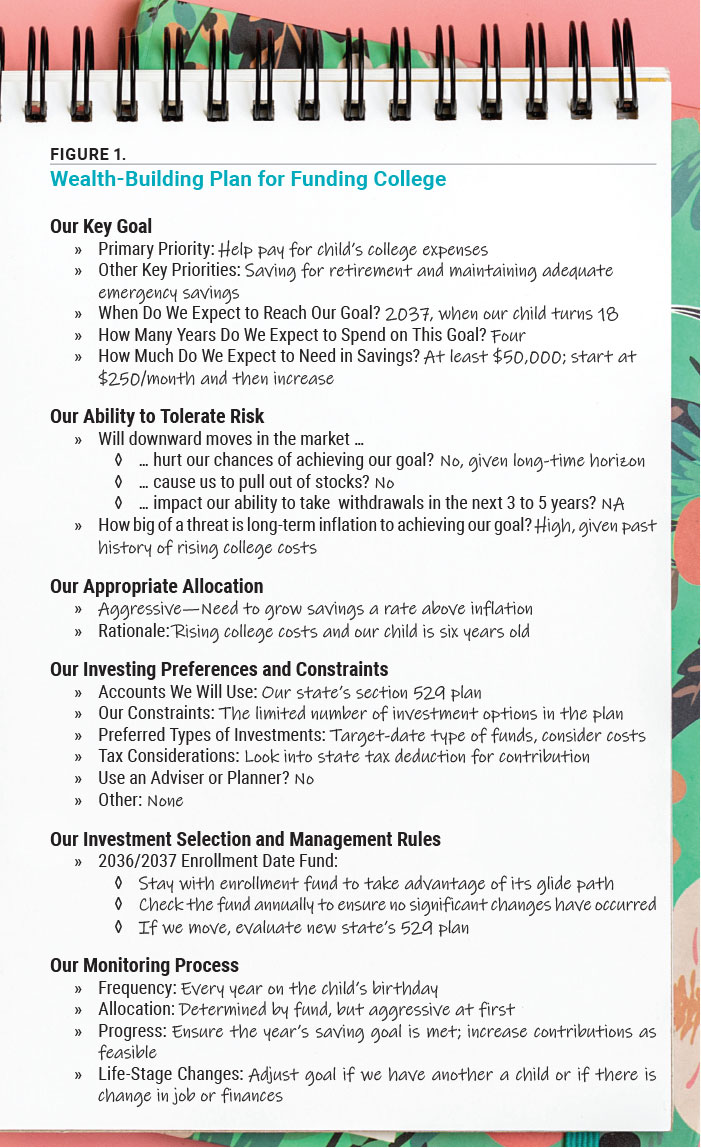
The one-page PRISM Wealth-Building Plan presented in this article uses a six-year-old child as the beneficiary (Figure 1). The child’s parents Dan and Emily expect their child will attend a state university upon graduating high school in 2037.
In creating their plan, we include commentary about how the one-page wealth-building plan may differ for students nearing college. We also note factors that grandparents who wish to financially assist grandchildren and other younger family members should consider.
College expenses come with many complexities. Needs-based, merit-based and athletic scholarships help reduce the cost. Private universities can discount tuition. State universities may offer reciprocity or other incentives to out-of-state students. Students may start at a community college and then transfer into a four-year college or into a university. Students may also work part or full time while taking classes. At the other end, payment terms and interest rates on student loans vary. While we cannot address all considerations in a single article, this one-page PRISM Wealth-Building Plan provides a basis for saving for college.
Goal: Save for a Child’s College Expenses
The first step, and the cornerstone of the PRISM Wealth-Building Process, is identifying and prioritizing goals. Dan and Emily’s goal is to save for their six-year-old child’s college expenses.
This goal has the advantages of a known target date for being reached and a known duration of spending. The couple’s child is expected to attend college in 2037 at age 18. Undergraduate studies are expected to be completed in four years.
Dan and Emily can use current costs as a base assumption to estimate their child’s future college expenses. For example, Robert Farrington of The College Investor estimates that the current average cost of tuition for an in-state four-year college is $22,000 annually. If tuition costs rise 4% per year—slightly above the average rate of inflation—the total cost for four years of college could reach approximately $150,000. Room, board, books and other expenses could add to this figure.
The couple should not be intimidated by this large number. The entire cost of a four-year public or private college may not need to be fully saved for. Their child may qualify for scholarships or discounted/waived tuition. Some classes could be taken at a community college. Student loans can be taken.
Dan and Emily must also consider their other financial needs. Saving for their own retirement must take precedence over saving for their child’s college. Unlike college, there are no retirement loans. Dan and Emily must also emphasize maintaining adequate short-term savings and covering their own living expenses ahead of their child’s college expenses. Similarly, grandparents should place their financial needs ahead of those of their grandchildren even though it may be emotionally hard to do so.
The couple estimate that they can set aside $250 per month in savings to start. They believe this amount will turn into at least $50,000 based on an average 6% rate of return. Dan and Emily intend to increase the amount they save as they get raises and promotions in the years to come. They will note this intention in the monitoring portion of their PRISM Wealth-Building Plan. The target amount saved will be adjusted as their capacity to save more increases.
Risk Tolerance: Lengthy Time Horizon With Short Spending Duration
The PRISM Wealth-Building Process considers four aspects of risk tolerance.
One is psychological. The one-page PRISM plan asks whether downward volatility would cause you to pull out of the market. Dan and Emily answer no to this question. They realize how important it is to consistently stay in the market.
Another involves the timing of withdrawals. Dan and Emily have no intention of taking withdrawals over the next three to five years given the young age of their child. This enables the couple to let their money work without any concerns about the impact of the stock market’s volatility.
The other two are inflation and sequence risk.
College costs have been rising faster than the broad inflation rate—as defined by the consumer price index (CPI)—for many years. This historical trend means the couple must seek out a higher return to grow their savings faster than college costs.
Sequence risk (aka sequence of returns risk) is an ill-timed drop in a portfolio’s value. It can cause a shortfall in wealth when withdrawals are needed.
Dan and Emily need not be concerned about sequence risk right now. Their child is six years old. Withdrawals from the portfolio will not be needed for another 12 years. This gives their portfolio plenty of time to recover from any corrections (declines of 10.0% to 19.9%) or bear markets (declines of 20% or more) in the stock market.
As their child ages, sequence risk will grow in significance. A bear market occurring when the child is a junior in high school could leave Dan and Emily without enough savings. As such, the couple’s portfolio objectives will evolve over their child’s lifetime from favoring growth of wealth now to favoring preservation of wealth as the college years approach and start.
Asset Allocation: From Growth to Preservation as College Approaches
Given their current need for growth of capital, Dan and Emily realize that they will need an aggressive allocation. They want most or all of the portfolio in equities to maximize returns while their child is young.
Allocating for college expenses is similar to allocating for retirement. There are known times to start (at/near birth and at/near the start of a career, respectively). The date of when each goal will be reached can be determined or estimated well in advance (at high school graduation and generally between age 60 and 70, respectively). Both have periods of spending after the initial goal is reached (starting college and entering retirement, respectively).
Thus, target-date funds are offered in both section 529 plans and in retirement accounts like 401(k) and 403(b) accounts. Target-date funds start with a significant allocation to stocks and gradually increase their exposure to bonds and other less volatile assets. The Aggressive 2042/2043 Enrollment Portfolio and Moderate 2042/2043 Enrollment Portfolio funds in Illinois’ Bright Start 529 program allocate 100% and 90%, respectively, to stocks.
Target-date funds designed for college differ from those intended for retirement by becoming very conservative at the end of their glide paths. This is due to the short spending duration once college starts. Bright Start’s Aggressive Enrolled Portfolio fund, which is intended for savings that are needed now, allocates 30% to an interest-bearing account insured by the Federal Deposit Insurance Corp. (FDIC), 55% to bonds and 15% to stocks. The Moderate Enrolled Portfolio fund allocates 45% to the interest-bearing account, 45% to bonds and 10% to stocks.
Retirement target-date funds maintain larger allocations to stocks in retirement. This is to account for the longer length of retirement.
Parents and grandparents saving for college do not have to follow a glide path. They can choose to allocate according to their preferences. Maintaining an aggressive allocation (or at least a less conservative allocation) may be desired if the goal is to provide savings beyond just an undergraduate program. This also makes sense if there is a desire to change the beneficiary and/or to provide excess dollars that can be later converted into a Roth individual retirement account (IRA).
Investing Preferences: 529 Plans Versus Other Options for College Savings
The biggest considerations when deciding what type of account to use for college savings are federal student aid, taxes and the purpose of the savings being set aside, according to Farrington.
Section 529 plans have advantages when the purpose of the funds is to pay for educational expenses. Almost half of states provide tax benefits for 529 plan contributions. (The state you live in determines whether a deduction can be claimed, Farrington points out. Contributions to a 529 plan are not deductible at the federal level.) Savings grow tax-free. Distributions are also tax-free if the funds are used to pay for qualified education expenses. Farrington notes that these expenses not only include tuition, room and board, but also vocational school, student loan debt and K–12 tuition.
Up to $35,000 from 529 plans can be rolled over to a beneficiary’s Roth IRA on a tax-free basis. Farrington cautions that not all states permit such distributions on a tax-free basis. In addition, there are several restrictions at the federal level. These include a requirement that the 529 account is funded for a minimum of 15 years ending on the date of distribution. Additional restrictions are listed in the “SECURE 2.0 Act and Related Changes” section in in the December 2024 AAII Journal tax guide.
Who owns the 529 plan account impacts financial aid. Farrington says that these accounts are treated as the parents’ asset if the student is a dependent for tax purposes. They do not impact financial aid when owned by the grandparent instead of the parents so long as the child is not a dependent of the grandparent. This ownership issue may be a moot point for children who will not likely qualify for financial aid because of their parents’ income and wealth.
Uniform Gifts to Minors Act (UGMA) or Uniform Transfers to Minors Act (UTMA) accounts can make sense for those who do not want restrictions on how the money can be spent. These accounts are viewed as being the student’s asset in terms of determining financial aid. Capital gains realized and income received in these accounts are taxable at the child’s rate provided the investment income does not exceed the “kiddie tax” limit, which is $2,700 in 2025.
Dan and Emily choose to use their state’s 529 plan. They like the tax-free growth and tax-free distributions (when used for qualified expenses).
By doing so, the couple is constrained in their choice of investments. Section 529 plans offer only a small number of mutual funds to choose among. Dan and Emily view this as an acceptable trade-off given the tax advantages of 529 plans. (In contrast, UGMA and UTMA accounts offer access to a wide variety of investments, albeit without the tax advantages of a 529 plan.)
The options in 529 plans typically include target-date funds tied to college instead of retirement, an S&P index fund or similar type of large-cap fund and a money market or stable fund, notes Farrington. Illinois’ Bright Start 529 program also includes value, real estate, bond, balanced and international mutual funds, as well as an interest-bearing account. Other 529 programs may as well, though the offerings will vary by state.
Dan and Emily opt for a target-date fund to simplify the savings process. These plans start with a high allocation to stocks and gradually increase their exposure to bonds and money-market-like accounts over time. Their allocations become very conservative as the college enrollment year grows close.
The Bright Start Aggressive 2036/2037 Enrollment Portfolio currently has a 70% allocation to equities and a 30% allocation to fixed income as of September 2024. It is designed to fund withdrawals in 11 to 12 years. The Aggressive 2026/2027 Enrollment Portfolio, which will fund withdrawals in one to two years, has a 20% allocation to stocks and an 80% allocation to fixed income as of September 2024.
Investors who prefer to manage the allocations themselves can choose individual funds within the 529 plan account instead of using a target-date fund. This provides greater customization and the possibility of realizing higher returns, but also requires greater oversight of the portfolio’s allocation.
Monitoring Progress: Keeping Your College Savings Plan on Course
The final step of the PRISM Wealth-Building Process calls for periodic monitoring. This is necessary regardless of the type of account used to save for college and the types of investments chosen in the account.
Dan and Emily agree to check the 529 account annually. They want to ensure the chosen fund continues to follow the same strategy and that there are no significant changes within the plan itself.
They also review their contributions each year. The couple compares how much they have added to the account versus the prior year. Their goal is to increase their contributions as their income rises. The couple must balance this desire with their financial realities, including the greater need to consistently increase how much they save for retirement. As part of the monitoring process, they take this feasibility into account.
Any life-stage changes are also considered. Should Dan and Emily have another child, they may have to revise how much they can contribute to their first child’s college savings. They may also need to adjust their planned contributions if either incurs a change in job status and/or unexpectedly large expenses (e.g., medical).
Grandparents would want to consider changes in their broader family. The birth or adoption of new grandchildren may lead to a change in how much is saved for each grandchild.
In both cases, an out-of-state move would require a reevaluation of a 529 plan, if one is used. The new state’s 529 plan may or may not be a better option.
A One-Page Wealth-Building Plan Can Help You Save for College
College is among the largest expenses a person will incur over their lifetime. It requires saving over a child’s lifetime with thought given to how much will be saved and in what type of account.
The one-page PRISM Wealth-Building Plan presented here provides a framework for saving for college. It outlines the considerations, from the future cost to types of accounts used to the monitoring process.
While it can’t address every aspect—such as whether to take student loans, start at a community college before moving onto a university, etc.—it will help you think through some of the bigger issues. It also provides a useful example of how to create your own one-page PRISM Wealth-Building Plan.

Related

Mutual Funds
How Target-Date Funds Work
Related

Financial Planning
Well-Built 529 Plans Can Be a Great Option for College Savings
Discussion
FREE REPORT

Get your free copy of our special
report analyzing the tech stocks
most likely to outperform the
market.
ROBERT A from NC posted over 1 year ago:
JOHN S from SC posted over 1 year ago:
JOHN S from SC posted over 1 year ago:
BARRY J from TX posted over 1 year ago:
DENNIS F from OH posted over 1 year ago:
CHARLES R from IL posted over 1 year ago:
SCOTT B from AZ posted over 1 year ago:
You need to log in as a registered AAII user before commenting.
Log InCreate an account