

The Processes I Use for Managing My Portfolio
by Charles Rotblut | October 29, 2020
Those of you who are regular readers know that I’m a believer in systematic approaches to investing. Today, I’m going to share with you some of the processes I use for my own portfolio. You’ll notice there is a quite bit of overlap with The Individual Investor Wealth-Building Process we’ve been rolling out over the past few months. (The Wealth-Building Process was formerly code-named “The AAII Way.”)
My goals are simple: save for retirement and keep building my short-term savings. Retirement is an obvious goal. Like the majority of my fellow Generation Xers, there is no pension for me to rely on. What my wife and I have set aside and what Social Security pays out in benefits are going to be our main sources of income in retirement. Short-term savings are for emergencies, vacations, health care deductibles and co-pays, larger purchases and those unexpected bills (e.g., I had brake work done on one of our vehicles last week—cheaper than a new car, I keep reminding myself).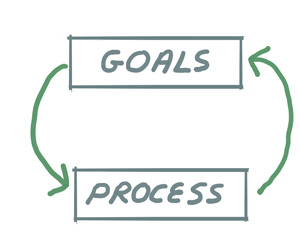
Being clear about my goals means to prioritize them. Every pay period, a portion of my salary gets automatically diverted away from my checking account and into retirement and savings accounts. Some people do really well by having a budget. I’m not one of them. I do better when someone takes the candy jar away instead of leaving it out and telling me I can only have two pieces of chocolate. This is why I rely heavily on automatic deposits. Every year, I try to increase the amount that gets diverted from my paycheck to savings. Even small changes at the individual pay-period level add up to significant differences over time.
Another big advantage of being clear about my goals has to do with my tolerance for volatility in the stock markets. The full retirement age for claiming Social Security of 67 is still a long way into the future for me. Plus, there is a history of longevity in my family. My parents are in their mid-80s and, fortunately, are in good health (knock on wood). Knowing this, I don’t get fazed by short-term volatility in the stock market. There is no way I’m going to fund my retirement if I don’t allocate heavily to stocks. And there is certainly no way I’ll be able to do so if I worry every time the market drops.
As far as what I invest in is concerned, limitations play a role. AAII’s 403(b) plan restricts us to Vanguard mutual funds. (No complaints, as many other funds and strategies fail to beat the performance of Vanguard’s index funds over the long-term. Is it possible to do better? Yes, but it’s not easy to do so.) In my other accounts, I hold a mix of exchange-traded funds (ETFs) and individual stocks. The decision about what is held where depends on the account. For example, my wife’s IRAs are mostly invested in ETFs because she doesn’t have a particular interest in doing security analysis. The accounts held in my name hold a mix of stocks, ETFs and mutual funds.
Contributions also play a role in determining what’s held. ETFs or mutual funds work well for dollar-cost-averaging paycheck contributions until the balance reaches a large enough amount.
Combined, these factors make me a partially hands-on investor in the context of our Wealth-Building Process.
I do follow set rules regarding my allocation and buy and sell decisions. The allocations for my and my wife’s accounts are checked semiannually to ensure the mix is within the 5% boundaries I set. (I did the semiannual review this past weekend and no rebalancing was required.) I use the VMQ Stocks strategy for many of my holdings and follow its rules. For the other stocks, I have sell rules based on the particular reason I bought them. The mutual funds and ETFs held in my and my wife’s accounts are monitored using the tools on AAII.com.
A list of our accounts and passwords has been maintained for several years. My wife has the ability to step in on my behalf at any moment should she need to. This type of list is something I suggest you create and maintain as well. In the event of something unexpected, it will be invaluable to your significant other and/or heirs. Our Key Estate Planning Information Worksheet provides a useful framework for doing this.
Finally, there is one other thing I do every year—inventory my accounts and check the beneficiary information. Doing so ensures all information is up to date and reminds me of what I have. It prevents unwanted headaches and occasionally identifies opportunities to close or consolidate accounts. I also use the annual review to check https://unclaimed.org and see if any unclaimed property turns up. Every so often something does.
Keep in mind that no single approach works for every person. I’ve set up and adjusted a system that works for me. The Individual Investor Wealth-Building Process was created to give you the flexibility to create a process that works for you. The key is to have something that is well-thought-out, limits the impact of emotions and is focused on helping you achieve your goals. Identifying your goals will help you to establish a good process for reaching them.
Do you have certain processes that help you make progress toward your financial goals? Share them in the comments section below.
Try out the Wealth-Building worksheets we’ve created so far and give us your feedback in the comments section for each. We want them to be useful to you.
1. Identifying and Prioritizing Your Financial Goals Worksheet
2. Our Revised Risk Tolerance Worksheet
3. A Worksheet for Determining How Your Portfolio Is Managed
4. Financial Account Inventory Worksheet
5. Investment Expense Tracking Worksheet
6. Portfolio Composition & Notes
7. Withdrawal Strategy Worksheet
8. Life Stage Changes Checklist

-
Biology and Life Experiences Influence Investment Style – Whether you favor value or growth stocks is influenced by both biology and how you grew up.
-
How Much Should You Have in Equities Until Retirement? – The T. Rowe Price study discussed in this 2010 AAII Journal article shows how staying allocated to stocks leads to higher retirement savings.
Optimism among individual investors about the short-term outlook for stocks declined modestly as pessimism rebounded. The latest AAII Sentiment Survey also shows lower neutral sentiment.
Bullish sentiment, expectations that stock prices will rise over the next six months, declined 0.5 percentage points to 35.3%. Bullish sentiment remains below its historical average of 38.0% for the 34th consecutive week and the 39th week this year.
Neutral sentiment, expectations that stock prices will stay essentially unchanged over the next six months, pulled back by 1.8 percentage points to 29.4%. Neutral sentiment is below its historical average of 31.5% for the 40th time out of the past 42 weeks.
Bearish sentiment, expectations that stock prices will fall over the next six months, rose 2.3 percentage points to 35.3%. Bearish sentiment remains above its historical average of 30.5% for the 36th consecutive week and the 38th time this year.
This is the first time bullish and bearish sentiment are tied since January 30, 2019 (31.8% each). At current levels, all three indicators are within their typical ranges.
Optimism continues to be below average while pessimism continues to be above average. This differential reflects ongoing concerns about the coronavirus pandemic, the economy and the upcoming election. Other factors influencing AAII members’ sentiment include valuations and interest rates.
In this week’s special question, we asked AAII members how the back-and-forth over new coronavirus-related stimulus has impacted their outlook for stocks. Two out of five respondents (40%) say that debates over coronavirus-related stimulus have had little to no impact on their outlook for stocks. This compares to 17% of respondents who say that the back-and-forth over new coronavirus-related stimulus has negatively impacted their outlook for stocks. About 10% of the respondents say this issue has only impacted their short-term outlook for stocks because they view the proposed stimulus as a temporary fix.
Additionally, 10% of respondents say that they expect to see market volatility until the election is over, after which they anticipate a market correction trending either up or down. About 7% of respondents say that their investment strategy has become more conservative due to uncertainties related to the fate of the proposed stimulus, and about 7% of respondents say that this issue could potentially create buying opportunities.
Here is a sampling of the responses:
- “No change in my outlook for stocks as I anticipated we would be going through ups and downs for the next two years and government handouts will not be enough to save some businesses or some industries over the long run. Until we have a safe and effective vaccine and have enough people immunized to stop the spread of the coronavirus, the economy will continue to just limp along.”
- “It affects short-term outlook only. The stimulus would be a life raft for some sectors in the short term but probably would not help long-term factors. Also, stimulus would have a short-term effect on consumer confidence and spending in the fourth quarter.”
- “I expect that the election results will signal a need for a stimulus in the short run and news of a vaccine will clear the path to a strong recovery.”
- “It has just hardened my belief that the market is reacting to politics, and not to the market itself. After the election, we’ll see where we really are.”
- “Lack of stimulus will hurt the economic recovery. Combine this with election results being delayed due to mail-in ballots, and possibly being contested, I see the stock market dropping in the near term. Recovery will be slow because of the lack of stimulus and increasing layoffs by state and local governments resulting from a significant decrease in tax receipts.”

Bullish: 35.3%, down 0.5 points
Neutral: 29.4%, down 1.8 points
Bearish: 35.3%, up 2.3 points
Bullish: 38.5%
Neutral: 31.0%
Bearish: 30.5%
October 22, 2020 For Portfolio Reviews, Look at Only What You Need To
October 15, 2020 Two Simple Ways to Avoid Estate Planning Problems
October 8, 2020 Upgrades to AAII.com Based on Member Feedback
October 1, 2020 Navigating the Tax Consequences of Required Minimum Distributions

Discussion
William Peterson from Arizona posted over 5 years ago:
While I am not in the same position as you (I am already retired), I completely agree with everything that you say in your article. However, I do have a suggestion for improving returns on common stocks. Once I have found a stock to buy and have determined that the stock is reasonably priced, I don't just issue a buy order. Instead, I sell a put option on the stock (100 shares per put contract) with a strike price within the range I am willing to pay for the stock. I usually use options that expire within three months, so I don't have to wait too long for something to happen, but I also don't have to check the stock or option very often. Of course, I receive a premium for selling the put option, which increases my income. If the put later expires, I may sell another one to make even more income, or I may choose a different stock. If the put is exercised I buy the stock at the strike price (be sure to have enough cash on hand to cover the purchase). Once I have purchased the stock I can sell a call option against it and take in more income. Again, if the call option expires, I can sell another one since I still own the stock. If the call is exercised, I sell the stock and start the process over again. This process allows me to make money in four ways: selling puts, selling calls, receiving dividends, and participating in the growth in the price of the stock. Without the options I would be limited to profiting in only two ways. Now, this process is not a slam dunk. It is possible for a stock to drop significantly in price after I have sold a put against it. However, if I had simply purchased the stock I would have exactly the same problem. Also, a stock can drop significantly in price after I buy it, thus making it uneconomical to sell a call against it with a strike price above my cost. If I hadn't sold the call, the stock would still be under water, so selling the call doesn't make any difference in this regard. However, puts and calls can be rolled over into new ones to postpone potential losses while continuing to take in income. The only potential disadvantage to this method is when I have purchased a stock, sold a call against it, and the stock rises dramatically in price. In this case I can allow the buyer of the call to exercise it, sell him/her the stock, and start the process over. In this case I lose some of the potential rise in value of the stock. Alternativelly, I can roll over the call, make some money doing so, and postpone selling the stock until later. Yes, options are not for everyone, and some people don't have enough cash to purchase 100 shares of stock at once, but those who can do so can make extra money every few months.
You need to log in as a registered AAII user before commenting.
Create an account