

Avoid These Costly Retirement Account Rollover Mistakes
by Charles Rotblut | August 01, 2024
According to Vanguard, more than one-quarter (28%) of rollovers to individual retirement accounts (IRAs) conducted in 2015 “remained in cash for least seven years.” This behavior has resulted in a large opportunity cost for many investors in terms of foregone wealth.
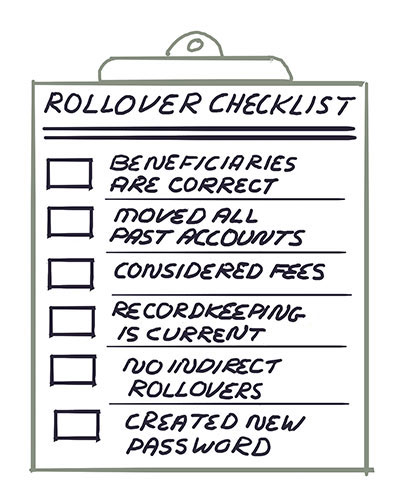 It is not the only mistake investors make when completing a rollover, moving an account to a different brokerage firm or doing another type of account transfer. Even seemingly small mistakes can have significant unintended consequences. Here are some of the main ones to avoid.
Failing to List Your Beneficiaries on the New Account: We’ve seen court cases where a family member didn’t inherit an account because the beneficiary information was not updated or completely left off. While it is easy to postpone doing this, it can have a big impact on how your estate is settled. Make the effort to fill out the beneficiary forms—and update them as needed. In doing so, ensure you have the correct Social Security number(s) and/or the trust’s employer identification number (EIN).
Forgetting About Past Accounts: There were an estimated 29.2 million 401(k) accounts left behind or forgotten in 2022. The total value of those accounts equated to 25% of all 401(k) plan assets, according to Capitalize. [Capitalize operates a platform for transferring 401(k) accounts.] Such left-behind accounts could continue to incur fees, be left in higher-fee investment options and eventually be cashed out. It’s a good practice to check https://unclaimed.org once per year to ensure there’s no money you’ve unintentionally left behind.
Failing to Consider Fees and Costs: Never overlook the fees you may be charged. One is the fee charged by your current broker or 401(k) sponsor to transfer your account. Another is any fees or commissions charged by the firm, plan or adviser you are moving the account to. Then there are investment-related fees. The 401(k) plan provided by a new employer may not have the same low-cost fund options your former 401(k) plan had. The investments suggested by a new adviser or planner may have higher expense ratios and/or tax-cost ratios than the investments you held at your old firm. Always do a comparison.
Letting Your Recordkeeping Lapse: When taxable accounts are moved, you are still responsible for taxable gains or income realized at the former account. Similarly, if you move a retirement account, you are still responsible for any required minimum distributions (RMDs) due for the current year. You should also note any cost basis for investments held in a taxable account that has been transferred.
Doing an Indirect Rollover: If you take a direct withdrawal from an IRA or other retirement plan—meaning you have all or part of the balance sent directly to you—you have 60 days to put the funds back into an IRA or similar type of account. Failure to do so will result in the withdrawal being taxed (for tax-deferred accounts) and potential penalties assessed if you are under the age of 59½. You can also only do one direct IRA rollover every 12 months.
Not Changing Your Passwords: Create a new password every time you open a new financial account. Doing so will help protect you from data breaches. Each of my financial accounts has a different password. So should yours. While your brokerage account is most likely covered by the Securities Investor Protection Corp. (SIPC), this does not protect you from the hassle of identity theft.

-
The Rules Regarding Retirement Account Rollovers
Terms and tips to help you decide whether to transfer retirement savings from one account to another. -
Understanding Mutual Fund Fees and Expenses
While it is natural to focus on the performance track record when selecting a fund, expenses and fees can have a dramatic impact on your realized rate of return. -
3 Ways to Redo Your Social Security Claim
The July AAII Journal reveals the circumstances that may allow you to improve your retirement prospects by changing a prior Social Security claiming decision.
AAII Sentiment Survey
Bearish sentiment among individual investors about the short-term outlook for stocks decreased in the latest AAII Sentiment Survey. Meanwhile, both optimism and neutral sentiment increased.
Bullish sentiment, expectations that stock prices will rise over the next six months, increased 1.7 percentage points to 44.9%. Bullish sentiment is above its historical average of 37.5% for the 38th time in 39 weeks.
Neutral sentiment, expectations that stock prices will stay essentially unchanged over the next six months, increased 4.8 percentage points to 29.9%. Neutral sentiment is below its historical average of 31.5% for the fourth consecutive week.
Bearish sentiment, expectations that stock prices will fall over the next six months, decreased 6.5 percentage points to 25.2%. Bearish sentiment is below its historical average of 31.0% for the seventh time in eight weeks.
The bull-bear spread (bullish minus bearish sentiment) increased 8.2 percentage points to 19.7%. The bull-bear spread is above its historical average of 6.5% for the 13th consecutive week.
This week’s special question asked AAII members if they think other investors are too bullish or bearish right now.
Here is how they responded:
- They are too bullish: 46.0%
- Their sentiment toward the market is about right: 30.5%
- They are too bearish: 13.3%
- No opinion/not sure: 9.7%
Bullish: 44.9%, up 1.7 points
Neutral: 29.9%, up 4.8 points
Bearish: 25.2%, down 6.5 points
Bullish: 37.5%
Neutral: 31.5%
Bearish: 31.0%
See more Sentiment Survey results.

AAII Asset Allocation Survey
Individual investors’ allocations to equities decreased slightly in the July Asset Allocation Survey.
Stock and stock fund allocations decreased 0.4 percentage points to 70.1%. Stock and stock fund allocations are above their historical average of 61.5% for the 50th consecutive month.
Bond and bond fund allocations are unchanged at 14.5%. Bond and bond fund allocations are below their historical average of 16.0% for the sixth consecutive month.
Cash allocations increased 0.4 percentage points to 15.4%. Cash allocations are below their historical average of 22.5% for the 20th consecutive month.
- Stocks and Stock Funds: 70.1%, down 0.3 percentage points
- Bonds and Bond Funds: 14.5%, up 0.0 percentage points
- Cash: 15.4%, up 0.3 percentage points
- Stocks: 33.8%, down 0.8 percentage points
- Stocks Funds: 36.4%, up 0.5 percentage points
- Bonds: 4.7%, down 0.4 percentage points
- Bond Funds: 9.8%, up 0.4 percentage points
- Stocks/Stock Funds: 62.0%
- Bonds/Bond Funds: 16.0%
- Cash: 22.0%
Take the Asset Allocation Survey.
July 25, 2024 July Charts of Interest: The Small-Cap Stock Resurgence
July 18, 2024 Chasing Super High Yields Can Burn Your Portfolio
July 11, 2024 Balancing Longevity Risk With Late-in-Life Care Expenses
June 27, 2024 Seven Steps for Picking the Right Fund

Discussion
No comments have been added yet. Add your thoughts to the discussion!
You need to log in as a registered AAII user before commenting.
Create an account