

Buffett on Buybacks, Dividends and Investing Mistakes
by Charles Rotblut | March 02, 2023
Featured Tickers: KO
KO
Long-term readers of this newsletter know that I like to share insights from Warren Buffett’s annual letters to Berkshire Hathaway Inc. (BRK.A) shareholders. I do so not because I’m a Berkshire Hathaway shareholder, but rather because I think the letters contain useful insights and good observations even if you are not a Berkshire Hathaway shareholder. In keeping with tradition, I’ll do so again today. But first, I want to point out something different I noticed.
Buffett is verbose. He even admitted being so: “[Berkshire vice chairman Charlie Munger] and I think pretty much alike. But what it takes me a page to explain, he sums up in a sentence.” I’m citing this quote because when I finished reading this year’s letter on Saturday, I thought I had missed something. I got through the letter quicker than expected. So much so that I even scrolled back up to see if I had advertently skipped over something. I didn’t. I read every word.
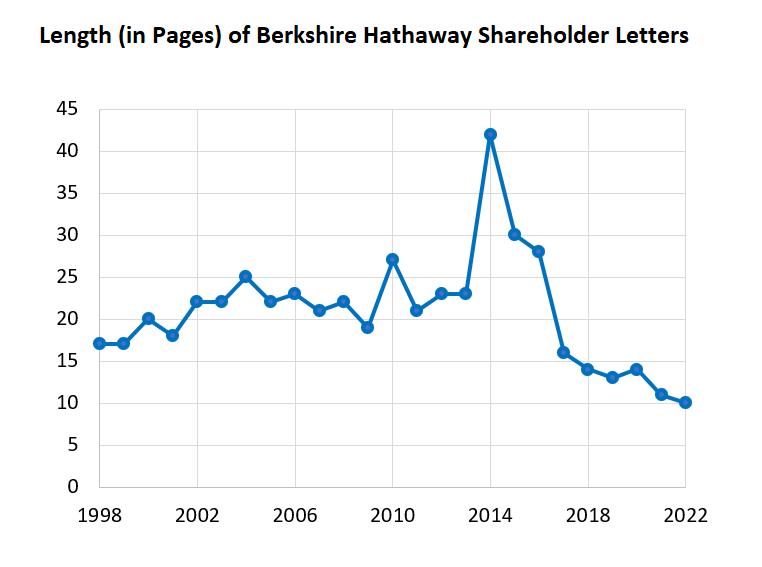
Being inquisitive, I went back and looked at past letters. The Berkshire Hathaway annual letter has been published in PDF format since 1998. This makes it easy to do comparisons on the page count. The past 24 letters have averaged 21 pages in length. The longest was 2014’s missive at 42 pages. This year’s letter barely made on to the 10th page.
It’s not as if Buffett has run out of opinions. He was very direct in reiterating his stance on buybacks. “When you are told that all repurchases are harmful to shareholders or to the country, or particularly beneficial to CEOs, you are listening to either an economic illiterate or a silver-tongued demagogue (characters that are not mutually exclusive),” wrote Buffett.
Buffett is not in favor of all buybacks. Rather, he supports those that are “value-accretive.” These are different than repurchases made at high valuations. “When a company overpays for repurchases,” Buffet explained, “the continuing shareholders lose. At such times, gains flow only to the selling shareholders and to the friendly, but expensive, investment banker who recommended the foolish purchases.”
It’s not just buybacks that he likes; growing dividends matter too. Buffett used Coca-Cola Co.  (KO) as an example: “The cash dividend we received from Coke in 1994 was $75 million. By 2022, the dividend had increased to $704 million. Growth occurred every year, just as certain as birthdays. All Charlie and I were required to do was cash Coke’s quarterly dividend checks.”
Buffett also touched on his mistakes, humbly describing most of his capital allocation decisions as having been “no better than so-so. In some cases, also, bad moves by me have been rescued by very large doses of luck. (Remember our escapes from near-disasters at USAir and Salomon? I certainly do.)”
Even the best investors make mistakes—a lot of mistakes. “Our satisfactory results have been the product of about a dozen truly good decisions—that would be about one every five years,” judged Buffett. What separates him and other great investors from the mediocre or just bad investors is discipline and a long-term focus. Limiting decisions, having a process for evaluating investments, cutting mistakes and having the tolerance to not get out of good investments simply becuse downside market volatility is occurring are key factors that will help you whether you follow a value approach or some other approach.
You can realize above-average returns like a great investor by focusing on those things. As Buffett put it, “The weeds wither away in significance as the flowers bloom. Over time, it takes just a few winners to work wonders. And, yes, it helps to start early and live into your 90s as well.”

-
Warren Buffett and the Evolution of Value Investing
Buffett realized that value investing had nothing to do with accounting factors. It was all about the cash—the return on equity. -
Buy Great Companies for the Long Term: Buffett Hagstrom Screening Strategy
For investors willing to do the homework involved, the Buffett Hagstrom approach offers a promising path to investment value. -
Tracking Dividends Versus Buybacks
Recent tracking of S&P 500 stocks shows that companies are clearly spending more on buybacks than dividends. -
Rebalancing to Navigate Bear Markets and Sequence Risk
Periodically adjusting allocations back to intended targets lessens the magnitude of swings in a portfolio’s returns. -
Doing My Taxes With Investments
In her latest My Investing Discoveries blog post, Anine Sus tackles the issues involved with filing her taxes now that she has investment income.
Members are looking for your input. Can you help with this question from the Retirement Withdrawals Community?
“With inflation surging and everyday costs skyrocketing, it can be overwhelming to think about how much you need for retirement. A recent survey found that 35% of high-net-worth investors think it will take a miracle to achieve a secure retirement. Many propose that $1 million may not cut it in the future. What are your perspectives on this and how are you planning to boost your portfolio in retirement?”
Tap the button and then choose the Join the Community button on the right to answer this question in the AAII Community
Answer This Question in the AAII Community »
AAII Sentiment Survey
Neutral sentiment extended its streak of above-average readings to nine consecutive weeks despite falling in the latest AAII Sentiment Survey. Bearish sentiment rose to an unusually high level, while bullish sentiment remained at an unusually low level. In addition, members cited monetary policy and inflation as the factors most influencing their outlook for stocks in response to our special question.
Bullish sentiment, expectations that stock prices will rise over the next six months, increased 1.8 percentage points to 23.4%. Optimism is at an unusually low level for the second consecutive week. Bullish sentiment is also below its historical average of 37.5% for the 65th time out of the past 67 weeks.
Neutral sentiment, expectations that stock prices will stay essentially unchanged over the next six months, decreased by 8.0 percentage points to 31.8%. The current streak with nine consecutive readings above the historical average of 31.5% is the longest streak since a nine-week stretch between April and June 2021.
Bearish sentiment, expectations that stock prices will fall over the next six months, jumped 6.2 percentage points to 44.8%. Pessimism is at an unusually high level for the first time since January 5, 2023, and is at its highest level since December 29, 2022 (47.6%). Additionally, bearish sentiment is above its historical average of 31.0% for the 62nd time out of the past 67 weeks.
The bull-bear spread (bullish minus bearish sentiment) fell for the third consecutive week, decreasing by 4.5 percentage points to –21.4%. Bears have outnumbered bulls during 63 of the past 67 weeks.
Optimism about this year’s rebound has faded following the recent pullback in stock prices and the rise in interest rates.
This week’s special question asked AAII members which factor is most influencing their six-month outlook for stocks. Their responses are:
- Monetary policy/interest rates: 43.4%
- The economy and/or inflation: 35.3%
- Corporate earnings: 11.8%
- Stock market volatility: 4.1%
- Other: 5.4%
Bullish: 23.4%, up 1.7 points
Neutral: 31.8%, down 7.9 points
Bearish: 44.8%, up 6.2 points
Bullish: 37.5%
Neutral: 31.5%
Bearish: 31.0%
See more Sentiment Survey results.

AAII Asset Allocation Survey
Individual investors’ exposure to equities increased for the fourth consecutive month in February according to the latest AAII Asset Allocation Survey. Fixed-income allocations also rose, while cash allocations continued to pull back.
Stock and stock fund allocations rose 0.4 percentage points to 65.7%. This is the highest reading since May 2022 (67.1%). Equity exposure remains above the historical average of 61.5% for the 33rd consecutive month.
Bond and bond fund allocations increased by 0.3 percentage points to 14.9%. Bond and bond fund allocations are below their historical average of 16.0% for the 24th consecutive month.
Cash allocations declined by 0.7 percentage points to 19.4%. This is the smallest exposure to cash since May 2022 (19.1%). Cash allocations are below their historical average of 22.5% for the third consecutive month.
The increases in equity and fixed-income allocations were not large, but both extended recent trends of rising allocations. This occurred despite a decline in stock prices and a rise in bond prices last month. Optimism about the short-term direction of the stock market reached its highest level since 2021 in the weekly AAII Sentiment Survey in early February before declining during the second half of the month.
- Stocks and Stock Funds: 65.7%, up 0.4 percentage points
- Bonds and Bond Funds: 14.9%, up 0.3 percentage points
- Cash: 19.4%, down 0.7 percentage points
- Stocks: 31.4%, down 0.6 percentage points
- Stocks Funds: 34.3%, up 0.9 percentage points
- Bonds: 4.2%, down 0.1 percentage points
- Bond Funds: 10.7%, up 0.5 percentage points
- Stocks/Stock Funds: 62.0%
- Bonds/Bond Funds: 16.0%
- Cash: 22.0%
Take the Asset Allocation Survey.
February 23, 2023 Portfolios With the Lowest-Cost Mutual Funds and ETFs
February 16, 2023 Charts of Interest to Individual Investors
February 9, 2023 Recent Dividend Aristocrats Additions Reveal Leeway in the Rules
February 2, 2023 We Want Your Feedback on an AAII Journal Article Idea

Discussion
Michael D. CPA-retired from CA posted over 3 years ago:
It is mathematically impossible for a stock buyback transaction to be “accretive” to a corporation (i.e., adding something to the corporation). Comparing a corporation’s “Equity” at the instant before a stock buyback, to the corporation’s “Equity” at the moment after, that corporation’s “Equity” is smaller by exactly the dollar amount of the stock buyback! On the Balance Sheet a stock buyback amount has reduced Total Assets (specifically “Cash in bank”) and in the second section, Total Liabilities and Equity, there has been an equal amount reduction (specifically to “Equity”). And remember, ultimately, the only thing the remaining common stockholders own is the dissolution net cash-value of a corporation’s “Equity”! A stock buyback is “accretive” to the remaining shareholders percentages of ownership, BUT NOT TO THE VALUE OF THEIR OWNERSHIP. Because, when that accreted, new larger percentage is multiplied times the new lesser “Equity”, THE VALUE IS EXACTLY THE SAME AS BEFORE THE STOCK BUYBACK OCCURRED. A stock buyback results in a few very large stockholders receiving a very large amount of money – IN TOTAL OFTEN LARGER THAN THE TOTAL AMOUNT PAID IN DIVIDENDS TO ALL OF THE STOCKHOLDERS DURING THE FISCAL YEAR – and those few have reduced their ownership (or perhaps sold all of their ownership), and it might be appropriate for the remaining shareholders to wonder why?? And, especially to wonder why the corporate management suite and the Board of Directors thought it was in the best interests of the corporation to facilitate their exit, by utilizing the corporation’s “Cash in the bank” (and sometimes even borrowing to have enough cash)?? Do you think it might have had anything to do with how the large amount of shares bought back voted in the most recent proxy on the compensation packages of corporate management and the Board of Directors?? Which makes me ask, does corporate management and the Board of Directors have a fiduciary responsibility to all the common stockholders??
Carl Fields from South Carolina posted over 3 years ago:
I too was somewhat surprised (and disappointed) by the brevity of Buffett's letter discussing 2022. I noticed that the discussion of the company's holdings of shares of other companies was particularly skimpy in the 2022 report. Unless I missed it, the report gave (slightly) detailed information for only the top five $-value holdings (plus Kraft and Occidental, which are treated on a different basis than "ordinary" stock-ownership investments). A few other holdings were mentioned when he listed firms where Berkshire has an over-10% ownership stake, but that section did not seem to mention exact percentages, number of shares owned, or the $-amount of those additional-firm holdings. I suspect that SOME of the reason for the shorter length of his letters, since around 2017, is that the company's Form 10-K is now distributed to shareholders as THE company annual financial report (with the chairman's letter as sort of a separate document "in front of" the 10-K). In this current format, some of the discussions of specific results of selected sectors of the company, which used to be discussed in the chairman's letters, are now covered in the various "Management Discussion" sections of the 10-K report.
Howard Chapman from SC posted over 3 years ago:
I have taken Buffett's advice by starting early and living into my 90s. In fact, I owned his stock until I realized it received great dividends but he kept them all. But dividends and buybacks should never be used in the same sentence since they are completely different. When I did graduate work in security analysis I believed the old adage that the value of a stock is the present value of its liquidation price plus all future dividends. So according to Buffett I am "economic illiterate". (Should I return my degree?) However, according to a discerningreaders.com article IBM has spent 201 billion dollars on buybacks. When I multiply 912 million outstanding shares by a price of $128 I get a value of 116.7 billion. If my math is correct we are short by 84.3 billion dollars. Therefore you could say that without the buybacks IBM would now be worth a negative 84.3 billion dollars, or minus $92.43 per share. As an owner during all of that time period I would rather have had the money in dividends.
Monk Jr Monk from Texas posted over 3 years ago:
I worked at IBM during the 90's until 2012. During that time, IBM bought back stock worth $75B. Those $75B did not go to the pocket of the company shareholders, and were not invested back into the business. How did that work out for the shareholders? The company was borrowing money to finance this mockery, and they starved their R&D. The rest is history. The C section bosses are rewarded for earnings per share, and they are the sole beneficiaries of this financial engineering. The oracle of Omaha really gets it wrong.
Monk Jr Monk from Texas posted over 3 years ago:
I worked at IBM during the 90's until 2012. During that time, IBM bought back stock worth $75B. Those $75B did not go to the pocket of the company shareholders, and were not invested back into the business. How did that work out for the shareholders? The company was borrowing money to finance this mockery, and they starved their R&D. The rest is history. The C section bosses are rewarded for earnings per share, and they are the sole beneficiaries of this financial engineering. The oracle of Omaha really gets it wrong.
Rob Adams from NC posted over 3 years ago:
In a growing company, I wouldn't mind stock buybacks so much if (BIG if) management had sense enough to buy its stock only when the price was depressed. Essentially, they're buying me a bigger slice of a growing pie, but if they pay more than the slice is worth (which is all too often the case), it's the same as if I'm paying too much for the stock to begin with. In general, I'd much rather have a cash dividend. That way, I can decide whether to spend it on a bigger slice of the company's pie--or on something better.
You need to log in as a registered AAII user before commenting.
Create an account