

Summarizing Your Investing Plan
by Charles Rotblut | November 05, 2020
Several years ago, University of Chicago professor Harold Pollack popularized the idea of using an index card to summarize your financial plan. The concept of simplifying one’s strategy to fit on such a small medium has some logic to it—complexity doesn’t necessarily mean better when it comes to investing. However, many people need more than an index card to convey their overall investment process.
Consider a married couple. They can easily have several retirement accounts. This would especially be the case if both spouses are working. In such a case they could have both 401(k) accounts and separate individual retirement accounts (IRAs). They have savings. There may well be a taxable brokerage account. If they have kids, there are college savings too.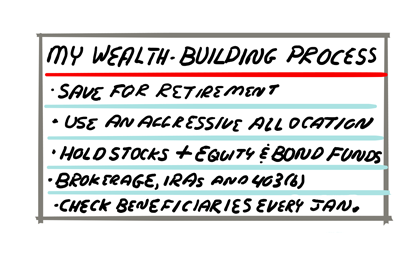
Within each of their investment accounts, there could be varying strategies and restrictions. The options in one spouse’s 401(k) may well be different than those in the other spouse’s 401(k). The 529 plan accounts could have different options as well. How the couple allocates for retirement will be different than how they will save for their kids’ college tuition. As the children enter their high school years, a more conservative allocation would be needed for the college savings accounts than for the couple’s retirement accounts.
Of course, if the couple were retired instead, there would be other considerations. Withdrawals would be a big one. Inheritance could be another. Taxes and Medicare premiums come into play, as does the existence of a pension in addition to traditional IRAs. And then there are estate planning considerations (which would also be a consideration for those still in their working years).
When everything is put together, there’s a lot of ground to cover. If your overall strategy is very simple, your financial and estate planning picture is not complicated and you can write in small handwriting, an index card might work. For everyone else, something bigger is needed.
Regardless of the medium used, a single document listing everything from your goals to your portfolio review process provides a bird’s eye view of who you are as an investor. It clarifies how you invest, why you invest and what steps you will take to manage your portfolio. It can also help you to identify unnecessary complexities. And should you choose to work with a financial planner or adviser, a summary of your investment plan is a document you can hand over and say, “This is who I am. Are you willing to help me implement and stick to this approach?”
The latest addition to our Individual Investor Wealth-Building toolkit provides a framework for creating an overview of your personal wealth-building process. It uses the entire wealth-building process to create a single, but powerful, document. It won’t fit on an index card, but we do encourage to you try it.
Do you already have a similar type of document? If so, tell us below.
Try out the Wealth-Building worksheets we’ve created so far and give us your feedback in the comments section for each. We want them to be useful to you.
1. Identifying and Prioritizing Your Financial Goals Worksheet
2. Our Revised Risk Tolerance Worksheet
3. A Worksheet for Determining How Your Portfolio Is Managed
4. Financial Account Inventory Worksheet
5. Investment Expense Tracking Worksheet
6. Portfolio Composition & Notes
7. Withdrawal Strategy Worksheet
8. Life Stage Changes Checklist
9. Key Estate Planning Information Worksheet

-
Beyond the Index Card: Implementing the Advice of the Financial Experts – Interested in learning more about the index card mentioned above? Harold Pollack shared the story of how he ended up putting his investment strategy on an index card.
-
The Art of Creating an Investment Policy Statement – The Wealth-Building Process helps you create your own investment policy statement. This 2016 AAII Journal article explains why having one is important.
Individual investor optimism about the short-term direction of the stock market is at its average level, ending a long streak of below-average readings. Additionally, the latest AAII Sentiment Survey shows pessimism falling to an eight-month low.
Bullish sentiment, expectations that stock prices will rise over the next six months, rebounded 2.7 percentage points to 38.0%. Optimism was last higher on March 4, 2020 (38.7%). Prior to this week’s reading, bullish sentiment had been below its historical average of 38.0% for 34 consecutive weeks.
Neutral sentiment, expectations that stock prices will stay essentially unchanged over the next six months, rebounded by 1.1 percentage points to 30.6%. Neutral sentiment is below its historical average of 31.5% for the 41st time out of the past 43 weeks.
Bearish sentiment, expectations that stock prices will fall over the next six months, declined 3.8 percentage points to 31.5%. Pessimism was last lower on February 19, 2020 (28.7%). Bearish sentiment remains above its historical average of 30.5% for the 37th consecutive week and the 39th time this year.
At current levels, all three indicators are within their typical ranges.
Optimism was comparatively higher throughout October relative to what we saw in late spring and throughout the summer. Though it’s very early, November appears to be continuing the recent trend. Nonetheless, AAII members have expressed concerns about the election, the coronavirus pandemic and the economy. Other factors influencing AAII members’ sentiment include valuations and interest rates.
In this week’s special question, we asked AAII members how they would describe the economy. Three out of 10 respondents (30%) describe the economy as uneven. An additional 17% of respondents describe the economy as uncertain while about 9% of respondents say that they think the economy is weak.
Conversely, about 12% of respondents say that they think the economy is strong and recovering. Another 23% say that their outlook for the economy is being influenced by the election and political turmoil.
Here is a sampling of the responses:
- “I believe the recovery is uneven. Those doing well are doing the best they ever have. Those doing poorly, or already out of business, are really struggling. Things are set up to be really good, depending upon a positive resolution to many issues which we are all aware.”
- “How can the economy be described as anything other than ‘uncertain,’ given how the coronavirus pandemic has affected every economy in the world and no one can be sure when it will end?”
- “The effects of the disruption due to the pandemic are uneven. Parts of the economy that deal with tech, the fact that many are working from home and the fact that many people are ordering online have been doing well. Those that require people to be in close proximity like bars, restaurants, airlines and cruise lines, not so much.”
- “Strong, the gross domestic product (GDP) is way up and business is coming back. Next year should be a lot better once everything opens up.”
- “I believe the economy is improving and that, despite rising coronavirus cases, most people have learned to live with it and do their jobs and spend their money. Travel and live entertainment are going to struggle until vaccines are widely available. I’m very concerned about limits to growth due to increasing regulation and taxes in 2021.”

Bullish: 38.0%, up 2.7 points
Neutral: 30.6%, up 1.1 points
Bearish: 31.5%, down 3.8 points
Bullish: 38.5%
Neutral: 31.0%
Bearish: 30.5%
AAII Asset Allocation Survey
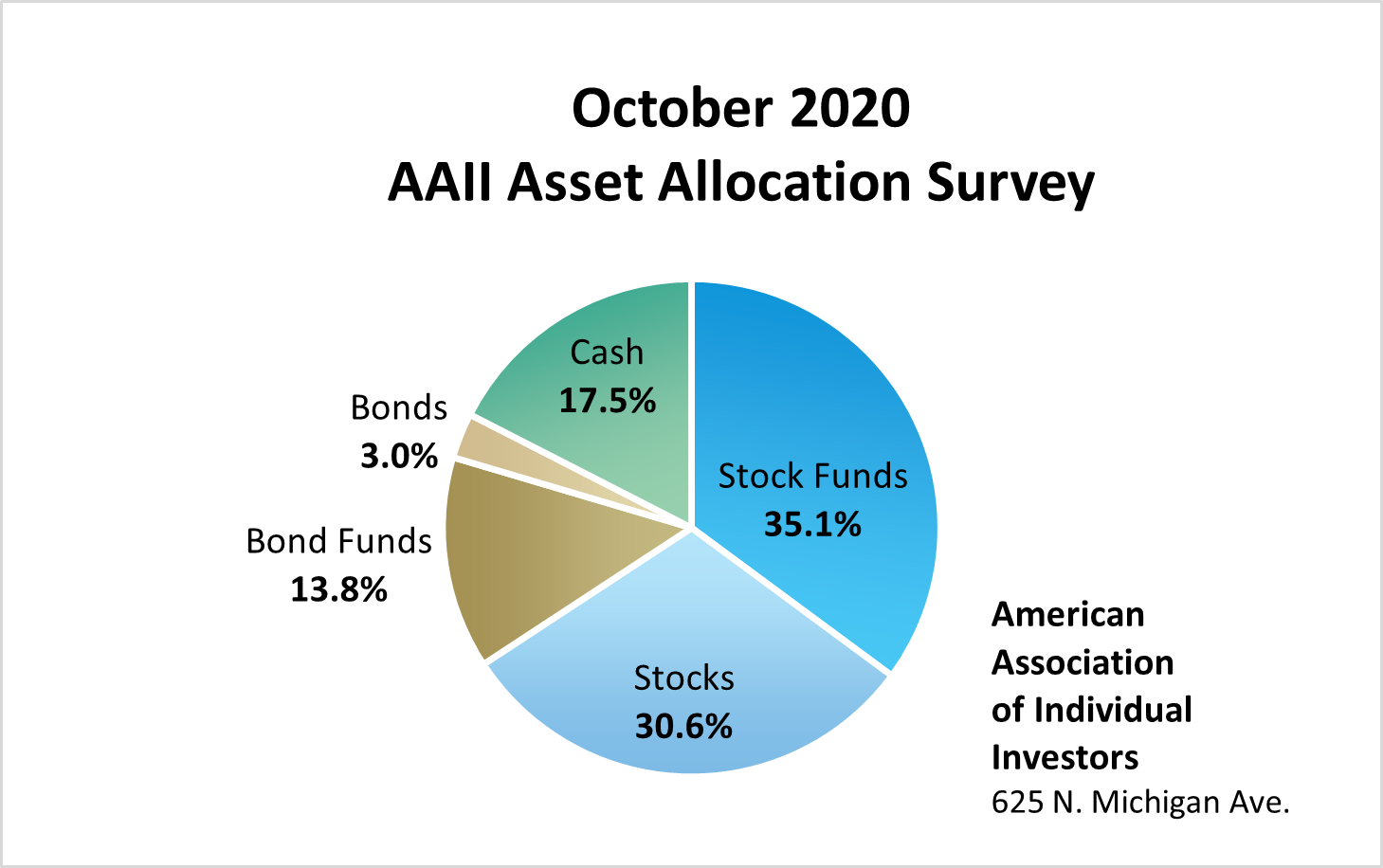
Individual investors’ exposure to fixed-income assets declined to its lowest level in 21 months according to the October AAII Asset Allocation Survey. Cash allocations declined as well, while equity exposure rose.
Stock and stock fund allocations rose by 2.2 percentage points to 65.8%. This marks the sixth consecutive month and the eighth month since the start of 2020 that stock and stock fund allocations are above the historical average of 61.0%.
Bond and bond fund allocations declined 1.1 percentage points to 16.8%. Fixed-income exposure was last lower in February 2019 (15.8%). This is the 21st consecutive month and the 22nd month since the start of 2019 that allocations to bonds and bond funds are above the historical average of 16.0%.
Cash allocations declined by 1.0 percentage points to 17.5%. The last time cash allocations were at the historical average of 23.0% was in April 2020 (23.0%).
Bond yields rose to their highest levels since June last month, reducing the value of bond holdings. We also saw a shift in our weekly sentiment survey with optimism improving on a relative basis and pessimism pulling back from its previously unusually high levels.
October AAII Asset Allocation results:
- Stocks and Stock Funds: 65.8%, up 2.2 percentage points
- Bonds and Bond Funds: 16.8%, down 1.1 percentage points
- Cash: 17.5%, down 1.0 percentage points
October AAII Asset Allocation details:
- Stocks: 30.6%, up 0.4 percentage points
- Stock Funds: 35.1%, up 1.9 percentage points
- Bonds: 3.0, down 0.5 percentage points
- Bond Funds: 13.8%, down 0.7 percentage points
Historical Averages:
- Stocks/Stock Funds: 61.0%
- Bonds/Bond Funds: 16.0%
- Cash: 23.0%
The numbers are rounded and may not add up to 100%.
The AAII Asset Allocation Survey has been conducted monthly since November 1987 and asks AAII members what percentage of their portfolios are allocated to stocks, stock funds, bonds, bond funds and cash. The survey and its results are available online at: www.aaii.com/investor-surveys.
- Stocks and Stock Funds: 65.8%, up 2.2 percentage points
- Bonds and Bond Funds: 16.8%, down 1.2 percentage points
- Cash: 17.5%, down 1.0 percentage points
- Stocks: 30.6%, up 0.4 percentage points
- Stocks Funds: 35.1%, up 1.9 percentage points
- Bonds: 3.0%, down 0.5 percentage points
- Bond Funds: 13.8%, down 0.7 percentage points
- Stocks/Stock Funds: 62.0%
- Bonds/Bond Funds: 16.0%
- Cash: 22.0%
Take the Asset Allocation Survey.
October 29, 2020 The Processes I Use for Managing My Portfolio
October 22, 2020 For Portfolio Reviews, Look at Only What You Need To
October 15, 2020 Two Simple Ways to Avoid Estate Planning Problems
October 8, 2020 Upgrades to AAII.com Based on Member Feedback

Discussion
sundar nilavar from Ohio posted over 5 years ago:
When FED is the MARKET , no investment startegey works other than to RIDE behind FED's put! So easy and most productive since March of '09! REST is moot and irrelevant! please read July 24th WSJ article by Mr. Ruchir Sharma titled 'RESCUES RUINS THE CAPITALISM" Apparently NOT popular in our BAILOUT Nation!
You need to log in as a registered AAII user before commenting.
Create an account