

Related

PRISM Wealth-Building Process
PRISM helps you develop a well-defined personalized plan for achieving your financial goals.
by Charles Rotblut | July 2026

Charles Rotblut leads a class in AAII's new Essential Investing Video Course. Go to https://www.aaii.com/ves for more information and to subscribe.
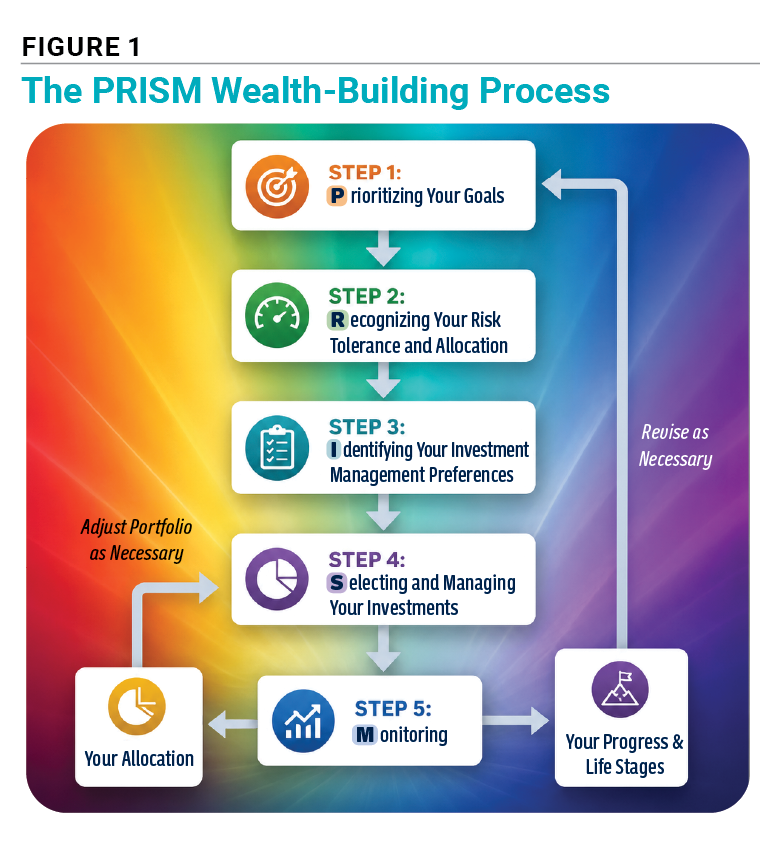
We first gave AAII members a process for achieving their financial goals in June 2020. The framework was built around five sequential steps: defining goals, determining an appropriate allocation, identifying investing preferences, selecting investments and monitoring progress.
As we made adjustments and incorporated member feedback, the framework was formalized into the PRISM Wealth-Building Process (Figure 1). We then demonstrated how the process could be applied to create easy-to-follow one-page wealth-building plans for a variety of goals.
This month, we take a step back and give you a broader overview of the entire process. If you have followed the PRISM Wealth-Building Process series, all the key insights are gathered here in one place for you. If you are encountering PRISM for the first time, you get a complete introduction to the framework with a path to the full archive at the end of this article.
Regardless of how you adjust PRISM for your personal situation, its underlying purpose does not change: to help you achieve your personal goals through a well-defined process.
The PRISM Wealth-Building Process always begins with the same question: Why are you investing?
The reason is practical. Writing down a goal—whether it’s specific or imprecise—clarifies your thinking and increases the odds of achieving it. More importantly, your goal determines the time horizon for when and how long you will take withdrawals. This time horizon drives the decisions that follow: how much risk you can bear, what allocation is appropriate and which types of investments belong in your portfolio. Even if your goal is to maximize wealth, clearly articulating your goal will make you more likely to stick to your plan.
The PRISM AAII Journal article series covers goals across a wide range of life stages and situations to demonstrate how thoroughly this wealth-building process can be personalized to develop an actionable one-page plan. These include: young adults saving for a down payment on a first home, parents saving for a child’s college expenses, couples transitioning into semiretirement, investors pursuing financial independence through FIRE, retirees planning for late-in-life care costs and older investors preparing to leave an inheritance.
The breadth of that list shows how flexible PRISM is. It provides a framework for creating a repeatable process to achieve whatever you are investing for, at whatever stage of life you happen to be in. It adapts to your goals rather than trying to force you to adhere to a rigid plan.
PRISM recognizes risk in a more personalized manner than traditional approaches, including basing your equity allocation on your age, which is what target-date funds attempt to do, or filling out risk questionnaires that ask you to envision how you would react if your portfolio were to fall by a certain amount (e.g., 20%).
Instead, PRISM considers the following four aspects of risk tolerance.
The first two questions address your ability to handle volatile returns. The third question considers how much you will require in short-term assets to cover short-term cash flow needs. The final question factors in your need for your portfolio to grow faster than the rate of inflation.
The answers to the four questions come together to guide your allocation decisions. A working couple with adequate short-term savings, a history of not reacting to downturns and a desire to maximize long-term wealth may find AAII’s Aggressive Allocation Model appropriate. This model calls for 90% or more of a portfolio to be invested in equities.
A young adult who wants to make a down payment on a house within the next five years requires a different allocation. Since large-cap stocks have historically endured a bear market once every four years, a stock-heavy portfolio would be less appropriate. This investor would need to consider how willing they are to postpone their deadline. If adhering to the timeline is important, then favoring assets that preserve wealth becomes an important part of their allocation decision.
A person who is willing to delay their goal or has other sources of wealth they can tap to make up for any shortfall could opt for a much more aggressive allocation. Bucket approaches can also work well for those who have both short- and long-term goals. This involves allocating the amount needed to fund the short-term goal to short-term investments or cash equivalents while aggressively investing the remainder.
PRISM frames your allocation based on your goals and ability to tolerate risk. This personalization leads to a more effective allocation than traditional strategies that follow a one-size-fits-all approach.
With your allocation established, Step 3 narrows the investment universe to what you have an interest in owning and are permitted to own given the types of accounts you use.
Investment preferences vary widely. Some investors are comfortable analyzing individual stocks. Some prefer the simplicity and diversification of broad index exchange-traded funds (ETFs), while others choose to work with a financial adviser or planner.
PRISM accommodates all of these approaches. It does not prescribe how you invest; it asks you to focus on the investments you have an interest in and are suited to manage. Investors in their later years have an additional reason to favor simplicity: Strategies that require active judgment and frequent decisions become harder to sustain as cognitive capacity changes over time.
Account type is often the most significant practical constraint. A 401(k) retirement plan limits your investment menu to whatever your employer has selected. A 529 savings plan offers meaningful tax advantages but restricts investment choices and requires funds to be used for qualified educational expenses.
Tax considerations deserve explicit attention because they materially affect outcomes. Retirement accounts, including traditional and Roth individual retirement accounts (IRAs), are useful for tax location. Required minimum distributions (RMDs) start at age 73 for retirement accounts funded with pretax dollars and can be a consideration to include in your plan. Some investors may wish to strategically make Roth IRA conversions in the years leading up to the start of RMDs.
This step is also a good opportunity to note any potential needs for planning assistance. A couple nearing retirement may desire input on selecting a Medicare plan, filing for Social Security benefits and determining a withdrawal strategy. Those wishing to leave an inheritance may wish to work with an estate attorney. A couple concerned about future cognitive decline may include notes about transferring control of their finances in the future to a trusted person or hiring a care manager.
This step is where you specify your selection and management rules for investments. It is based on AAII founder James Cloonan’s belief that investors should follow a consistent, well-defined approach to investing using prewritten buy and sell rules.
The rules you write will depend on the allocation established in Step 2 and the types of investments identified in Step 3. These rules should always be tailored to the type of investment being purchased, with the inclusion of any style, factor or other preferences.
Index ETFs and mutual funds were used in many of the PRISM plans presented in past articles. In the April 2023 AAII Journal article “A One-Page Wealth-Building Plan to Reach the Goal of Retirement,” Liz, a 35-year-old investor saving for retirement, states that she will seek index funds first. If they are not available in her 401(k) plan, she will give first preference to actively managed funds with the lowest expense ratios. In both cases, she will use AAII’s A+ Investor Grades to identify and replace any funds that underperform their category peers.
Individual stocks require rules based on the style of investing used. Setting limits on how high a price-earnings (P/E) or price-to-book-value (P/B) ratio can rise are important for value strategies. Growth investors may wish to establish minimums for how much sales or earnings must increase for a stock to be considered for or kept in the portfolio. Dividend investors may require a certain level of yield or dividend growth.
Again, the exact rules depend on what you are investing in and the style you are following. Whatever rules you write, be sure to follow them routinely. Doing so will improve your portfolio’s performance.
Figure 2, republished from “A One-Page Wealth-Building Plan to Reach the Goal of Retirement,” illustrates how the rules established in Step 4 connect directly to the decisions made in the earlier steps. Liz stated her preference for index mutual funds and ETFs in Step 3. Her buy and sell criteria—favoring broad-index funds, replacing underperformers identified by A+ Investor Grades and watching for fund returns that diverge from their underlying indexes—give her a written standard to apply consistently, regardless of what the market is doing in any given year.

The final step of the PRISM Wealth-Building Process calls for periodic monitoring. The portfolio’s allocation is checked to ensure that it remains within an acceptable range of the specified target. Progress toward the goal is reviewed to ensure that it is still on track. Changes in one’s life are considered to determine whether the specified goal is still valid or if it needs to be revised. This step ensures that one’s wealth-building plan evolves as their life does.
Step 5 starts with defining how often and when you will conduct your review. For many investors, an annual review conducted at the start of the year works well. Those saving for a college education may wish to conduct the review on the child or grandchild’s birthday instead. Monthly budget reviews may also make sense during transition periods, such as semiretirement.
Portfolio allocation should be checked annually as part of this step. Using percentage bands—say, five or 10 percentage points—for how much each asset class within your portfolio may fluctuate can help you maintain your allocation without excessive trading. Those making use of safe assets (e.g., a cash bucket) should use this review to determine if they need to be tapped (stock market is down) or replenished (stock market has rebounded).
Checking your progress refers back to Step 1: your goals. It asks you to determine if you are still on track to meet or fulfill them. This can mean monitoring your savings rate if you are in the accumulation phase or tracking your spending if you are in the withdrawal phase. A semiretired couple may wish to monitor their satisfaction to determine whether they want to continue working or move toward full retirement.
Life-stage changes have ramifications for the entire PRISM plan. Changes in your employment, health or family can lead you to reevaluate your goals. This is intentional. PRISM is designed to evolve as your life does. Revising your plan helps you achieve your new goals, whether they are slightly modified or represent a big change.
There is one practical use of a completed PRISM plan that is easy to overlook: It is a natural conversation starter. For investors who want to discuss legacy wishes and estate plans with their heirs, a one-page plan provides a concrete, nonintimidating way to begin. For those who want to help a child or grandchild develop the habit of investing with a purpose, walking through the five PRISM steps together—starting with their goals, whatever those happen to be—is a more useful introduction to investing than any amount of abstract financial instruction.
Our many PRISM articles have covered a great deal of ground. Combined, they demonstrate how a foundational framework can be customized for investors at various stages of life, with differing levels of wealth and, most importantly, with personalized goals.
We created the PRISM Wealth-Building Process to help you develop a well-defined plan for achieving your goals. Explore the full range of PRISM articles we’ve published so far.
We think you’d like this related webinar! Applying PRISM to Achieve Common Financial Goals.
PRISM Wealth-Building Process
PRISM Wealth-Building Process

PRISM Wealth-Building Process

ROBERT A from NC posted 3 months ago:
BARRY J from TX posted 3 months ago:
CHARLES R from IL posted 3 months ago:
You need to log in as a registered AAII user before commenting.
Log InCreate an account